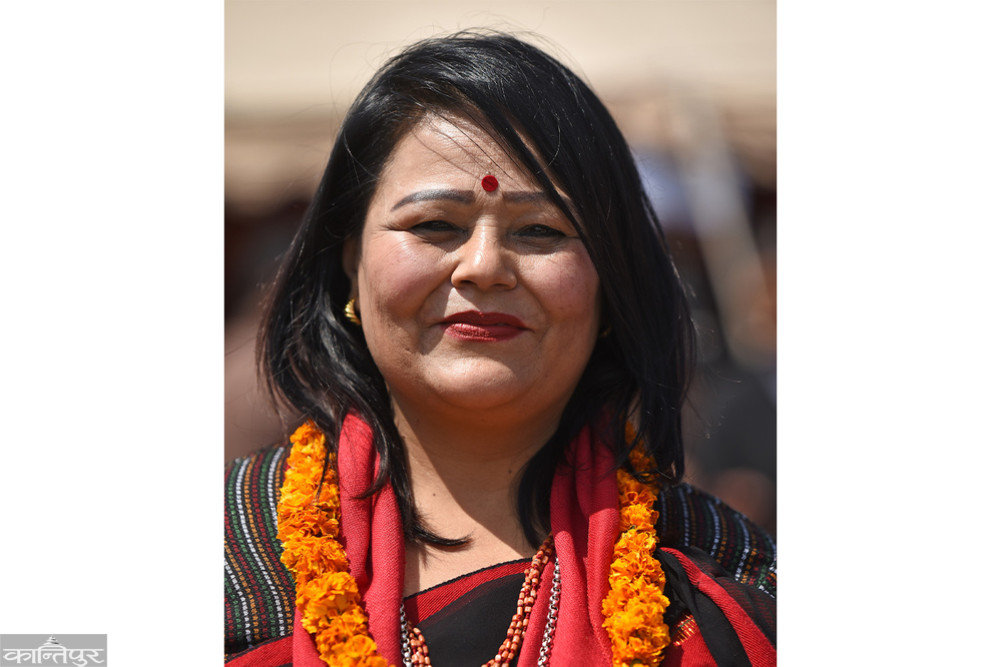
She said that she will raise her voice in Parliament about banning the excessive use of pesticides in agriculture and against violence against women. She said that she will vote so that no one is a victim of violence in the future.
We use Google Cloud Translation Services. Google requires we provide the following disclaimer relating to use of this service:
This service may contain translations powered by Google. Google disclaims all warranties related to the translations, expressed or implied, including any warranties of accuracy, reliability, and any implied warranties of merchantability, fitness for a particular purpose, and noninfringement.
Gangalakshmi Awal had also been nominated on the proportional list from the Congress in the 2079 House of Representatives elections. Everyone had congratulated her at the time. The people of Bhaktapur were very happy that Gangalakshmi would now be able to represent her constituency by becoming an MP.
Gangalakshmi also knew for sure that she would be elected. She said, ‘I had even sewn a coat.’ But in the end, she did not become an MP. She gave up and put her coat in a drawer.’
Even though she was not an MP, she did not give up. Ganga, who has been in politics for more than 3 decades, did not stop working hard in her field. This time, the party did not let her hard work go to waste. The Congress has made her an MP from the proportional list this time.
She said, ‘Since I was born in Bhaktapur, the Congress has not won. However, I am happy to be able to enter the House representing the Congress from Bhaktapur.'
This is why she entered politics
Gangalakshmi said that the main reason for entering politics was social service. 'I still remember the old days when I left my baby at home and entered politics.' The purpose of entering politics is social service,' she said. 'I entered politics to serve women, the elderly, the disabled, farmers, as well as the entire Nepal and to be their voice.'
Born in an ordinary family in Bhaktapur, Gangalakshmi was curious and strong-willed from a young age. Her father worked in agriculture and house construction, while her mother used to take care of the household and weave and sell clothes. The family's main source of income was the money earned from selling grains and vegetables grown in the fields.
Although her mother believed that a daughter should stand on her own two feet, the society at that time was such that what would a daughter do after studying a lot? Sometimes her mother would also say, "Don't you know how to do household chores?" We are people who do business and earn a living. It is enough to know how to do accounting... When her mother kept saying this, she would contradict her mother's words. No matter what anyone said, she would complete the work she wanted.
Recognizing her inner potential, she is an entrepreneur, an agricultural expert and has now been elected to the House of Representatives from the Indigenous Peoples Cluster on the proportional representation side of the Congress.
She has made a long list of things to talk about once she reaches parliament. She said, "Too much pesticides are being used in agriculture. Since I am also an organic inspector, I am concerned about the use of pesticides." Banned pesticides are also being used. Now I will raise these issues in Parliament.'
Similarly, she said that she will raise her voice against violence against women in Parliament and vote so that no one is a victim in the future.
Gangalakshmi, who became an MP while being an entrepreneur, wanted to study law and become a lawyer. Her dream was to work in the justice sector. After SLC, she decided to study law. With that in mind, she reached Nepal Law Campus. However, she stopped after her mother said that she could not afford to travel to Kathmandu and study law.
After her plan to study law was stopped, she decided to study political science. She enrolled in Bhaktapur Multiple Campus. The day she went to college, she also joined politics after seeing student leaders of various parties campaigning for the party. In college, she registered her name in the Nepali Sangh. She said, 'My brother used to read BP's theory and Mahatma Gandhi's books. I had also read all the books. Influenced by that, my faith in democracy grew.
Gangalakshmi had taken training in weaving in her free time after SLC. With the idea of continuing this skill, she started a clothing weaving enterprise from Tibetan wool.
During this process, she was told that she had provided training and employment to 300 women in weaving.
Immediately after completing her graduation from the campus, she also got the opportunity to teach at the Bhaktapur Multiple Campus, where she had studied. She also worked there for a few years. Later, she even did a PhD in sustainable energy management.
'Culture Breaker', that is, Gangalakshmi
Gangalakshmi had also broken the customs that were deeply rooted in the society at that time. The word ‘a daughter who gets married and goes to someone else’ had repeatedly hurt her. So, with the money she earned through hard work and struggle, she built a house in 2058 before her wedding. A year after building the house, she got married in 2059. She said, ‘We got married and lived in the house she had built. We did things differently than what society does. That’s why they call me a ‘culture breaker’.’
Gangalakshmi also studied ‘permaculture’ in 2007. She said, ‘Since I was born in a farming family, I was interested in agriculture from a young age.’ However, when I shared my experience when I went to study, I was tagged as a ‘fake farmer’. That’s why I studied permaculture.’
This helped her understand the depth of agriculture. It helped her to farm sustainably or understand agriculture. She has provided training on agriculture and entrepreneurship in more than 60 districts of Nepal. She said that she has provided training on organic farming not only in Nepal but also in various parts of India. She said that at that time she launched a pesticide-free campaign. She said that she had the opportunity to understand many things about each community closely when she traveled abroad. She said, ‘When she reached the Terai, she would observe the treatment of women. When she reached Humla, she would observe the Chhaupadi system that women had to endure. Seeing this, she felt that she had to speak out to remove patriarchal thinking.’ She said that this was also the reason she entered politics. The government honored her with the ‘Prabal Janaseva Shree Medal’ in 2080 BS in recognition of her voice raised in the agricultural sector and the struggle she had undertaken. She has also traveled to countries including the Netherlands, Canada, and Japan for studies.
Political journey
Gangalakshmi, who entered student politics in 2046 BS, has only reached here after a lot of struggle. Her political journey, which began as a member of the Self-Sufficiency Union at Bhaktapur Multiple Campus, was the city treasurer at the Bhaktapur General Convention, the district vice-president of the Women's Association, a central member, a member of the organization department, and she became a member of the central working committee at the 14th General Convention.