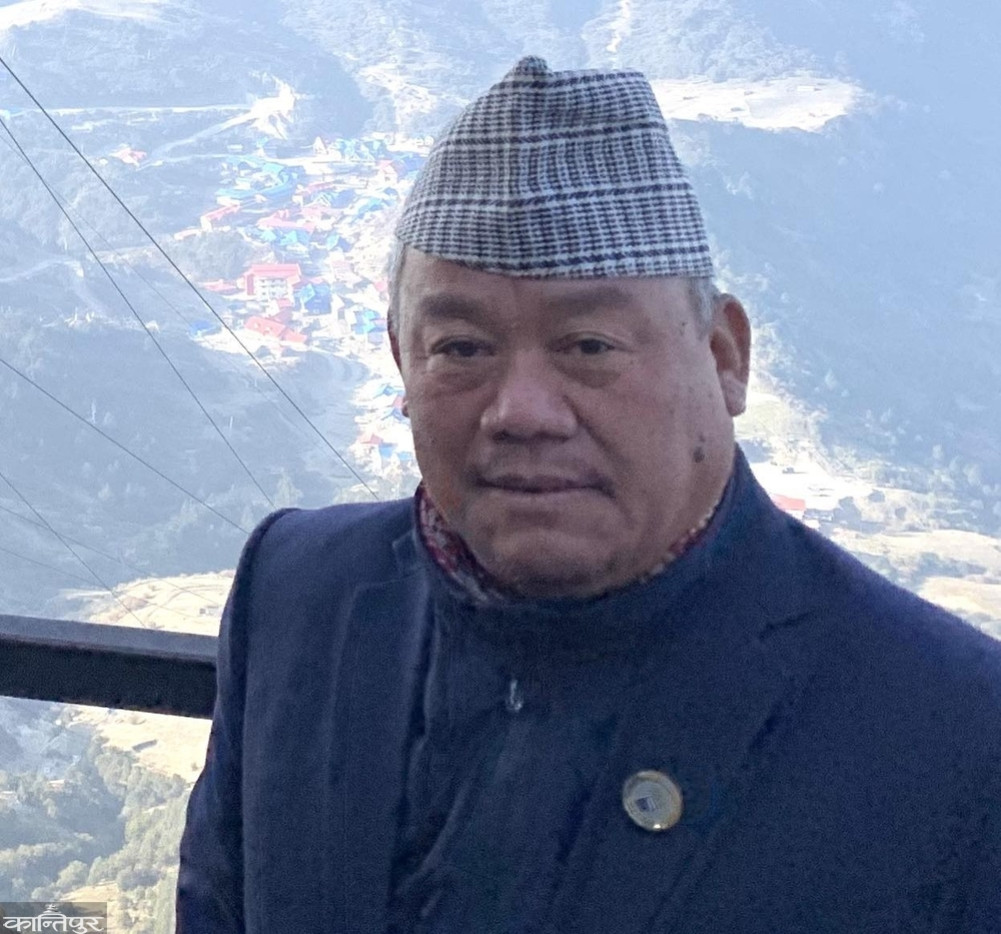
Bhishma Raj Angdembe, who stood in favor of multi-party politics in the 2036 BS referendum, remained active in various subsequent movements. He was elected as a member of the Constituent Assembly from Panchthar Constituency No. 2 in the second Constituent Assembly election of 2070 BS.
We use Google Cloud Translation Services. Google requires we provide the following disclaimer relating to use of this service:
This service may contain translations powered by Google. Google disclaims all warranties related to the translations, expressed or implied, including any warranties of accuracy, reliability, and any implied warranties of merchantability, fitness for a particular purpose, and noninfringement.
Bhishmaraj Angdembe, born in 2020 in Falgunanda Rural Municipality-1 (formerly Navamidanda), has been elected as a member of the House of Representatives under the proportional system from the Nepali Congress.
Born into a family with a political background, he has been continuously holding various responsibilities since the 2036 referendum. Standing in favor of multi-party politics in the 2036 referendum, he remained active in various movements thereafter.
He has served in various positions in the Nepal Students' Union, Tarun Dal, and the Nepali Congress. He says that the 2036 referendum was the initial turning point in his political life. 'That struggle against the Panchayat system set the foundation for my political thinking and journey,' he recalls.
He joined the Nepali Sangh in 2042. His formal political life began after that. His journey, which began as a member of the Nepali Sangh, reached the leadership level. He played an active role in the 2046 BS people's movement and established himself as a front-line youth leader. The same movement restored multi-party democracy in the country, in which Angdembe's participation was significant. He was even arrested during the movement.
From 2046 BS to 2052 BS, he was elected as a central member of the Nepali Sangh for two terms, playing an important role in organization building, cadre mobilization, and expansion of democratic values. During this period, he succeeded in developing leadership and capacity and creating a separate identity in the party.
Entering youth politics from student politics, Angdembe became the central vice-president of Nepal Tarun Dal in 2054 BS. This responsibility established him as an influential leader of the young generation within the Congress.
He again participated in the historic 2062/063 BS people's movement against the monarchy, participating in the street struggle. He was arrested during that period as well.
He was elected as a member of the Constituent Assembly from Panchthar Constituency No. 2 in the second Constituent Assembly election of 2070. That was his first entry into parliamentary politics. Before that, he was a candidate from Panchthar-2 for the House of Representatives in 2056 BS and was defeated by UML's Dambar Singh Sambahamphe.
After being elected as a member of the Constituent Assembly, he assumed a leading role in economic policy, trade management and consumer rights as the chairman of the Industry, Commerce and Consumer Rights Committee under the Constituent Assembly.
In the 2074 BS House of Representatives election, he again contested directly from Panchthar and was defeated by NCP's Basanta Kumar Nembang. In 2077 BS, he played an active role in maintaining discipline within the party, resolving internal disputes and strengthening the organization.
He was elected as the Central Joint General Secretary for Indigenous Affairs at the 14th General Convention of the Nepali Congress held in 2078 BS. In the 2079 election to the House of Representatives, he was again defeated by UML's Basanta Kumar Nembang by a narrow margin of 46 votes. This time, the Congress elected him to the position of member of the House of Representatives through the proportional system from the indigenous peoples' quota.
The residents of the district have considered this position as a continuous process of movement, organization building and leadership development. His journey, which began with student politics, has today entered the field of national law-making.