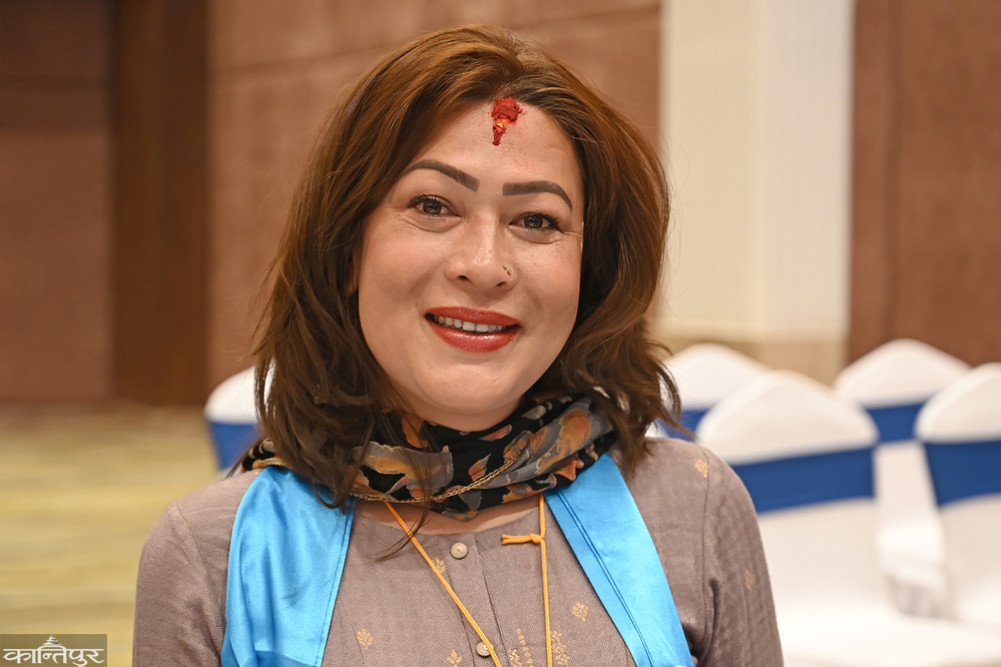
Bhumika Shrestha has been continuously raising her voice for equal rights for gender and sexual minority communities for over two decades. Now, she says she will work for the welfare of her community as well as the country from Parliament.
We use Google Cloud Translation Services. Google requires we provide the following disclaimer relating to use of this service:
This service may contain translations powered by Google. Google disclaims all warranties related to the translations, expressed or implied, including any warranties of accuracy, reliability, and any implied warranties of merchantability, fitness for a particular purpose, and noninfringement.
There was a time when Bhumika Shrestha used to raise her voice from the streets for the sexual and gender minority community. She never backed down from the view of the minority community in society, the situation of being rejected by the family, the contempt that was rampant in the society, and the atrocities.
She has given rights to many from the streets. She always fought against atrocities. ‘Just as women and men are considered equal in society, people from the sexual and gender minority community should also be considered equal. We should also get equal rights.’ She always raised her voice saying. She has always fought for the rights and identity of the sexual and gender minority community. She has been raising her voice for the equal rights of the sexual and gender minority community for more than two decades. Now, she says that she will work for the benefit of the country from the House along with her community.
She was elected from the RSVP proportional representation through the indigenous peoples' quota. Her selection is considered a big leap forward in parliamentary history for the gender and sexual minority community. Experts also say that she will be seen as a strong pillar in the House for the rights and interests of the gender and sexual minority community.
After being elected from the proportional list, she said, 'I will raise my voice not only for my community but for the rights and interests of every citizen of the country.' She said that she was very happy to represent her community. She said, 'I will be able to raise my voice for my community from the House. I am very happy.'
She said that she aims to include many issues of the gender and sexual minority community. She said, 'The goal is to emphasize the creation of necessary laws for citizenship, health, access to education, as well as marriage equality,' she said, 'It is not enough to just write it in the Constitution of Nepal.' Articles 12, 18 and 42 have ensured the rights of sexual and gender minorities. However, they have not been implemented in practice. A clear policy is needed to implement them. She says that concrete laws and regulations for her community are yet to be made. She said that she will always raise her voice in policy making. She said that she will also raise the issues of people with disabilities, Madhesis, Muslims, indigenous peoples, as well as minority communities.
Looking at her political life, she joined the Nepali Congress with the idea of raising the voice of her community. Then she joined the Rashtriya Swayamsevak Sangh (RSS). Before her, Sunil Babu Pant was elected as the first gay member of parliament in Asia after the 2064 BS Constituent Assembly elections.
The journey to the parliament by raising the voice of identity on the streets
Bhumika is one of those who has come here after struggling a lot in social life.
She was born in 2044 BS in Chandragiri Municipality-14, Kathmandu as a son in a Newar family. Her name was Kailash. Since childhood, her family felt that she had a different nature from men. She liked to wear her mother's 'lipstick' and her sister's 'skirt'. In other words, she was happier and more satisfied being a woman than being a man, even if it was for a moment.
She enjoyed doing household chores. Her family took this matter in a simple way. They thought, 'Maybe when you are young, this habit will change on its own when you grow up.' But, even when she was growing up, she enjoyed doing the same work. One day, her mother told her, 'When you study well and grow up, you should get a daughter-in-law.' She interrupted her mother and replied, 'I will get a son-in-law, not a daughter-in-law.' At first, everyone was surprised. But, gradually, other family members including her mother started watching her closely. Then they started working to create a comfortable environment for her at home.
Bhumika always got along with her family. However, she was insulted and made fun of every day in school and society. The reason why she could never enjoy her freedom was because of the different treatment she received in society and school. She could not even guess the words used in society by seeing her. Every day, society insulted her by uttering obscene words that she had never heard of.
She had dreamed of becoming a big man after studying and wanted to fly in the open sky by following her dreams, but she could not bear the treatment she received at school. Finally, she was forced to drop out of school when she was in grade 9. She was very hurt at that time. Despite the support of her family, one thing always remained in her mind. ‘Why am I treated differently in society? Why did God make me different?’
Having suffered a lot from her sexuality since childhood, she met Pinky Gurung, the president of the ‘Blue Diamond Society’ (Neel Hira Samaj) at the age of 16. Until the previous day, she had thought ‘Why am I different’, but she started to feel ‘I am not alone’. Her self-confidence gradually increased. It was only after joining the Blue Diamond Society that she accepted her identity. And she became a Bhumika from Kailash.
Overcoming many obstacles and obstacles in life, she joined the Blue Diamond Society in 2004 and worked. She said that she struggled a lot for citizenship. She said, ‘From the beginning, I struggled a lot to make my identity a citizenship. I wanted to write as a man, not a woman, and I succeeded in making it my identity citizenship after raising my voice. After struggling so much, I got citizenship. However, other people in my community have not yet received citizenship of identity. I will fight for that.’
When she joined the organization, she was always ready to heal the wounds of her friends who were ignored by society. She always worked closely with the organization to become the voice of the voiceless. She has been working for the rights of the gender and sexual minority community by joining the Blue Diamond Society. ‘I have always raised my voice until now. By raising my voice, the way we are viewed and treated has changed a lot compared to before,’ she said. ‘The new generation has to be ready to work to change society so that they do not have to raise their voices to live freely in society as gender and sexual minorities.’
In 2019, the British organization ‘Apoliticals’ recognized her struggle to raise the voice of the gender and sexual minority community, and in recognition of her efforts, she was included in the list of 100 influential women fighting for gender equality. Similarly, the US government honored her with the ‘International Women of Courage Award’ in recognition of her contribution. She has also been honored with the ‘Janasevashree Fifth’ decoration by the Government of Nepal. She has also acted in various films and documentaries. Her book ‘Bhumika: Autobiography of a Transgender’ has also been published. Her experience and identity, the pain she experienced as a gender and minority in her life, the obstacles she faced in society, and her struggle for identity are included in the book.
She said that those who used to make fun of her identity in childhood, now encourage her by saying that she has done a good job. ‘My family used to say that when I was young, I should do something to show that society is not good.’ Now I am very happy with my progress,’ she said, ‘Those who used to say all sorts of things to my family because of me. Now I feel happy to see them congratulating my family.’ She said that her family and her community were very happy after she was elected through proportional representation.
Now, she said that she will become stronger and fight for the rights and interests of different communities, society and the country. She said, ‘I am not only raising the voice of the community to which I belong. It is my responsibility to raise my voice to end the distortions and anomalies in the country.’