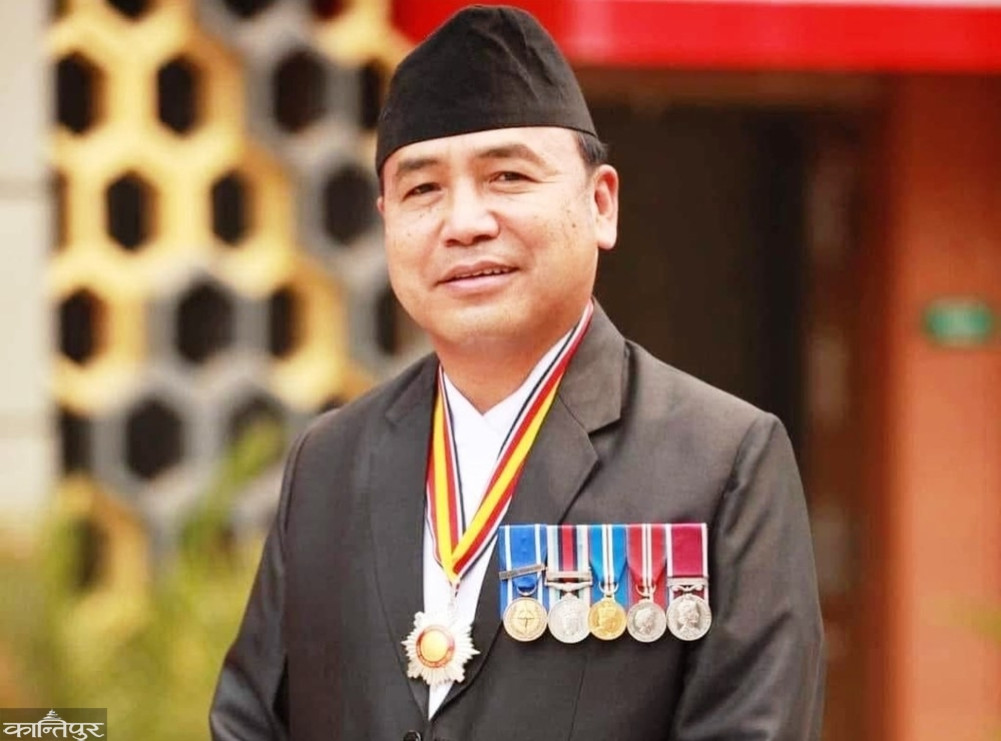
Elected through the proportional representation system from the tribal male cluster of the Labor Culture Party, Limbu's life journey began in a simple rural environment, and culminated in international military service, social activism, and the federal parliament.
We use Google Cloud Translation Services. Google requires we provide the following disclaimer relating to use of this service:
This service may contain translations powered by Google. Google disclaims all warranties related to the translations, expressed or implied, including any warranties of accuracy, reliability, and any implied warranties of merchantability, fitness for a particular purpose, and noninfringement.
Former Gorkha Captain Purna Limbu of Dharan Sub-metropolitan City-15 has entered national politics as a member of the House of Representatives. Elected from the Janajati Male Cluster through the proportional system from the Shram Sanskriti Party, Limbu's life journey began in a simple rural environment and ended up in the federal parliament through international military service, social activism, and later.
Born in Chainpur Municipality-4 of Sankhuwasabha in the eastern hilly district, 62-year-old Limbu spent his childhood in an ordinary family. Dreaming of becoming a Gurkha soldier since childhood, he joined the British Gurkha Army in 1980.
Limbu, who received his primary education in Nepal, completed various high-level military training after becoming a Gurkha soldier. He served in the British Army for about 28 years and retired as a captain in 2008. During his service, he had the opportunity to work in various conflict-affected and strategic areas of the world.
An important chapter in his military life is connected to the Falklands War of 1982. The war between Britain and Argentina for control of the Falkland Islands in the South Atlantic Ocean lasted 10 weeks. About 650 Argentine and 255 British soldiers lost their lives in the war. Finally, on June 14, 1982, Argentina surrendered and the islands were returned to British control. Participation in the war provided Limbu with not only military experience but also an opportunity to gain international military skills.
During his time in the British Army, he played an active role in military and peacekeeping operations in countries such as Afghanistan, Bosnia, Sierra Leone, Brunei, Hong Kong and Germany. These experiences gave him a global perspective, leadership skills and crisis management.
Limbu's career was not limited to war. He also worked as an instructor at the prestigious Gurkha Training Center in Britain, where he trained new Gurkha soldiers in discipline, leadership and modern warfare. This also established him as a trainer and guide.
After retiring from military service, he returned to Nepal. His wife, two sons, daughter-in-law and grandchildren are in the UK. His two sons are serving in the Royal Seafarers and the UK Air Force. Limbu did not rest even after retirement. He continued his service by being associated with various organizations working for the welfare of former Gurkha soldiers and their families.
He expanded the scope of social service from Bhojpur, Khadbari to Dharan. In particular, he made significant contributions to the rights, education, health and rehabilitation of former soldiers. His social activism was not limited to institutional work.
From distributing relief during the 2072 BS earthquake to reaching out to the doorsteps during the Corona pandemic, he remained at the forefront of helping the needy, helpless and oppressed. He has also been helping the needy, helpless and oppressed classes on a personal basis.
In appreciation of this contribution, he was awarded the 'Prabal Janasevashree (IV)' medal by the then President Bidya Devi Bhandari in 2072 BS. This honor recognized his dedication to social service at the national level.
Another aspect of Limbu's personality is also linked to art and culture. He is also known as a singer, actor and film producer-director. To address the drinking water problem of Khamling village, he produced a film named 'Namlo', which was screened in Nepal, the UK and other countries. This film, along with its social message, worked to spread public awareness on resource management.
He has also tried to preserve historical memories by playing the role of coordinator in the development and management of the Gorkha Memorial Park at Shram Saskriti Park in Dharan-13. This park was built with the help of the East Indian, Singaporean and Beatrice Lahore communities with the aim of conveying the bravery and sacrifice of the Gorkha soldiers to the new generation. Even after spending a long time abroad, he never forgot his homeland. After retirement, he settled in Nepal with his family and continued to be active in social service.
Purna Limbu, who was actively involved in the labor campaign launched by the then mayor of Dharan, Hark Sampang, has been continuously involved in social and labor activities since then. Limbu had represented the Lahure community in various projects including the construction of the Labor Culture Park, the Kokaha Drinking Water Project, and the Gorkha Park, and had also provided voluntary labor and financial support. After getting close to the labor campaign, he continued to strengthen his presence in local development and community issues.
In the same vein, after the Labor Culture Party was established, he became a central member of the party. After that, his political journey formally progressed. In the House of Representatives elections held on Falgun 21, he was included in the closed list in the indigenous nationalities male cluster from Sankhuwasabha under the proportional system, which opened the door for him to reach the federal parliament.
Limbu, who represents the Lahure community, has said that his priority is to give voice to the issues of tribal communities and social justice, and especially to bring the issue related to the British Gurkha soldiers to the Parliament. He says, 'The issue of the Beatrice Army is currently under consideration in the Supreme Court, how much of it will be addressed from there? If not, I will raise it in the parliament, there are many other issues. I will discuss that issue with all the concerned individuals and bodies and do my homework and raise the issues to be raised in the parliament.'
He said that he will work together with other parties in the parliament. He said that he will support the positive and public interest issues raised in the house and will also play a warning role if necessary.