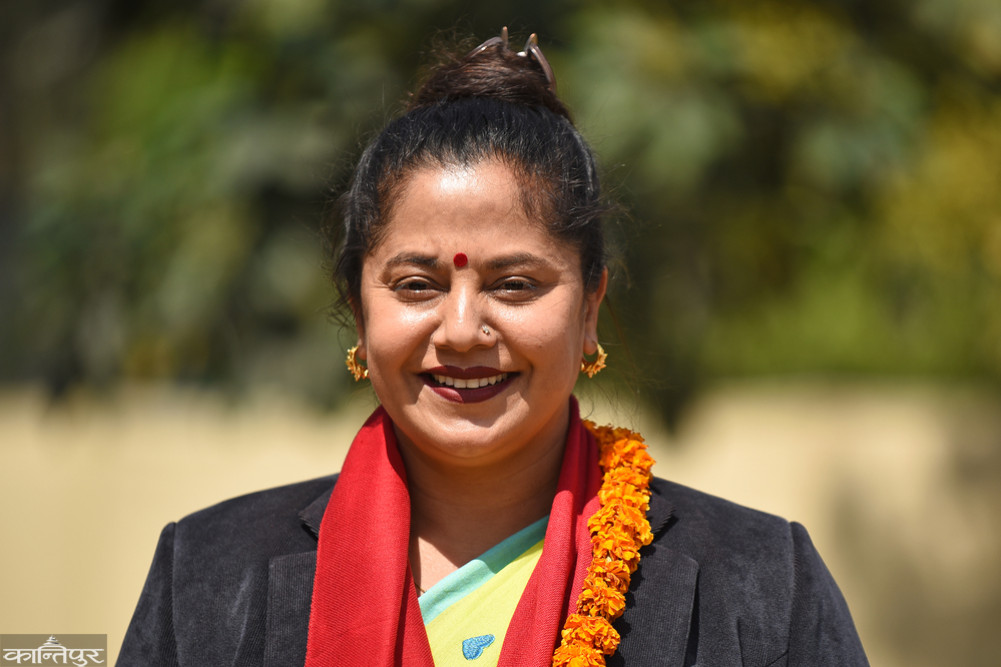
Urmila Thapaliya, who took to the streets against the monarchy, has been engaged in continuous political struggle since her student days. Now she is entering Parliament as a proportional representation MP.
We use Google Cloud Translation Services. Google requires we provide the following disclaimer relating to use of this service:
This service may contain translations powered by Google. Google disclaims all warranties related to the translations, expressed or implied, including any warranties of accuracy, reliability, and any implied warranties of merchantability, fitness for a particular purpose, and noninfringement.
After the then King Gyanendra Shah took power on Magh 19, 2061, seven political parties were on the streets against him. Protest marches and sit-ins were held on the streets every day demanding the restoration of the House of Representatives. The focal points of this were Padmakanya Campus, Bagbazar, and Putalisadak.
Where hundreds of Padmakanya students would bravely take to the streets against the regression. Urmila, i.e. Sita Thapaliya, was at the forefront of that crowd.
Along with her, Binita Adhikari, Uma Shiwakoti, Maheshwori Kunwar, Srijana Adhikari, Krishna Kumari Basnet, Tika Chaudhary, Injila Neupane, Chanda Adhikari and other students had a routine – the movement. They would gather around 9/10 in the morning. There would be sit-ins and marches throughout the day. The police would arrest and repress them. They would not back down. They would leave with their shrouds on. Tear gas would be fired. They would be lathicharged. They would get injured. They would go to the hospital. They would return. It would start from 9/10 am and last till 4/5 pm. At this time, the most pictures on the pages of the newspapers were probably of the protest by the students of Padmakanya.
After the protest of the seven political parties could not be decisive, a 12-point agreement was reached with the Maoists who were in armed conflict. Then, a joint movement of the seven parties and the Maoists began. The movement was successful. A republic came. A new constitution was promulgated. It has been 10 years since the country entered a new state structure with the promulgation of the constitution.
In the meantime, some of the three militant leaders of the movement went abroad. Some are still active in politics. Urmila, who has been continuing that active politics, has now become a proportional representation MP.
My political career began with a poem she recited at the moment of welcoming Girija Babu. During the protest, she lost hearing in her left ear due to the effects of tear gas. She spent about three months in a teaching hospital after being injured in the protest. 'On Chaitra 30, 2017, I suffered a serious head injury. I went home after receiving basic treatment. Sushil Koirala, Deepak Giri and Tirtharam Dangol came to meet me at my house in Kalanki,' she recalled. 'The next day, my face was contorted.' Ajay Babu Shiwakoti, a member of the current central working committee, was working at Image Channel at that time. He took me to the teaching hospital in Maharajgunj in his office car.' After that, she remained in the hospital. 'At that time, Girija Prasad Koirala used to come to meet me as often as he would bring me fruits. I cannot forget that incident,' she says.
She considered Girija Prasad her ideal father. After his death, Urmila published a book of articles written about him. After that, Sushil Koirala became her ideal. After Sushil's death, she is in the Shashank group. She got the opportunity to become an MP from the same group.
000
Born in Siddhalek Rural Municipality, Dhading, Urmila was a struggler since childhood. She had a curious nature since childhood.
When she was studying in 6th grade at Nilakantha Secondary School in Dhading, her interest in politics grew. At that time, Girija Prasad Koirala had reached Dhading for a program. Girija Prasad was also among those who praised her poetry.
She was on stage with Girija. The next morning, the whole village was talking about her being with Girija Prasad. ‘I believe my political life began with the poem I recited at the moment of welcoming Girija Babu,’ she says proudly.
In 2054, she became the vice-president of the Nepali Congress unit in the secondary school where she was studying. In 2056, she took on the responsibility of the Nepali Congress district treasurer. She started raising the issue of women entering politics. With continuous activism, she became the Nepali Congress district secretary in 2059.
In 2062, she became the self-employed secretary of the Vishwabhasha Campus, in 2063, she became a member of the Nepali Congress central committee, and after the 12th general convention of the Nepali Congress, she rose to central politics as a member of the Mahasamiti. Along with being a member of the Mahasamiti, she got the opportunity to become the Central Vice President and General Secretary of the Nepali Sangh.

She spent three months in the hospital during the 2062/063 movement and has also been detained three times. ‘No matter how many obstacles there were, I never thought of leaving politics. Instead, I felt that I had to be stronger,’ she says.
Rape incidents are increasing every day. I will emphasize the need to amend the law Urmila, who published a collection of prose poems called ‘Anubhutika Tarangharu’ in 2059 BS, has 5 books in various genres in the works. She has written many articles. She has sung songs.
‘When I was young, my family supported me a lot.’ There was no problem in doing politics after marriage,’ she said, ‘You have to do politics.’ My husband, mother-in-law, and in-laws encouraged me to never hesitate to speak for the truth. That's why I am what I am because of my family.' She got married in 2072 and has 2 children.
She has now pledged to urgently raise the issue of creating an environment in the country that connects youth with employment and entrepreneurship and ending corruption in the House. She says that she has always wanted youth power to come into politics and has fought for that.
She also said that she is thinking of raising awareness about the bad things happening in the country and especially raising her voice on women. 'Rape incidents have increased every day. Due to such incidents, daughters are not safe at home or outside. I will emphasize the need to amend the law,' she said.
She understands that no matter how much women struggle and come to leadership, social discrimination has not ended. ‘There is a lot of discrimination in everything. When a man enters politics, he is called a leader. But when a woman enters politics, she is called a woman leader. There is discrimination in this too,’ she says, ‘Now the House, which is dominated by youth, must move forward by rejecting such comments.’