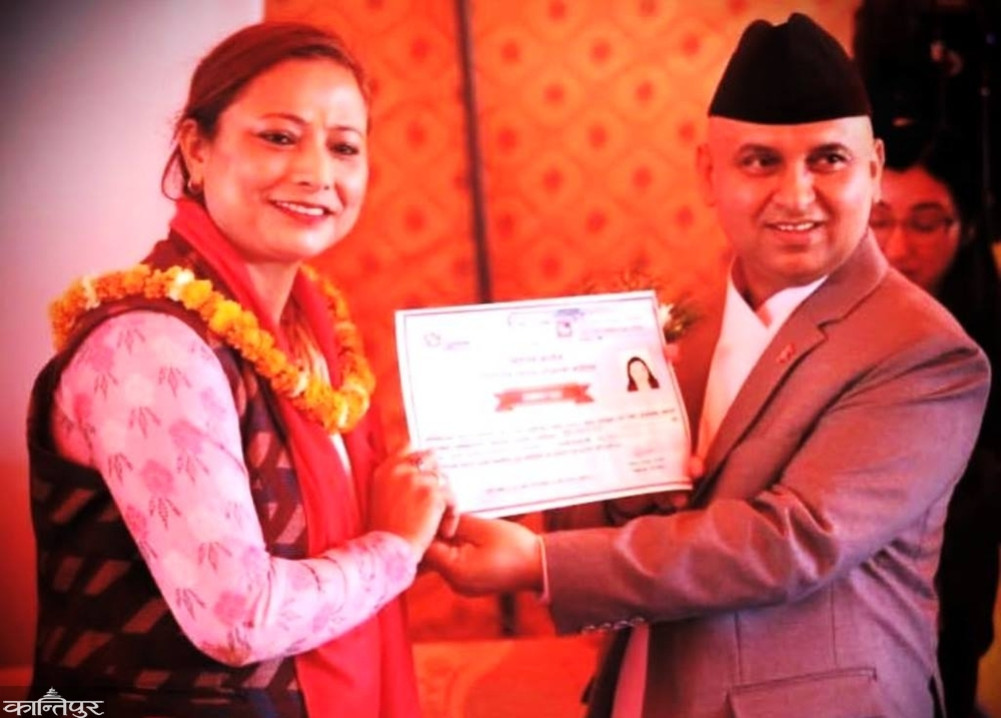
Changing political parties due to the rush of social change, 50-year-old Manju Gyawali Bhusal of Butwal Sub-metropolitan City-11 has become a member of the House of Representatives from the proportional quota of the Rashtriya Swayamsevak Sangh (RSS) since Thursday.
We use Google Cloud Translation Services. Google requires we provide the following disclaimer relating to use of this service:
This service may contain translations powered by Google. Google disclaims all warranties related to the translations, expressed or implied, including any warranties of accuracy, reliability, and any implied warranties of merchantability, fitness for a particular purpose, and noninfringement.
Political awareness since childhood, active affiliation with more than a dozen organizations, and social background have brought Manju Gyawali Bhusal to the policy-making level of the country.
Changing political parties established in the haste of social change, 50-year-old Manju Gyawali Bhusal of Butwal Sub-metropolitan City-11 has become a member of the House of Representatives from the proportional quota of the Rashtriya Swayamsevak Sangh (RSS) since Thursday.
Born in 2032 BS in the former Chidika VDC-4 of Arghakhanchi, Bhusal's grandfather Man Bahadur Gyawali had become the zonal chief before 2022 BS. Two grandmothers, Gitadevi Gyawali, became the head of the Daungha VDC of Gulmi in 2022 BS, and another grandmother, Hiradevi Gyawali, became the head of the Chidika VDC of Arghakhanchi. Father Meghnath Gyawali became the Vice President of the VDC before 2046 BS and after the advent of multi-party politics. That background had connected Manju to politics.
Manju, who joined politics with the inspiration of her grandmothers, chose the Nepali Sangh during her student life after the advent of multi-party politics. She joined politics by holding the hand of the then student leader of Arghakhanchi, Soma Kumal, and took the membership of the Nepali Sangh in 2051 BS. She became the village secretary of Tarun Dal and Congress and became a communist around 2059/2060 BS.
When the influence of the People's War was growing, she became a Maoist through contact with Bhakti Pandey, a Maoist leader from Butwal who had a family background. After the unity of the Maoists and UML in 2074 BS, she joined the UML from the NCP. She left UML after the Genji protests of Bhadra 23 and 24, 2082 and got the opportunity to become a proportional MP two months ago by joining the Rashtriya Swayamsevak Sangh (RSS).
Along with politics, Manju's background is also linked to social activism and leadership roles in dozens of organizations. She has been trying to learn and understand national issues since the age of 11. Manju, who has been developing an awareness of leadership and social responsibility since childhood, believes that politics should be a profession for service and income.
She said that she is pursuing politics and her profession together because her grandmother and father amassed a lot of wealth and valuable jewelry while in politics. She seems to have the ability to give a positive direction to society, find solutions to problems, and take unanimous decisions.
Manju is also an active social activism. Born in Arghakhanchi, she is the only woman among the 77 districts of the country to become the district president of the Construction Entrepreneurs Association. She is also a former central member of the Construction Entrepreneurs Federation and former vice president of Lumbini Province. From the women's president of JCIS 2016, national coordinator of 2017 to women's district president of the Federation of Cottage and Small Industries, a member of the Lumbini Province of the Chamber of Commerce and former advisor to the West Nepal Truck Entrepreneurs Committee, Manju has studied up to grade 12 in education.
Bhusal, who says that she has succeeded in reaching the policy-making level of political leadership with the support of her husband Narayan Prasad Bhusal, has resolved to give priority to solving the problem of squatters in the House of Representatives, fulfill the dreams of Genji, work for the problems of the construction sector of Rupandehi, Gulmi and Arghakhanchi, development infrastructure, employment creation, and development of the industrial sector. "My first responsibility is to fulfill Genji's dreams," she said. "I am determined to ensure economic stability, control corruption, create jobs, and resolve problems in service delivery."
She said she would also do her best to develop the mindset that politics is not a source of income, but a means of service.