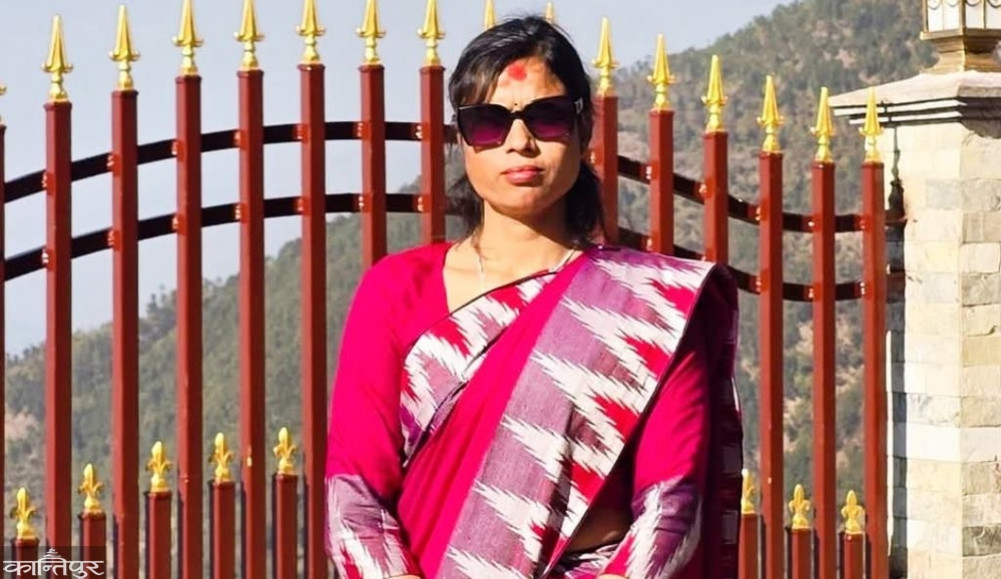
Eshuda Baral, who has suffered from disabilities and financial struggles since childhood, has become a proportional representation member of parliament, increasing her political activism along with education, business, and social service.
We use Google Cloud Translation Services. Google requires we provide the following disclaimer relating to use of this service:
This service may contain translations powered by Google. Google disclaims all warranties related to the translations, expressed or implied, including any warranties of accuracy, reliability, and any implied warranties of merchantability, fitness for a particular purpose, and noninfringement.
Born in Raskot-8, Kalikot, 34-year-old Eshuda Kumari Baral became disabled at a young age. She was injured when a stone fell on her right leg at the age of 4 while playing in the difficult terrain of Kalikot.
Due to lack of timely and proper treatment, her legs became short and it was difficult for her to walk. The disability became a lifelong pain for her. Born on 25 Asoj 048, 5, Eshoda was active in the UML from a young age. That political involvement has made her a proportional member of the House of Representatives from the backward areas, women and disabled sectors. Even though the party got poor results in the elections, she managed to be among the 16 proportional members.
After completing grade 7 from the village's Janajagruti Basic School, she studied grade 12 from Badimalika Secondary School, Raskot, traveling up and down for two hours every day. She became the initial committee president of ANRFSU when she was in grade 8 at school. At the age of 17, she went to Kathmandu alone to pursue higher education. She entered the city with the confidence that she could do something despite her disability, but she had to struggle a lot to adapt to the new place, surroundings and environment. Even though the family's financial situation was not strong, when her daughter said she wanted to study, her father sought a loan to cover the expenses. "What good is educating my daughter?" she recalls. She said that after continuing her studies and completing her master's degree from Nepal Commerce Campus, everyone started praising her.
Stating that a society that despises daughters has a tendency to despise the disabled even more, she said, ‘People with disabilities also have to struggle a lot to be human.’ Eshuda, who has been raising her voice for disability-friendly physical infrastructure, disability-friendly behavior, speech and participation, was very troubled by the issue of youth wandering around without getting employment. She runs a fancy shop in Bhrikuti Mandap to survive in Kathmandu.
She educates her siblings and manages her expenses from the income from that. ‘I have not had to shake hands with anyone in my business. I have done social service, politics, and business,’ she said. She said that her siblings and parents are currently taking care of the shop. She is single.
Active in politics and advocating for the rights of people with disabilities, Eshoda became a central member of the All Nepal Women's Association after becoming a central member of the ANNFSU. She is also a district committee member of UML Kalikot. Baral filed a case in the Supreme Court two years ago demanding that the 480 MW Fugad Karnali dam being built in Kalikot be in the interest of the people. UML and other parties made it an election issue in this election, saying that the work on the project, which is the pride of Kalikot, was stopped because of her filing the case.
She filed a case in the Supreme Court in 2080 demanding that the rights of the locals in Fugad Karnali be ensured and that hydropower should be built with domestic investment keeping in mind the national interest. The case of Eshoda was dismissed with a directive order on 23 Bhadra.
When she was studying in Kathmandu, she saw that the youth of the village were going to India and other Gulf countries without getting jobs, so she filed a writ petition in 2069 Baisakh, making the Council of Ministers the defendant, saying that the right to employment mentioned in Article 18 of the Interim Constitution 2063 was not implemented. Since there had been no progress even after 6 years since the promulgation of the Interim Constitution, the system could not be implemented as it is, so the Supreme Court had issued a mandate in the name of the government to provide employment by making a law. She was also very popular due to both these cases.
She said that people with disabilities are still not able to exercise their rights to participation and equality, and that people with disabilities have a separate problem in Karnali. ‘We are not in a position to use the Hiruvalchiar even if we want to,’ she said, ‘Since there are cliffs everywhere, we have to crawl on our hands and feet.’
She plans to reach the House of Representatives, the highest place for policy-making, and advocate for a Karnali-friendly policy, especially for social security. ‘Although Karnali is rich in natural resources, due to their inability to be properly utilized and mobilized, the people of Karnali have not been able to become happy and prosperous,’ she said, ‘I hope that Karnali can be developed with the common understanding and initiative of all the people’s representatives representing Karnali.’
She said that Karnali, which is home to beautiful lakes like Rara and Phoksundo, as well as tourist destinations such as Badimalika, Chulimalika, Pug Malika, Mahabai, Chandannath, Chhayanath, has not had a long-term plan for its protection and development, and she said that she plans to raise her voice for the protection of Karnali’s water, forests, and herbs. She plans to raise her voice for the social security and protection of the marginalized groups in society, especially the disabled, the poor, single women, and senior citizens.