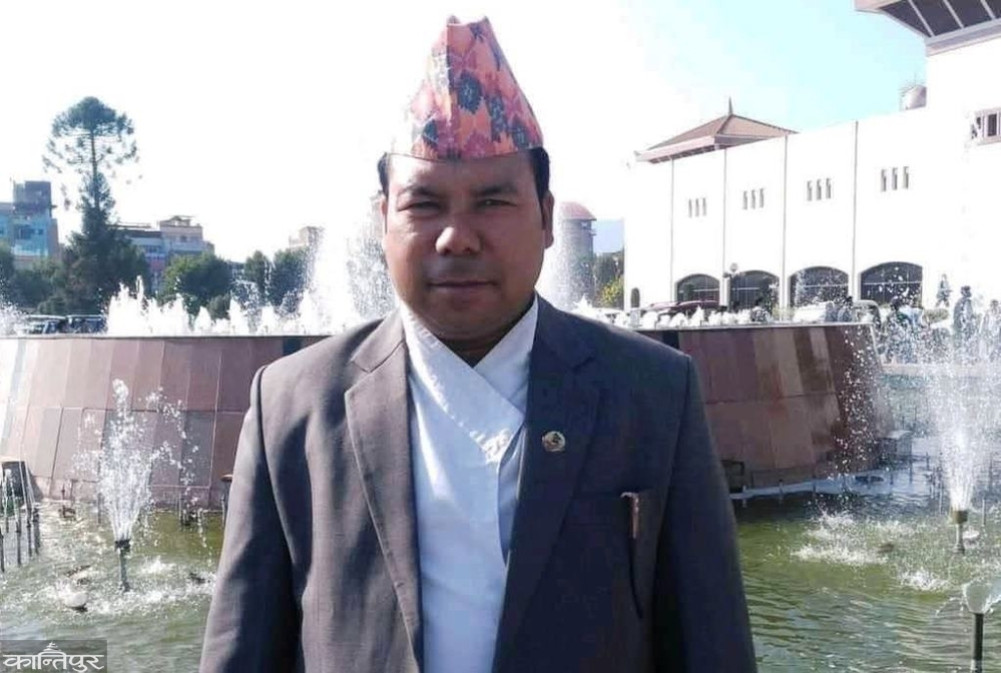
Kripa Ram Rana, who was elected as a member of the second Constituent Assembly through proportional representation in 2070, has been elected as a member of the House of Representatives through proportional representation by the UML this time as well.
We use Google Cloud Translation Services. Google requires we provide the following disclaimer relating to use of this service:
This service may contain translations powered by Google. Google disclaims all warranties related to the translations, expressed or implied, including any warranties of accuracy, reliability, and any implied warranties of merchantability, fitness for a particular purpose, and noninfringement.
Kripa Ram Rana, a member of the Ranatharu community, which is located only in Kailali and Kanchanpur in western Nepal, has reached the parliamentary stage for the second time. Known as a caste within the Tharu community, this community has its own unique way of life and dress. Kripa Ram Rana is the only one from this community dependent on agriculture to become a member of the House of Representatives. He became a member of the House of Representatives through proportional representation from the CPN-UML. This is the second 'innings' in parliament for Rana, who came to politics from a teaching profession. Rana, who was also elected as a member of the second Constituent Assembly through proportional representation in 2070, has been elected through proportional representation this time too. Born in an ordinary family in Jadepani, Bedkot Municipality-2, Kanchanpur, Rana was involved in the teaching profession for 13 years. He taught at Baijnath Secondary School, where he himself studied until grade 7, from 2053 to 2070. His family, who studied till his master's degree, was dependent on agriculture. After completing his inter-school education, he started teaching along with agriculture.
Rana is also a member of the Bhalmansa family. His father Shalikram Rana and grandfather Dayaram Rana worked as a Bhalmansa for years. Now, after his father got old, the Bhalmansa job has passed to another family. His family had been responsible for Bhalmansa for more than a hundred years. 'Since I was born in an ordinary agricultural family, studying was not that easy,' Rana said while recalling his childhood days, 'I studied by earning a little bit myself.' He entered politics after being influenced by his grandfather's Bhalmansa job. He entered politics from ANRFSU while he was studying in the 8th grade. He is now a central member of UML.
In the social sector, he has led various organizations including the School Management Committee, Red Cross, and Community Forest. He is also the former central president of the Ranatharu Society. He has led the Ranatharu language cataloging, grammar, and dictionary creation. He took the initiative to list the Ranatharu community and even for reservation in the Personnel Administration Act.
He is also known as a decent leader in the UML. He is always at the forefront for the rights of the Tharu community. ‘Ranatharu is a caste of the Saru community,’ he said, ‘Both are backward communities, a lot of work will have to be done for their upliftment.’
According to the 2078 census, the population of the Ranatharu community is around 100,000. But he claims that the actual population is still higher. He had raised this issue even when he was the central president of the Ranatharu Society. The Ranatharu community resides in the local levels of Shuklaphanta, Laljhari, Beldandi and other areas of Kanchanpur along with Bedkot. This community is known for its traditional attire, festivals and food. This community, which enjoys agriculture and animal husbandry, is far behind in education.