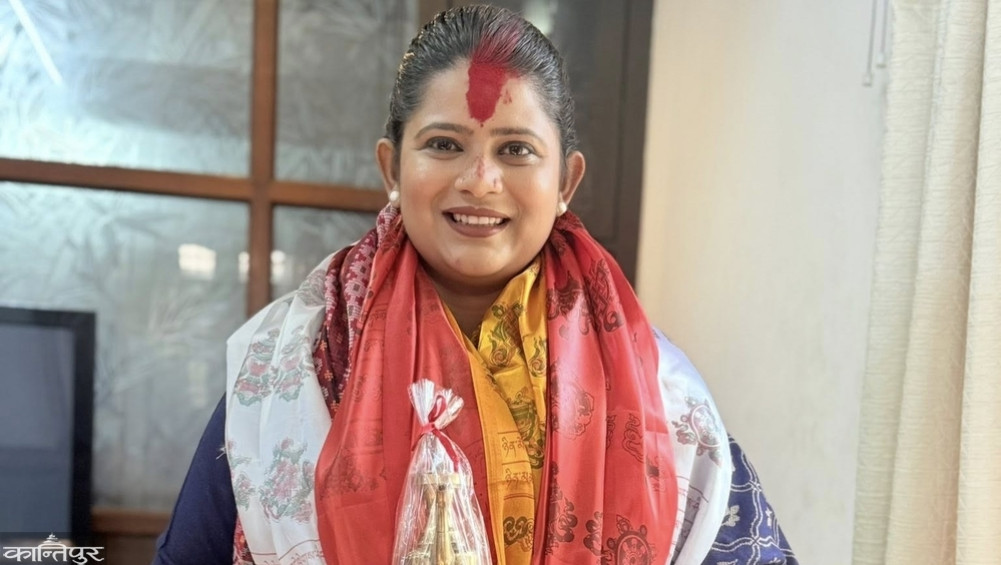
Thakur has reached the parliament representing Madhesi women. She said that she saw this not only as a personal achievement but also as an opportunity to bring the voices of Madhesi women to the parliament.
We use Google Cloud Translation Services. Google requires we provide the following disclaimer relating to use of this service:
This service may contain translations powered by Google. Google disclaims all warranties related to the translations, expressed or implied, including any warranties of accuracy, reliability, and any implied warranties of merchantability, fitness for a particular purpose, and noninfringement.
Dr. Ankita Thakur, who has been examining patients' teeth, is now moving forward with a different responsibility. After serving as a dentist for four years, she has now reached the parliament, the place where the country's policy is made. Ankita, the Chief Executive Officer (CEO) of Nova Dental and Aesthetic Clinic in Lalitpur, used to work in a confined room, where patients would come, tell their problems and she would get them treated and return them.
After she was elected to parliament from the Madhesi Women's Cluster on the proportional list of the Rashtriya Swayamsevak Sangh (RSS) party, her scope has also widened. She has an experience that politics and medicine are different. Recounting her different experiences of politics, she said, 'Being a doctor means sitting in a room and seeing patients, the scope of which is small and limited. Politics is a broad field, where one has to work on issues related to the daily lives of all people.'
She was not affiliated with any political party before becoming an MP. She worked as the president of a group called ‘Friends of Zoo’ for about 6 years. During this period, she led various social activities. She was constantly active in organizing blood donation programs, conducting cleanliness campaigns, and spreading awareness for environmental protection. She said that these activities gave her the opportunity to connect closely with various aspects of society. She said that
The idea that youth should come into politics, especially women from Madhesh, inspired her to enter politics. ‘Everyone should take responsibility for building the country.’ She said that I entered politics because I felt that it was necessary for youth and women to come forward in this too,’ she said.
Thakur had been informally associated with the National Independent Party (NISP) for the last two years. She said that the NISP party attracted her because it was seen as a party with different thinking and perspectives than other parties. Explaining the reason for entering politics through the Rashtriya Swayamsevak Sangh (RSS) party, she said, "I was attracted to it because it has a clear agenda that the youth should do something against corruption. I have decided to move forward through this party because the RSSS is different from other parties in its promises, thinking, and leadership style." She also said that the RSSS is an inclusive party. "There are professionals from various fields here. Doctors, engineers, teachers, businessmen, people from all fields are here. I feel that their education and skills will help in the development of the country," she said. Thakur reached the parliament representing Madhesi women. She said that she considered this not only a personal achievement but also an opportunity to bring the voices of Madhesh women to the parliament. "The women of Madhesh are still lagging behind in many areas, I have come to represent them to raise their voices," she said.
She has seen firsthand the problems faced by women in the Madhesh region. She understands that they are still lagging behind in terms of education, health, economic opportunities, and social structure. She said that they are not fully informed about their rights. After reaching the parliament, she plans to raise the issues of Madhesh women with priority. Stating that she will represent Madhesh women in the parliament, she said, ‘I want to speak in the parliament as the voice of Madhesh women. I want to bring the problems to the fore and emphasize the law-making process.’
Her next goal is to make policies and reform changes. After reaching the parliament, she has planned to identify the flaws in the existing policies and rules and improve them. She said that her aim is not only to make new laws but also to make the existing laws effective.