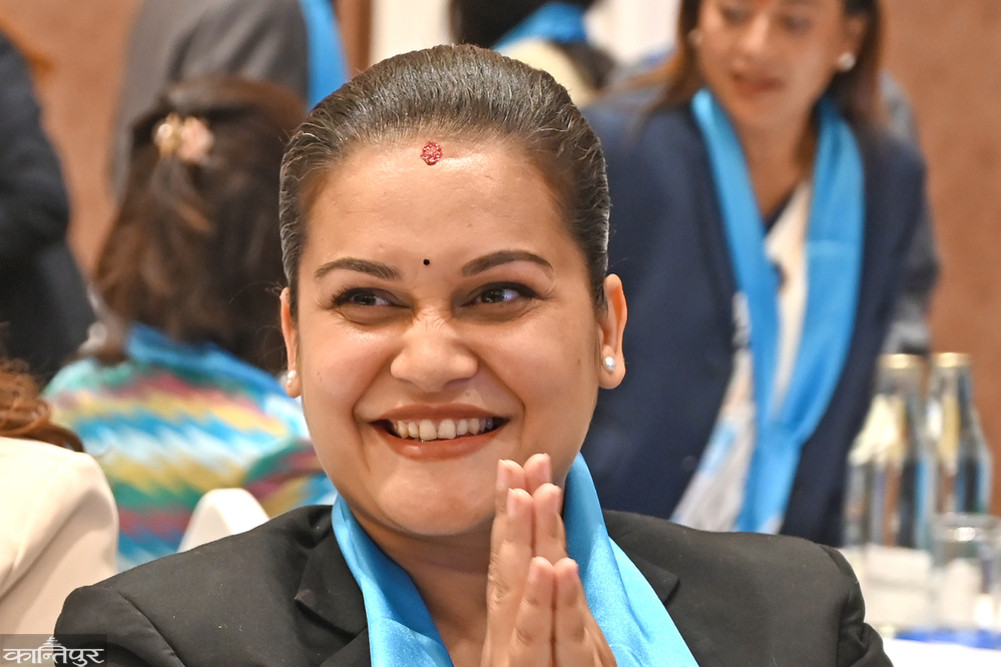
Reema, who spent a long time of her childhood without her parents, has embarked on a political journey by taking the path of art. Many are curious about how she will fulfill her parliamentary role, having gone through many ups and downs of struggle and adversity.
We use Google Cloud Translation Services. Google requires we provide the following disclaimer relating to use of this service:
This service may contain translations powered by Google. Google disclaims all warranties related to the translations, expressed or implied, including any warranties of accuracy, reliability, and any implied warranties of merchantability, fitness for a particular purpose, and noninfringement.
Actress Rima Vishwakarma, who has been shining on film and television screens, will be seen in the House in the coming days. That is why filmmakers are expressing their best wishes to her in proud words. Rima's well-wisher, actress Keki Adhikari, expressed her words with love on Monday, 'May your fearless voice be heard clearly inside the Parliament building.'
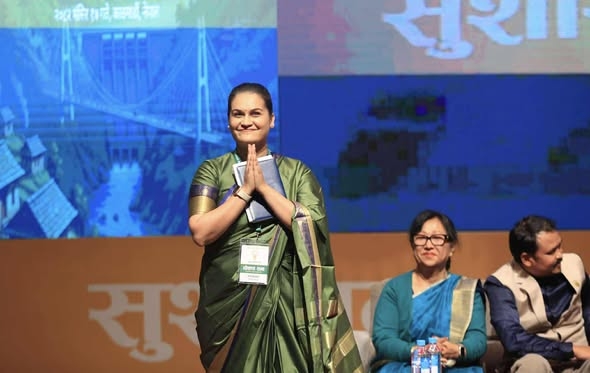
After the Rashtriya Swayamsevak Sangh (RSS) made her an MP from the Dalit women's cluster of the proportional list, now her journey and responsibilities have taken a U-turn. Rima, who made announcements on glass screens and stages yesterday, will now stand in the Parliament with the voice of the people. She will participate in the policy-making process. 'If I reach there, I will speak the voice of Dalits and marginalized communities. I will speak the voice of women. I will think for the future of the film industry,' Rima had told Kantipur Daily before the election.
Rima, who started her political journey from Kulman Ghising-led Ujjal Nepal Party, was a proportional candidate from the same party for the House of Representatives elections. When Kulman merged Ujjal Nepal into the Rashtriya Swayamsevak Sangh (RSS), Rima was the first Dalit woman cluster in the Rashtriya Swayamsevak Sangh (RSS).
Ujjal Nepal separated from the Rashtriya Swayamsevak Sangh (RSS) within 12 days of the party unification. But Rima did not. Her candidacy was secured in the forefront of the Rashtriya Swayamsevak Sangh (RSS). She was criticized and commented on for leaving Kulman in a crisis. However, Rima's stance was, 'I supported change.' Rima was trolled once during the election campaign in Syangja. During the election campaign in Syangja, she had promised to bring Ravi and Balendra to the area after the election if the Rashtriya Swayamsevak Sangh (RSS) candidate won. She had said, 'I want to make a promise.' If we win with a majority from Syangja-1 and 2, I will bring party president Ravi Lamichhane and senior leader Balendra Shah to Syangja.' Although it was a promise for her, it was considered cheap propaganda for many. When the video went viral and was being trolled, she had clarified her intention to Kantipur, 'Leaders always visit the door to door only during elections, after which power is centralized only at the center. What I am trying to say is that we should rise above that and now, if necessary, before and after the elections, we should not go to the center, but power should come to us.'
Childhood without parents Rima's childhood was spent without the protection of her mother and father. When Rima was 2 years old, her mother came to Kathmandu from Bardiya with her sister and brother. Her mother decided to keep them in a hostel in Kathmandu and educate them. And, her mother went to India in search of work. Rima never saw her father except in pictures. Before Rima knew it, her father had gone to India for work. Her father used to drive in India. Rima, her sister and her brother grew up in a hostel in Kathmandu. During that hostel life, she deeply experienced the family's hardship and loneliness. Rima's sister returned to her village in Bardiya after completing her schooling. Rima and her brother were the only ones in the hostel. 'During festivals, parents would come to take other children home, but no one would come to take us. We would sit on the roof of the hostel and say 'bye-bye' while watching other friends go home. And we would cry, fearing that our parents would never come to take us,' she recalls with a saddened voice.
Friends would tease Rima's siblings as 'orphans'. The word orphan had deeply hurt her mind at that time.
Rima's mother was the only guardian in her life. For the first year, her mother even worked as a caretaker in the same hostel so that they could live together. 'But, later, due to financial constraints and the need to earn for the future of her children, my mother had to leave us and go to India,' Rima says.
When Rima was in the 6th grade, her father died in a road accident in India. She only learned about his passing much later. Rima met her mother, whom she had left in the hostel when she was young, after 10 years. During this period, Rima cried many times, remembering her mother. She was shocked. Many times, she even hugged a woman who looked like her mother, crying, calling her 'mother'.
Later, when she was in 8th grade, her sister took Rima and her brother to the village. That was when her mother came to meet them for the first time.
Along with her studies, Rima completed her SLC from Navratna Secondary School in Kavrepalanchowk. The main reason for attending that school was that her brother Prabhat was studying there. She had come to Kavre from Kathmandu as she had planned to complete her SLC together. Before going there, they studied at Siddhartha Banasthali in Kathmandu.
Rima was already filled with a hunger for art while studying at school. She used to 'host' children's programs on Nepal Television when she was in 5th-6th grade. She was very outgoing by nature, had the ability to lead everything, and was always at the forefront in dancing, singing and speaking.
As soon as she completed her SLC, a big family responsibility fell on Rima's shoulders. She started living with her brother in a rented room in Prayagpokhari, Lalitpur. At that time, they had only a bed, a water filter, and a few plates and bowls in the room. Amid financial constraints, Rima continued her studies and work simultaneously.
She completed her 11th and 12th grades from Pinnacle Academy in Lalitpur. At the same time, she started working as a fashion editor at DC Nepal Online TV and Maharajgunj. Rima would go to college at 6 in the morning, leave college at 9 and go straight to the office and work all day. She not only paid her and her brother's education fees, but later brought her mother and sisters to Kathmandu to make the family one.
During the 10-year separation between her mother and Rima, her other 2 sisters (Isha and Ayesha) were born while she was in India. Rima did not know about them at first. Later, after Rima completed her 12th grade studies and started earning money from art, she brought both her sisters to Kathmandu from India.
Interest in art
Rima also spent some time in journalism. She worked for News Nepal National Television but was not active in journalism for a long time. She discovered her interest and took her professional art journey to the heights through music videos. She started her art journey with singer Chris KC's music video. However, her first hit videos were 'Mero Dil Cha Pokharama' and 'Kun Rangko Kami Thio Ra' directed by Prasanna Poudel. The song 'Timro Premle' directed by Alok Nembang took her to further heights.
After getting into music videos, she entered the film industry. Her 'debut' film is 'Swar'. After that, she worked in films like 'Ritu' and 'Visa Girl'.
Along with being an artist, Rima is also a successful host. She worked for a long time on NTV 2 Metro and National Television. Recently, Rima was also the host of famous reality shows like 'Nepal Idol' and 'Comedy Champion'.
Whether it is acting or hosting, Rima, who has won the hearts of the audience by showing her artistic skills, is now in parliamentary politics. This is also a new test of her career. Rima, who won the hearts of the audience yesterday, will now be successful in winning the hearts of the people, her presence in the coming days will decide.