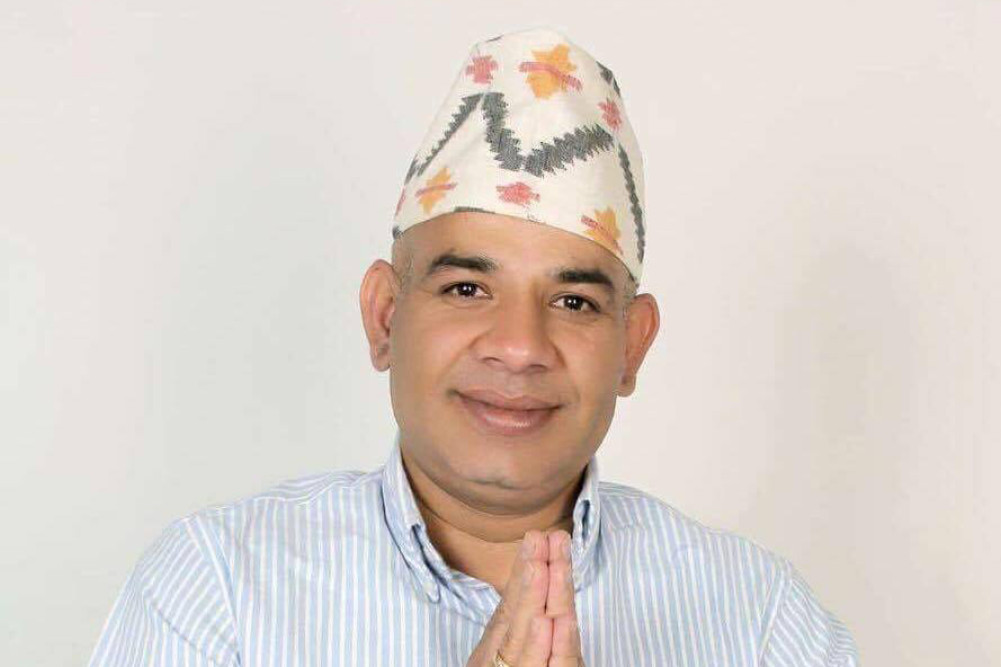
This time, Mohan Acharya has got the opportunity to be elected consecutively among the 18 people directly elected by the Congress.
We use Google Cloud Translation Services. Google requires we provide the following disclaimer relating to use of this service:
This service may contain translations powered by Google. Google disclaims all warranties related to the translations, expressed or implied, including any warranties of accuracy, reliability, and any implied warranties of merchantability, fitness for a particular purpose, and noninfringement.
While many Congress candidates are being defeated across the country in the recently concluded House of Representatives elections, Congress' Mohan Acharya has been elected for the third time in a row from Rasuwa.
This time, he has got the opportunity to be elected consecutively among the 18 people who won directly from the Congress. In fact, Tek Bahadur Gurung, elected from Manang, is also the third in his parliamentary journey. However, he is not consistent.
Gurung, who started his parliamentary journey by being elected to the Constituent Assembly in 2070, was defeated by the left alliance in 2074. Since 2079, he has also been elected continuously.
Acharya, however, started his parliamentary journey during the left alliance in 2074. At that time, when the Congress was reduced to 23 seats in the direct election, he made a brilliant 'entry' from Rasuwa.
5,000 votes more than his competitor
Acharya scored a 'hat trick' by getting almost 5,000 votes more than his nearest competitor. He got 10,656 votes while Basanta Bhatta of the Rashtriya Swayamsevak Sangh (RSS) got only 5,571 votes.
Winning consecutive elections from border and geographically challenging areas is not just about party strength. His strong organization, personal influence, and style of focusing on local issues are also equally important.
Acharya was born on 29 Chaitra 2033 in Laherpouwa, Uttargaya Rural Municipality-5, Rasuwa. She grew up amidst geographical remoteness and limited opportunities. She is also a civil engineer. After completing her studies in civil engineering, Acharya was not attracted to a government job. She tried her hand in the construction sector. The Rasuwa Construction Company under his leadership falls under the 'A' category.
Due to her experience related to the construction business, her interest in development and construction issues has been more visible. There is a negative side to this too. Due to the relationship between politicians and businesses, questions of transparency and conflict of interest have sometimes arisen against him. However, he has been avoiding it to some extent.
Looking at the political map of Rasuwa, personal access and local relations have played a major role in the election results. A small number of voters, community relations and direct contact have played a big role in the election. He has not had to back down because he has understood and followed them.
He understands that politics will make local development and service delivery more effective than national issues. Local Congress leaders say that Acharya has prioritized coordination with the local level, road and infrastructure expansion and border trade reform by understanding this political structure.
Rasuwa is also a district bordering China. Trade, infrastructure development and disaster management are its main challenges. He has been prioritizing road network, road upgrading and bridge construction. These issues became his political agenda in this election as well. He emphasized local issues based on the needs of the district rather than national policies and agenda. He has been raising his voice in tourism, agriculture, hydropower and infrastructure development even in parliament. Which did not put a 'break' in his journey. He was approved by the people for the third time.
Political journey since his student days
He is a leader who emerged from the politics of the Nepal Students' Union. Active in organization expansion, cadre management and local issues in the initial stage, he became familiar with the district and expanded his access to central leaders. Through that access, he got the opportunity to mingle with former President Sher Bahadur Deuba. Deuba gave him a ticket in 2074.
After starting his parliamentary journey by being elected for the first time, Acharya was elected as a central member at the party's 14th general convention held in Mangsir 2078. After the Gen-G movement, Acharya left the Deuba group and stood in favor of a special general convention.