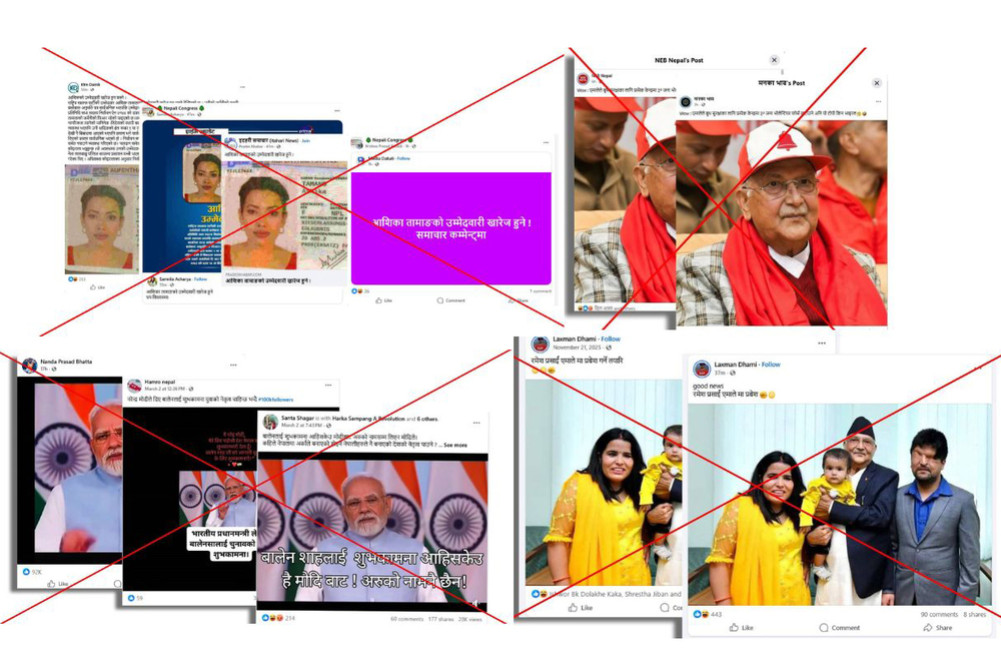
Rumors are being spread on social media by distorting facts about candidates and creating 'deepfake' audio and video. At the initiative of the Cyber Bureau, 449 misleading and irrelevant materials have been removed.
We use Google Cloud Translation Services. Google requires we provide the following disclaimer relating to use of this service:
This service may contain translations powered by Google. Google disclaims all warranties related to the translations, expressed or implied, including any warranties of accuracy, reliability, and any implied warranties of merchantability, fitness for a particular purpose, and noninfringement.
A 27-second video was posted on Tuesday evening at 6:09 pm by a Facebook account named ‘Nanda Prasad Bhatt’ with 34,000 followers. In the video, a person who looks like Indian Prime Minister Narendra Modi has wished senior Rashtriya Swayamsevak Sangh (RSS) leader Balendra Shah. The person said in Hindi, ‘I wish all my best to all my brothers and sisters in my dear neighbor Nepal, Narendra Modi. I wish all my best to Balendra Shah ji for the upcoming elections. Youth leadership, its new thinking and positive energy strengthen democracy. Nepal continues to make progress, that is my wish.’
When Kantipur used the AI ‘detection’ tool ‘Hive Moderation’ to check the authenticity of the video, it was found that the video was created by AI at 0.7 percent, while the audio was found to be created by AI at 99.7 percent. To further confirm, when the ‘key-frames’ of the video were extracted and analyzed with the help of the ‘Invid’ tool, unnaturalness was seen in the facial expressions and lip movements of the person called Modi.
Although the voice in the video sounds like Modi, there is artificiality in the expressions, pauses and pronunciation, which is a feature usually seen in content prepared using ‘AI Lipsync’ technology. Therefore, the video was misleading .
By the time Kantipur fact-checked the video, it had been viewed more than 1.2 million times. It had 88,000 reactions, more than 1,700 responses and 4,100 shares. Nanda Prasad Bhatt of Bharatpur Metropolitan City-16 has been arrested for the same video.
He was arrested for an offense under the Electronic Transactions Act as he was seen spreading rumors through the video and directly affecting the election activities, informed DSP Rabindra Khanal, spokesperson of the Chitwan District Police Office. ‘Bhatt’s involvement was discovered during the study with the technical assistance of the Cyber Bureau of the Police Headquarters. He has been arrested from Bharatpur-10 and the investigation is being carried out,’ he said. The video has been removed after Bhatt’s arrest.
This is not the first incident of misleading information being spread ahead of the election. There is a trend of spreading rumors on social media by distorting facts about political parties and candidates, creating ‘deepfake’ audio and video. Some are spreading misleading content by partially quoting and incompletely explaining legal sections.
On Wednesday alone, news claiming that ‘Asika Tamang’s candidacy from Dhading-1 on behalf of the Nepali Congress Party would be rejected’ spread in some media outlets and social media. The news claimed that Tamang had obtained a permanent residence permit (PR) from Germany. A Facebook page named ‘KTAV Dainik’ had posted at 12:12 pm on Wednesday under the title ‘Asika’s candidacy may be rejected’. It claimed that German PRs are considered ‘like citizens there’ and cited Section 12 of the House of Representatives Election Act, 2074 BS and Section 14 of the Election Offenses and Punishment Act, 2073 BS. It argued that ‘a person who is not allowed to vote cannot be a candidate’ citing the statement of advocate Ramchandra Koirala.
Pradesh Khabar.com had also published content under the same title. Content with the same title was also posted on Prime TV’s Facebook page. However, Election Commission Assistant Spokesperson Sita Shree Pun said that there was no truth to the claims made in the content. According to her, no complaint regarding the rejection of Tamang’s candidacy has been registered against Tamang. ‘All the news coming out now is rumours,’ she said. Some media outlets have apologized for publishing false news about Tamangs.
A video of Chitwan-2 RSVP candidate Sobita Gautam claiming that Tharu and Gurung communities would be 'sold for money' also went viral on social media. Online portals including Janaastha and Facebook users shared the video, saying that Gautam had insulted the indigenous community.
A video of Gautam urging other parties not to participate in distributing money during the election period was edited. Kantipur found that the video had been edited and distorted to create confusion. Tekpana has also fact-checked the matter.
Meanwhile, a video of Congress President Gagan Thapa's speech was also posted in a way that spread confusion by cutting out certain parts. ‘A 37-second video in which Gagan Thapa made derogatory comments about the tribal community and spoke in favor of Brahmins and Chhetris was shared by user ‘GlobalMedia0098’ on TikTok, Facebook, and X. In the video, Gagan says, ‘What do the tribals think they are in Nepal? By demanding rights for everything, by wanting this and that, what are they trying to do? If there were no Chhetris and Brahmins in Nepal, would any party be running?’
The video was prepared by cutting a short part of a speech that was made public seven years ago. Thapa did not express his own views in the original speech. He quoted the then Maoist chairman Pushpa Kamal Dahal. ‘Nepal Fact Check’ has also fact-checked this.
After the 37-second partial video went viral, Congress President Thapa said, ‘The confusion spread by adding my name on social media is completely baseless.’ My thoughts and behavior have always been respectful towards all races and communities. I do not believe in racial superiority, but in human equality and brotherhood. Please do not follow any misleading propaganda,' he wrote. He also included the YouTube link to the full video.
Another irrelevant material has also been spread about Thapa himself, in which it is claimed that Thapa is prostrating with money at his feet. A Facebook user named 'Awaral Bisauni', who has 73,000 followers, posted a photo on 17 Falgun, claiming that the person in it is Gagan Thapa. In the photo, a man is seen prostrating with money at the feet of a woman, but the faces of both are not clearly visible.
When Kantipur 'reverse searched' the photo for fact-checking, it was found to be related to a news published on 29 Baisakh 2079.
According to the news, Amrit Khanal, who is the ward chairman candidate from the Congress in Melamchi Municipality-10 of Sindhupalchowk, had offered 1,000 rupees to his aunt Chet Kumari Karki while bowing down. Ratopati and Ujjaya Online published the news that the Election Commission had asked for an explanation on this and warned him that the answer was not satisfactory.
There was a false report that Ramesh Prasai, who became a proportional candidate from the Rashtriya Swayamsevak Sangh (RSS), had joined the UML. When Kantipur called him about this, Prasai said, ‘I will not join KP Oli’s UML not only in this life, but also in the next life. Even if the RSSS cooperates with KP Oli to form the government tomorrow, I will resign from the RSSS.’
According to journalist and fact-checker Umesh Shrestha, since candidates are not allowed to speak during the silent period of the election, misleading information is spread by taking advantage of it. ‘During the silent period, misleading rumors are spread, such as that the candidacy has been rejected or that another candidate has been supported,’ he says. During the silent period, activities that can influence the election such as election campaigning, speeches, gatherings, discussions are not allowed. According to fact-checker Shrestha, the use of ‘deepfake’ and AI has increased slightly this time compared to the previous elections. ‘Especially, attempts are being made to deceive people by manipulating the videos and audio of political party leaders through AI,’ he said. ‘Voters can easily be misled because short videos on TikTok and Reels do not contain all the context.’ If misleading content is found to be spreading on social media, the Election Commission proposes to the Cyber Bureau and the Telecommunications Authority to remove it. According to Cyber Bureau spokesperson Deepak Raj Awasthi, 449 misleading and irrelevant content has been removed so far. ‘We have seriously taken forward the monitoring and action against misleading content spread on social media during the silent period of the election,’ he said.
Awasthi also said that TikTok responds quickly to remove such misleading content, but Facebook's parent company 'Meta' responds slowly. 'TikTok is cooperating quickly and effectively.' But Meta's response is very slow,' he said. 'It makes little sense to respond only after misleading content has caused damage to society.'
According to Umesh Shrestha, who is also the editor of 'Nepal Fact Check', misleading information can spread a lot on voting day. 'There can be a lot of misleading information about insecurity at polling stations,' he says. 'Readers and social media users should not immediately believe the information they see. If there is content that excites your emotions or is sensational, it should be viewed critically. Only information from reliable media should be followed.'