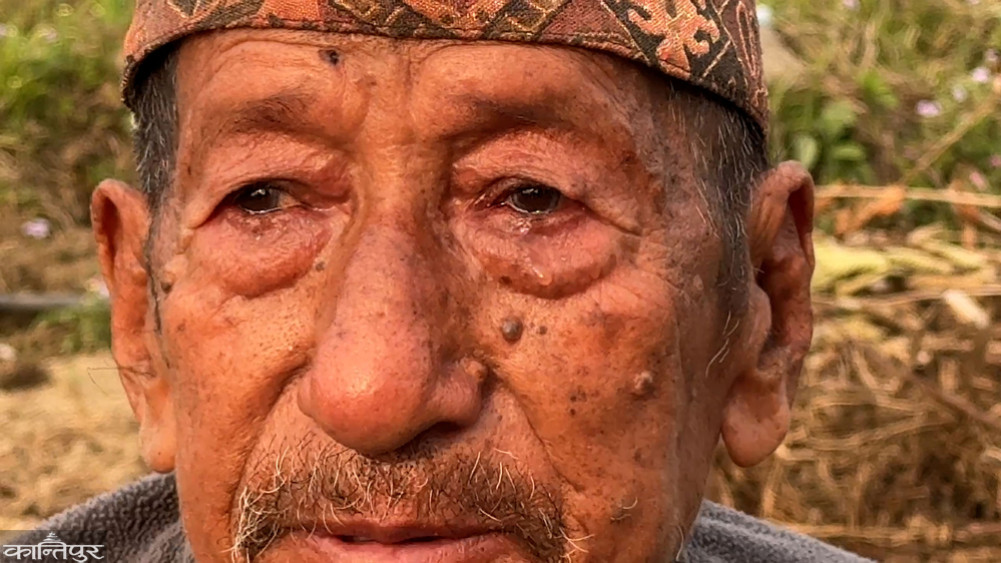
Voters from Palpa-2 say: After the elections, candidates from all political parties come to seek votes, and it is not known where they go at other times. There is no understanding of the people's situation.
We use Google Cloud Translation Services. Google requires we provide the following disclaimer relating to use of this service:
This service may contain translations powered by Google. Google disclaims all warranties related to the translations, expressed or implied, including any warranties of accuracy, reliability, and any implied warranties of merchantability, fitness for a particular purpose, and noninfringement.
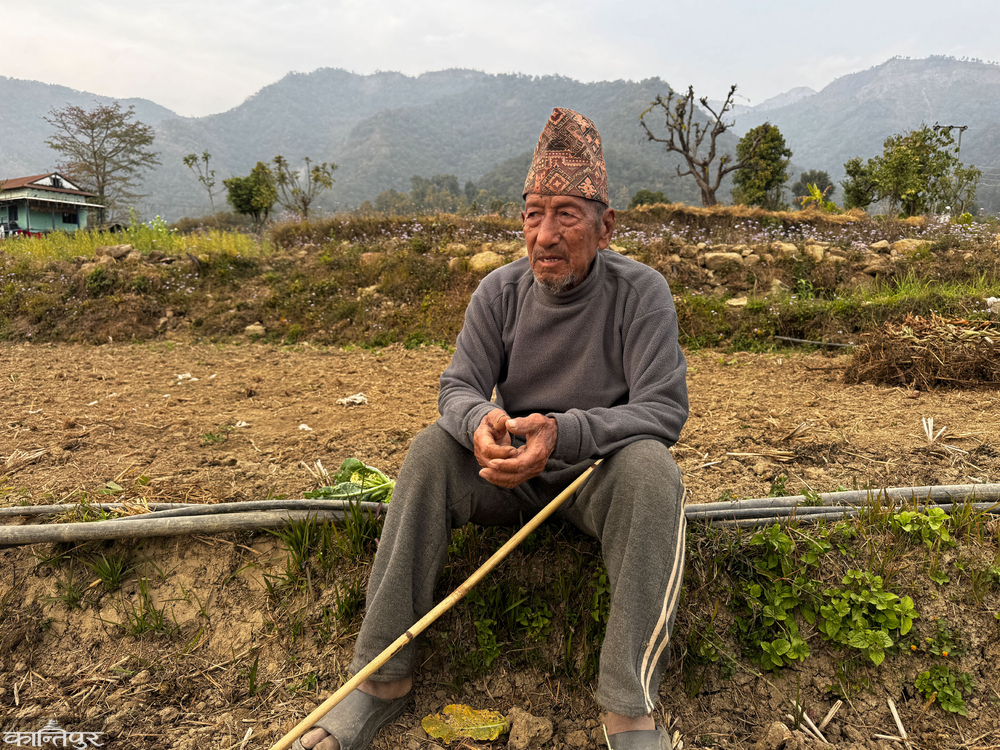
Krishna Bahadur Chhahari Magar, 84, of Kachalphant, Tinau Rural Municipality-1, has seen many elections. He has experienced not only the Panchayat, but also all the events including the 2046 BS movement and 2062/63 BS. He came to Kachal from Rainadevi Chhahara-4, Chhahara Aryaphan. Kachalphant was a place to keep 'Goth' or 'Pai'.
It was a practice to cultivate one field and take its produce to the lake to eat. In Kachalphant, which was in the former Fek village panchayat, the then late Lal Singh Bucha planned to irrigate a large field.
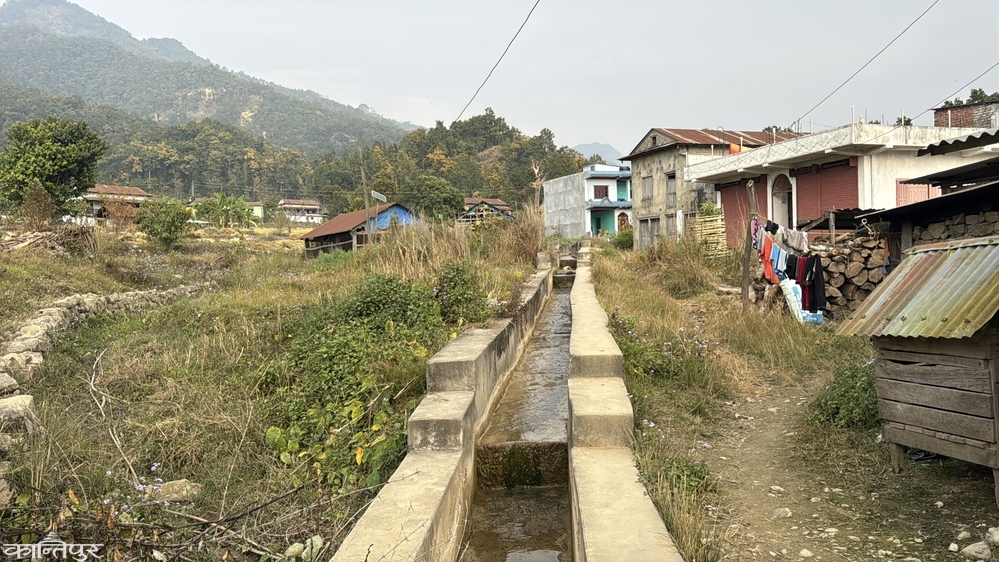
‘I know that he approached the king himself and made a request,’ he said, ‘In 2039, a plan of 3.5 crore rupees was planned by the then king’s order.’ Like the irrigation of Rampur and Chapakot, a plan was also planned for Kachalphant. In Chapakot and Rampur, the work was done from the source and was successful. In Kachalphant, the work was done from the lower area. He has experience of doing mischief by bringing water from rivers and streams. But recently, after 13.5 crore rupees were allocated at the initiative of former MP Hari Prasad Nepal and his wife Sita Nepal, he said that the work was done properly. ‘It has been three years since the water has been flowing well in the field,’ he said, ‘but no plan has been made for this matter.’
Chahari Magar, who was found in the field during the excitement of the House of Representatives elections to be held on Falgun 21, lamented the lack of election excitement. ‘I am also a Nepali citizen,’ he said, ‘There is no tradition of electing leaders who improve the living standards of the people. There are no conscious citizens. Who has worked for the poor? The Nepali people do not know them.’ According to him, the trend of creating ‘vote banks’ has prevented Nepal from developing.
As the conversation went on, he said that he had spent 35 years in India. Recalling that he had to be insulted and called a dog, he said, "It is sad that the people of the country of Everest, the country that has earned a name in the country and abroad, are still poor and unaware." Recalling that he spent a long time in India for a living, he has seen the last three/four elections well. Although he has voted many times in his life, he did not seem very excited about this election. "I do not even feel like voting," he said, shedding tears from his eyes, "All leaders are the same, we Nepalis do not know those who will develop the country and change the living standards of the poor."
 Not only Chhahari Magar of Kachal, but Krishna Prasad Dhakal of Ribdikot Rural Municipality-2 also has the same complaint. He said that he has voted for the same party for many years and complained that the living standards of the poor people are the same. ‘Leaders have been elected by voting for many years,’ he said, ‘Leaders have improved their living standards by going to Tansen, Butwal, Kathmandu. Who cares about us who live in villages?’
He said that it is difficult for farmers to maintain their living standards. He complains that any assistance/grants come to be close to their relatives and leaders. Industries have opened near the village. But after passing through the village, nothing but dust could be found. ‘No one listens to what we say,’ he said, ‘What can we do by voting? We should understand the situation of the country and the condition of the voters.’
He said that even the tea shops where the elders of the village used to chat were not as lively as they used to be. He said that in the past, when leaders did not generate income and employment as well as carry out development work according to the people’s wishes, there was a growing distaste for politics among the citizens. ‘In the upcoming elections, the villagers have become aware of voting without being pressured by anyone,’ he said, ‘This situation has been brought about by our leaders.’
Nowadays, there are not many young people in the village, only the older generation. This generation also expresses disappointment, saying that the leaders of political parties are interested in personal and family interests. Jwala Gautam of Ribdikot Rural Municipality-2, Deurali said that although they want development, employment, and changes in the agricultural sector in the village, they are disappointed because the leaders are interested in their own interests. According to her, the leaders of the old parties are expecting to be corrected. She understands that voters in rural areas are not seeing a situation where they will trust the faces of new parties immediately.
The largest number of those who have gone for foreign employment in recent years are from rural areas. According to the District Administration Office, Palpa, about 39 thousand youth are in foreign employment from Palpa. More than this population has reached India for employment. Gautam said that after there were no employment opportunities in their own villages and no other way to earn a living, citizens have turned to foreign employment as an alternative. There is no market management for the youth involved in vegetable farming, goat farming, and pig farming. The wave of Akbar chilli has come, but the local level has failed to manage its market. According to Ammar Bahadur Thapa of Deurali, if the living standards of the poor people were improved, employment arrangements were made in the villages, and initiatives were taken for enterprises and businesses, then the youth would have stayed in the villages. ‘After the elections, candidates of all political parties come to seek votes,’ he said, ‘I don’t know where they go at other times. There is no work to understand the condition of the people.’
This time too, the candidates have not brought an employment agenda. The people’s desire is to give jobs to those who bring the employment agenda, says Bipin Thadrai, a youth from Thimure. Palpa constituency number 2 has always been a constituency where new and old faces have been candidates in the elections. The Congress fielded Hari Prasad Nepal in 2048 and 2051 in the former constituency number 3 [currently 2]. Nepal won in 2048. In 2051, CPN-UML vice-president Bishnu Prasad Poudel won the election. In 2056, the Congress fielded old leader Bhagwat Dhawaj Rajlawat as its candidate. Yadav Bahadur Rayamajhi, who was fielded by the UML, won the election. In 2064 BS, the Congress fielded Hari Prasad Nepal and the UML fielded Kul Prasad Nepal. Kul Prasad, who was fielded by the UML, won the election.
In 2070 BS, the Congress won the election with Kul Prasad from the UML and Hari Prasad from the Congress. In 2074 BS, the UML fielded Som Prasad Pandey and the Congress's Hari Prasad Nepal as its candidates. The Left Alliance candidate Som Prasad won. In 2079, Thakur Prasad Gaire from UML and Pandey from CPN-UML were the candidates for the alliance, and Gaire was elected. In 2064, Kul Prasad Nepal from UML won by a narrow margin between UML, Congress and Maoists. In the remaining elections, UML and Congress are competing. This time, Som Prasad from Nepali Communist Party and Rastriya Swatantra Party are also seen as competitors in this area.
Gaire, who was defeated in the party's central secretary post and won the central member post in the general convention held in November last year, has become the candidate. This time, there was a tug-of-war over Gaire's ticket. The name of UML Vice-President Bishnu Prasad Poudel, who won the election in 2051 from the district, was the first recommendation. Earlier, the UML secretariat had given Poudel a ticket. After Poudel returned to his own area, the news broke that UML leader Ram Bahadur Raut from Area 2 got the ticket again. On the morning of Magh 6, the day of nomination, UML Lumbini Province President Radhakrishna Kandel had registered at the office of the Chief Electoral Officer at the first number after coming with a Gaire ticket. Even though the office of the Chief Electoral Officer had given time until 1 pm, he suddenly went to the first number and registered his candidacy.
The Congress has nominated District President Himal Dutt Shrestha as its candidate. The National Independent Party has nominated Madhav Bahadur Thapa, a former district member of the Congress. Candidates are worried whether voters will be in a position to choose new ones because old leaders have only talked. Recently, the minds of common voters have changed.
 Everyone is also afraid because voters have prepared a list of old works that old leaders have not done. Voters say that leaders who come with an agenda of improving the livelihood of poor citizens are their choice. ‘The leaders who won by voting in the past did not come to our house one day,’ said Sarishma Kumal of Rainadevi Chhahara Rural Municipality-3, ‘They never remembered us . Apart from roads, they could not do the expected work in the field of employment and development for the poor .’
Gaire, who was a candidate from CPN-UML in the 2079 election from Palpa-2, was elected as a member of the House of Representatives . Thakur Gaire defeated Som Prasad Pandey, the candidate of the Unified Socialist Party, a joint party of the Congress, Maoist Center and Rastriya Janamorcha. Gaire got 27,817 votes while Pandey got 23,851 votes . Their difference was 3,966 votes .
In that election, Som Prasad Gerai (Suman), the candidate of the National Independent Party, got 5,180 votes . In the previous elections, other parties and independent candidates were also in the fray. Looking at the results of the previous elections, it is seen that the competition will mainly be between UML, Congress, NCP and RSVP. According to the Office of the Chief Electoral Officer, Tansen Palpa, in Constituency No. 2, 14 political parties and 2 independent candidates are in the fray. According to the District Election Office, Palpa, there are 19,053 voters in Constituency No. 2.