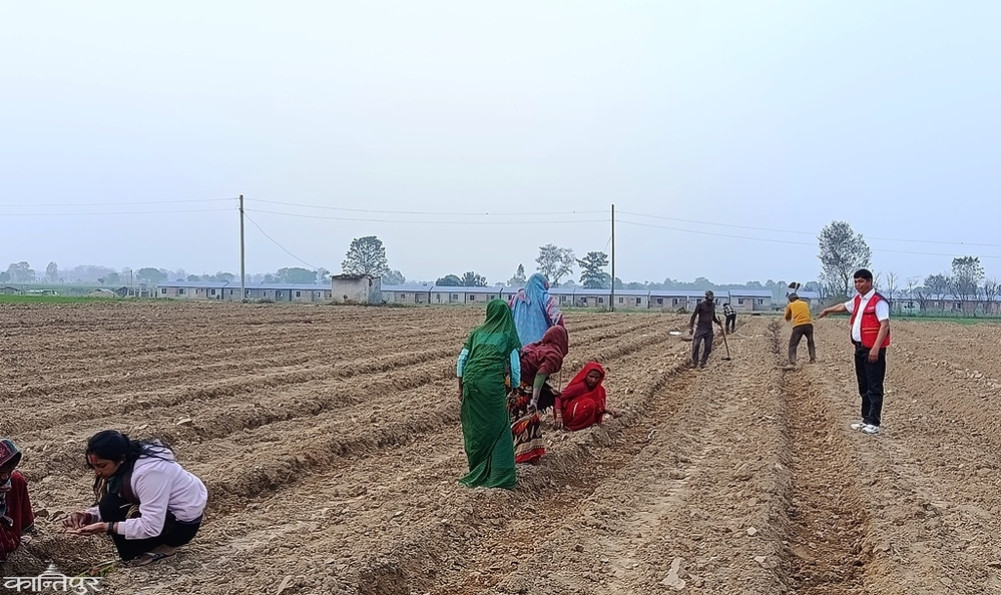
Biodiversity, conservation of rare wildlife, blackbuck, the country's longest Karnali River, Bardiya National Park, religious-linguistic diversity, food reserves, diverse religious tourist sites, religious-cultural, and tolerant society are also defining the identity of Bardiya.
We use Google Cloud Translation Services. Google requires we provide the following disclaimer relating to use of this service:
This service may contain translations powered by Google. Google disclaims all warranties related to the translations, expressed or implied, including any warranties of accuracy, reliability, and any implied warranties of merchantability, fitness for a particular purpose, and noninfringement.
Bardiya, known as the granary of western Nepal, is bordered by Banke to the east, Kailali to the west, Surkhet and Salyan to the north, and Bahraich district of the Indian state of Uttar Pradesh to the south.
There is an open border with India to the south of 82.8 kilometers. The total area of Bardiya is 2025 square kilometers. Of this, 68.76 percent of the land is occupied by the plains of the Terai, while 31.24 percent is occupied by the Chure Mountains. This district, which is dominated by the indigenous Tharu community, has ethnic and cultural diversity due to the recent increase in migration from outside districts.
Biodiversity, rare wildlife conservation, the country's longest Karnali River, Bardiya National Park, religious-linguistic diversity, grain reserves, various religious tourist sites, and a religious and culturally tolerant society are giving Bardiya its identity. Bardiya is also known as Bardiya by its tiger. However, due to the failure to properly manage wildlife, there are occasional incidents of loss of life due to wildlife attacks. In recent times, wildlife attacks have been increasing. Shiv Bahadur KC, Information Officer of the Division Forest Office, informed that 10 people have died in the district due to wild animal attacks from Shrawan to Magh of the current fiscal year.
Uma Bhandari of Gulariya Municipality-4 said that locals are losing their lives because the government has not taken concrete steps to reduce conflict between wild animals and humans. ‘The leopard is seen around the village every day,’ she said, ‘It is not possible to go out at night.’ It is risky to travel alone on the roads that pass through fields or forest areas during the day.
The people of this district are more involved in raising cows, buffaloes, goats and agriculture. Due to this, they are dependent on the forest. They are often attacked by wild animals while going to the community forest to get grass for cows, buffaloes and goats.
Conservationists say that it is necessary to introduce a program that allows residents of the park and buffer zone to earn income without depending on the forest. Due to the lack of forest, residents of the southern municipalities have to take risks and go to the Indian forest to graze their livestock.
The Jabdighat bridge connecting Gulariya and Barbardiya municipalities has been in a dilapidated state for a long time. Bikram Tharu of Barbardiya Municipality-6 said that they have been suffering due to the lack of reconstruction of the bridge. ‘Whenever we came to Gulariya for work, we had to pay the amount for crossing by boat in the morning and evening,’ he said. ‘After the said work was heavily criticized, we have stopped taking the amount from last Magh 15.’
This bridge has become an election agenda every time an election comes. On July 28, 2074, the Jabdighat bridge connecting Gulariya and Barbardiya municipalities collapsed before it was inaugurated. The 2079 Asoj 20 flood completely blocked the traffic when the span was washed away. Due to the failure to reconstruct the bridge, the residents of Barbardia are forced to take a risky boat trip to reach the district headquarters, Gulariya. The bridge was built by Pappu Construction Company.
The Babai, Bhada, Aurahi River Management Project was established in 2074 to reduce erosion and floods on the Babai River. However, the project office has been shifted from Bardiya since last Shrawan without completing the work. The Babai River Management Office has been shifted to Dadeldhura with 26 percent of the work remaining.
As the work for flood prevention has not been fully completed, Gulariya, the district headquarters of Bardiya, is at high risk of flooding from the Babai River in Barkha. The district headquarters Gulariya is at high risk of erosion and flooding after the work of the Babai, Bhada, Aurahi River Management Project established to reduce erosion and flood in the Babai River remained incomplete. The residents of this area are very worried after the office of the project, which has about 74 percent of the embankment work, was canceled.
Due to the lack of significant large industries here, young people are leaving for India and other Gulf countries without employment. Similarly, there are private investment in furniture, juice production, water, tiles, bricks, noodles, crushers and agricultural industries.
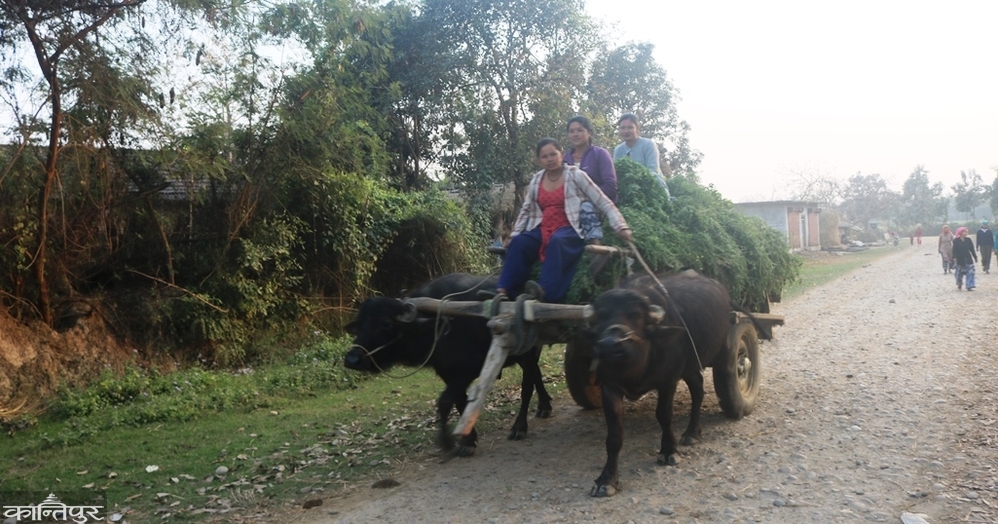
In recent times, the market has changed significantly due to the development of roads and other infrastructure. The district headquarters Gulariya Bazaar, Mainapokhar, Madhuban and Rajapur Bazaar have expanded more than before. Similarly, after the postal road from Gulariya to Nepalgunj was expanded to four lanes, settlements are increasing along the roadside.
As the settlement is getting denser, the general public is doing business by setting up small shops. Similarly, since Bardiya has flat land and roads reach most places, people are migrating from the hills. The main customs office of the district, Rajapur, is mostly deserted. After the construction of the road, the business at Khagrola customs office in Kailali has increased.
The issue of setting up a border checkpoint in Gulariya is a recurring issue in every election. When the then Prime Minister Madhav Kumar Nepal visited India on October 27, 2009, an agreement was reached under a bilateral agreement to set up a border checkpoint in Gulariya and Murtihama, India. The operation of the border checkpoint has been hampered for years due to the presence of a reserve in India. Devendra Pandey, President of the Gulariya Chamber of Commerce and Industry, said that the election issue of opening and closing the border checkpoint is always raised.
The main occupation of the residents of the district is agriculture. But the government cannot provide seeds, irrigation facilities and fertilizers to farmers when they need them. Balkram Lodh, a vegetable farmer from Gulariya Municipality-8, said that farmers are always disappointed when their production, which they have struggled to produce due to lack of resources, does not get a market and price. ‘The production made amidst shortages has not been able to get a market price,’ he said, ‘All the things we need here, including fertilizer and diesel for irrigation, are expensive.’ However, in neighboring India, all the things are available cheaply and the farmers there need less investment. Our production is often overshadowed by Indian vegetables that easily enter through open borders.’
Arun Tharu from Gulariya Municipality-5 said that farmers have always had a problem of not getting fertilizers during the season of cultivating rice, wheat and other crops. ‘The government cannot provide fertilizers to farmers,’ he said, ‘During elections, leaders come saying that they will solve the problems, but after winning, they forget the problems of farmers.’
The government has not come up with a concrete policy to attract youth towards agriculture, and the involvement of youth in this profession is decreasing. When some youth try to do commercial agriculture, the state has not been able to provide concessional loans. Similarly, due to the complicated process of loan and agricultural firm registration, youth do not try to get involved quickly.
The business of Gulariya has decreased drastically in recent times due to the cheap goods brought from the border market. The tax paid to the state has also decreased due to the lack of business by traders. Similarly, domestic traders have not been able to increase investment in their business. Due to this, the general public says that employment has not been created at the local level. Jayakumar Yadav, a gold and silver trader from Gulariya, said that the business condition is bad even though the Gulariya market has expanded significantly compared to before. ‘Even though the market has expanded, there is no business,’ he said, ‘Business has come to a standstill due to the increase in the price of gold and silver.’ Other businesses in Gulariya have also become a drain on the border market. When you wait in a shop all day, sometimes you don't even have a snack .
Bardiya has eight municipalities and 75 wards, including 6 municipalities and 2 rural municipalities. There are 36 candidates in both constituencies for the upcoming House of Representatives elections in Bardiya, which has two constituencies.
36 candidates, 21 in constituency number 1 and 15 in constituency number 2, have entered the election . According to the Census 2078, the district has a population of 459,900.
Constituency number 1 has 83,803 males, 84,227 females, and 168,034 voters, including 4 others . According to the District Election Office, there are 75,584 males, 79,646 females, and 155,232 voters, including 2 others, including 2 others, including 2,232 voters, in the district, there are a total of 323,266 voters.