The root causes of Nepal's conflict were complex and multifaceted. Inequality of political, socio-economic, and cultural opportunities among different identity groups, the lack of effective governance, and the lack of social justice exacerbated tensions.
We use Google Cloud Translation Services. Google requires we provide the following disclaimer relating to use of this service:
This service may contain translations powered by Google. Google disclaims all warranties related to the translations, expressed or implied, including any warranties of accuracy, reliability, and any implied warranties of merchantability, fitness for a particular purpose, and noninfringement.
Three communist parties that believed in Mao's ideas, policies, and programs formed the CPN Unity Center. The United People's Front became its political front. They demanded revolutionary change through a people's movement and that decisions regarding the 'monarchy' should be made through Constituent Assembly elections.
But the 2046 movement was suspended after the Congress and the United Left Front rejected it and reached an agreement on constitutional monarchy and multi-party democracy through a power-sharing agreement. General elections were held in 2048. Despite being dissatisfied, the CPN-U participated in the elections. Winning 9 out of 205 seats, it became the third largest party after the Congress and the CPN-M.
On 21 Magh 2052, under the name of the United People's Front, the Communist Party of Nepal (Maoist) presented 40-point demands to the then Prime Minister Sher Bahadur Deuba and warned that if they were not addressed within 15 days, they would start a 'people's war'. The government did not take the demands seriously. After the Prime Minister left for a visit to India, the Maoists launched an armed conflict on 1 Falgun 2052 by attacking the Holeri police station in Rolpa and the Thibsikot police station in Rukum.
The 12-point agreement laid the foundation for peace talks, an end to the armed conflict and the establishment of a federal democratic republic. By unifying all political forces, the country was finally moved forward on the path of a republic with the peace process and the end of the monarchy. According to the data of the then Ministry of Peace and Reconstruction, more than 17,886 people lost their lives in this conflict. Economic and social development was disrupted, property worth billions of rupees was destroyed, insecurity and fear spread, human rights violations increased and social relations weakened. It seriously damaged the governance structure and process of the multi-party system established by the political change of 2047.
The CPN Unity Center had formed the CPN (Maoist) in 2051 BS with the aim of bringing about political and economic change in the Maoist framework and formally launched the 'People's War'. But since the state side could not properly assess and analyze the conflict, the wrong strategy was adopted. On top of that, the direct intervention of the king from 18 Asoj 2059 further complicated the situation. This transformed the bilateral conflict between the Maoists and the parliamentary parties into a tripartite one between the king, the parliamentary party and the Maoists. After 19 Magh 2061, it again changed into a bilateral polarization between the Maoists and the parliamentary party against the king.
The long-standing poverty, inequality, social and political exclusion, gender discrimination, caste discrimination, corruption and the weak governance style of the multi-party system established in 2047 in the country prepared the ground for the expansion of the conflict. The Maoists adopted the strategy propounded by Mao Zedong in conducting the armed conflict, which included the party (the work of ideology and policy formulation), the people's army (the work of defending and attacking the controlled area) and the united front (the work of expanding the support base). The integrated mobilization of these three structures strengthened them organizationally and strategically. Due to this, the Maoists were able to expand their influence.
Causes of the Maoist Armed Conflict
The Maoist conflict can be interpreted from various perspectives. Based on conflict analysis, it was a violent expression of popular discontent! From a security perspective, it was a serious challenge for the state and society! From a political perspective, it was a struggle to control state power! And from a sociological perspective, it was a violent attempt to bring about social change and transformation by breaking down the structure of poverty, inequality, and injustice that had been entrenched for hundreds of years.
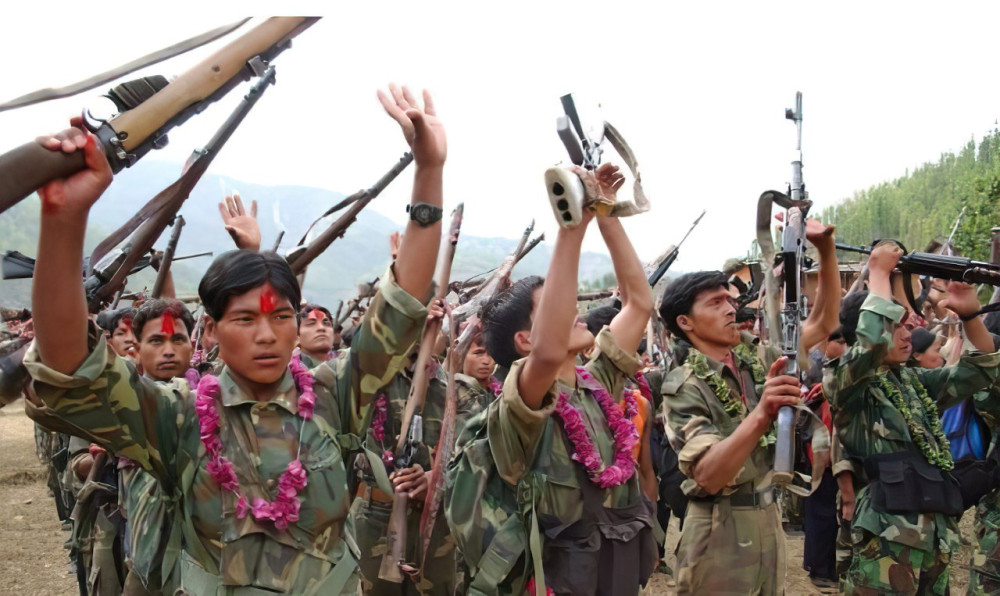 The failure of the multi-party democracy restored in 2047 was not the only cause of the Maoist conflict. It was also the result of about 240 years of exploitation, discrimination, and the continuous influence of the state structure. The failure of the changes after 2046 to meet the expectations of the people, the spread of misrule, and the civil liberties granted by the constitution to provide an opportunity for discontent to organize openly—all of these contributed to the conflict. Corruption, impunity, politicization and abuse of state machinery, and monopoly control over resources by a limited ruling group weakened the foundations of democracy, which the Maoists strategically exploited to expand their armed conflict. The multi-party system empowered citizens and provided them with opportunities to organize, demand rights, and resist.
The root causes of Nepal's conflict were complex and multifaceted. Inequality of political, socio-economic, and cultural opportunities among different identity groups, lack of effective governance, and lack of social justice increased tensions. The failure of the existing governance system to address inequality increased the potential for social conflict and violence, which was clearly seen in Nepal.
1. Structural (socio-economic) causes: Poverty, unemployment, discrimination based on class, caste, gender, and geography, centralized and power-oriented corrupt governance, limited access and control of production resources, and exclusion of poor and marginalized communities from basic services.
2. Ideological reasons: The extreme ideological training of the CPN (Maoist) leadership, distrust of the parliamentary system, ideological ambiguity and support from international communist groups like RIM, Sikomposa, Mao's strategy created an interest in alternative politics among the people and on the other hand, ambivalence among the common people.
3. Geographical reasons: Long-term neglect of remote and backward areas and excessive concentration of resources in accessible urban areas.
4. International reasons: The growing interest of powerful countries, especially India, the United States, the United Kingdom and the European Union, in Nepal (political, economic, natural resources-water, historical monopoly, religious, strategic and military aspects).
The change in the global security dimension and responsibility after the terrorist attacks on September 11, 2001 in the United States, the interest of influential external economic institutions such as the World Bank, Asian Development Bank and International Monetary Fund, the increasing role of international NGOs in the movement and extremism, and the changing international response and environment after the direct rule of the king after Magh 19, 2061.
5. Natural resources and environmental causes: Population pressure on environmental resources, destructive use of natural resources and increasing damage, lack of access to natural resources by poor and marginalized communities, unequal distribution of land, decline in productivity and exploitation of people dependent on natural resources by the elite.
6. Inefficiency of governance: Politicization of bureaucracy and security apparatus, institutionalization of non-performance and negative culture among employees, vested interests of the powerful (both political and personal), rampant corruption, misgovernance, growth of nepotism and cronyism, strategy of the palace and political parties to use armed conflict as a means of gaining power, failure in development and policy framework that benefits certain classes more.
7. Catalytic factors: The palace massacre of 19 Jestha 2058, failure of the leadership of political parties, direct intervention of the king in active politics after 18 Asoj 2059, sense of revenge and vengeance as a psychological factor and the impact of the terrorist attacks on September 11, 2001 in the United States.
8. The King's seizure of power on Magh 19, 2061: Former King Gyanendra's desire to control politics and society, abuse of power and authority and monopolistic centralization, misinterpretation of democracy and distortion of policies and regulations, control over civil liberties, restriction of socio-economic, political, cultural and religious freedoms and rights, rejection and misinterpretation of pluralism, multi-ethnicity, multiculturalism and religious identity.
Establishment of unconstitutional mechanisms such as the Royal Commission to Control Corruption, appointment of regional administrators and politics of revenge, creation of an environment of fear, intimidation and insecurity for those who do not support his rule and attempts to prevent change and reform in the name of national unity.
Thus, the combined effect of structural inequality, ideological polarization, weak governance and political interference led to the expansion and long-term development of armed conflict in Nepal.
Peace Process and Armed Conflict Management
For the first time, informal talks were held in Kathmandu between Ram Chandra Poudel on behalf of the government and Rabindra Shrestha on behalf of the Maoists under the facilitation of Padmaratna Tuladhar. Then, on 22 Poush 2056, the Krishna Prasad Bhattarai government formed the ‘High-Level Mechanism for Resolving Maoist Problems’ under the coordination of Sher Bahadur Deuba.
This committee presented a report with the conclusion that the Maoist armed conflict was political in nature and was more related to the weakness of state governance, poverty, inequality and exclusion than to the failure of democracy, so a solution should be sought through governance and socio-economic reforms and that talks should be held with the Maoists for the time being.
As agreed, a ceasefire was declared on 25 Shrawan 2058 and a negotiation team was formed. Chiranjeevi Wagle was the coordinator and Mahesh Acharya, Narahari Acharya, Vijay Gachhadar and Chakra Bastola were members on behalf of the government, while Krishna Bahadur Mahara was the coordinator and Agni Sapkota and Top Bahadur Rayamajhi were members on behalf of the Maoists. The facilitators of the talks were Damannath Dhungana and Padmaratna Tuladhar. The first phase of the peace talks was held at Godavari Resort and the second phase at Thakurdwara in Bardiya.
However, the talks could not be successful due to the Maoists' stance that 'the process of institutionalizing the republican system should be started immediately'. After that, the Maoists broke the ceasefire and declared a national people's government and launched military attacks on various places including Dang, Syangja, Solukhumbu on the night of November 21. In response, the king declared a state of emergency on November 11, 2011, and declared the Maoists and their sister organizations as 'terrorists'. In addition, nine autonomous provinces were established and the militants were expanded.
After the signing of the code of conduct, a ceasefire was declared on January 15, 2059, and the government led by Lokendra Bahadur Chand formally started the second peace talks at the Shankar Hotel in the capital. The facilitators of the talks were Damannath Dhungana, Padmaratna Tuladhar, Shailendra Kumar Upadhyay, and Karnadhwaj Adhikari, while the Maoist side was led by Baburam Bhattarai. The second phase was completed on April 20, 2060, and the third phase was completed in Hapure village in Dang. But while the talks were going on from 30-32 Shrawan 2060, the ceasefire was broken on Bhadra 10 after the 'Doramba incident' in which Maoist activists and supporters were killed by security forces in Doramba, Ramechhap.
The situation changed after the king assumed power on 19 Magh 2061. After a 12-point agreement between the seven parties and the Maoists, the restored House of Representatives paved the way for the Constituent Assembly elections, released imprisoned leaders, and reduced the powers of the king and made the parliament the supreme body. Then, a government negotiation team was formed under the leadership of Home Minister Krishna Prasad Sitaula and the Maoists appointed Krishna Bahadur Mahara as the coordinator. On Jestha 12, the first round of meetings were held at Gokarna Resort and a 25-point ceasefire code of conduct was issued to make the Constituent Assembly elections positive.
After Prime Minister Girija Prasad Koirala's visit to India, an agreement was reached to seek the help of the United Nations in monitoring the management of Maoist weapons. The government withdrew the cases against Maoist leaders and released the prisoners. The second round of talks concluded on Asad 1 and a decision was made to form a 31-member monitoring committee. The high-level talks held on Asad 2 agreed to an interim government, an interim constitution, elections to the Constituent Assembly, and to seek UN assistance in arms management.
In the later stages, agreements were reached to convert the House of Representatives into an interim parliament, include the Maoists, extend the ceasefire period, and increase UN involvement in the peace process. The Maoists insisted on keeping the fighters in camps but not completely disarming them. The draft of the interim constitution was prepared, the date for the Constituent Assembly elections was set, and the ceasefire period was extended again.
Finally, on Kartik 21, a six-point agreement was reached, ending the decade-long armed conflict and paving the way for long-term peace. मंसिर ५ गते विस्तृत शान्ति सम्झौतामा हस्ताक्षर भई माओवादी लडाकुहरूलाई शिविरमा व्यवस्थापन गर्ने सहमति भएपछि शान्ति प्रक्रियाले औपचारिक रूप लियो ।
शान्ति स्थापनामा राजा ज्ञानेन्द्रको भूमिका
संवैधानिक राजतन्त्र स्वीकार गरेपछि पनि ज्ञानेन्द्र शाहले २०६१ माघ १९ मा सत्ता आफ्नै हातमा लिएर बहुदलीय व्यवस्थालाई असफल साबित गर्न खोजे । राजनीतिक दलका नेता नजरबन्दमा परे, नागरिक स्वतन्त्रता संकुचित भयो र दमनकारी शासनशैली अपनाइयो । यस कदमले लोकतान्त्रिक शक्तिलाई कमजोर बनाउने उद्देश्य देखियो, जसका कारण दलहरू र माओवादी एकै मोर्चामा उभिए ।
फलस्वरूप सात दल र नेकपा (माओवादी) बीच सहकार्य बढ्दै जनआन्दोलन–२ सुरु भयो । समाजका सबै वर्ग र पेसाका नागरिकहरू अहिंसात्मक आन्दोलनमा सहभागी भई निरंकुश शासनविरुद्ध उभिए । १२ बुँदे सहमतिले शान्ति वार्ता, सशस्त्र द्वन्द्वको अन्त्य र संघीय लोकतान्त्रिक गणतन्त्र स्थापनाको आधार तयार गर्यो ।
यसरी राजतन्त्रको केन्द्रीकृत र दमनकारी हस्तक्षेपले एकातर्फ द्वन्द्व चर्कायो भने अर्कोतर्फ सबै राजनीतिक शक्तिलाई एकताबद्ध बनाउँदै अन्ततः शान्ति प्रक्रिया र राजतन्त्रको अन्त्यतर्फ देशलाई अघि बढायो । इतिहासमा पृथ्वीनारायण शाह र महेन्द्र शाहले राष्ट्र निर्माण र विकासमा भूमिका खेले पनि पछिल्ला शासकहरूको अलोकतान्त्रिक प्रवृत्तिले अन्ततः २४० वर्षे राजतन्त्रको अवसान गरायो ।

