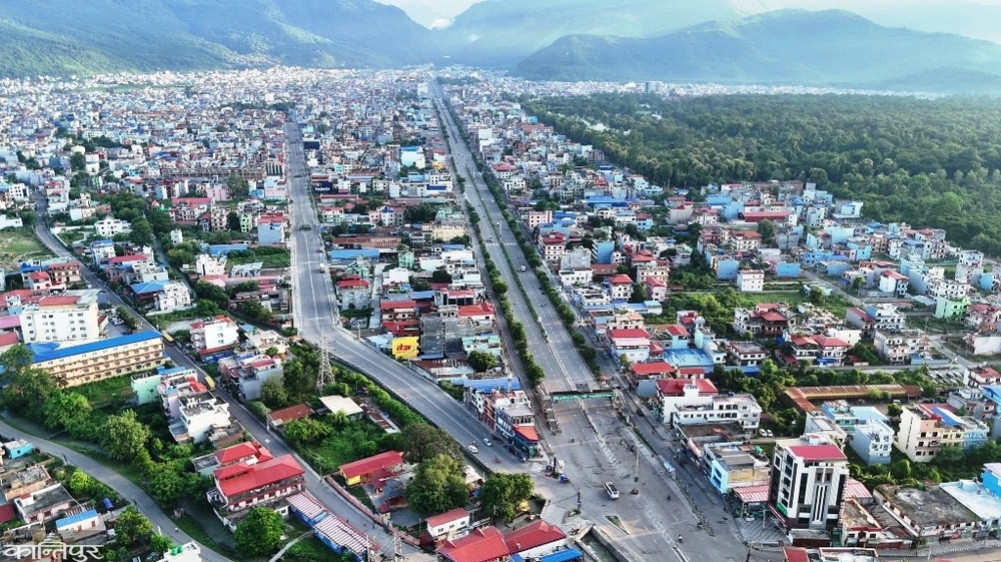
Despite positive indicators in many infrastructure areas, the problem of drinking water continues to grow for the citizens of Butwal and the southern region. The Jhumsa drinking water project, which has been a constant election slogan of political parties for the past 15 years, has not yet been completed.
We use Google Cloud Translation Services. Google requires we provide the following disclaimer relating to use of this service:
This service may contain translations powered by Google. Google disclaims all warranties related to the translations, expressed or implied, including any warranties of accuracy, reliability, and any implied warranties of merchantability, fitness for a particular purpose, and noninfringement.
Rupandehi, a fertile land for agricultural production 20 years ago, has recently become a center of economic development. Cultivable land is being transformed into a city. The infrastructure construction, education, health facilities, and rapid migration that have taken place in the last decade and a half are changing the identity of Rupandehi.
Rupandehi is becoming a major destination for industry, trade, education and health in Lumbini Province. It is transforming the fertile land of agricultural production into a center of employment and opportunity. With the development of industry and trade, the number of people migrating from the hilly districts of this region to Butwal and Bhairahawa in search of opportunities is increasing.
The infrastructure necessary for urban development in Rupandehi, from roads, bridges, electricity, water, irrigation, health, education, air transport to easy border crossings with India, is sufficient. The development of the tourism sector and the establishment of large industries are creating employment and opportunities. In the last 10 years, the number of families migrating to Rupandehi from the hilly districts of Lumbini Province, along with Gandaki, Karnali and Sudurpaschim, has exceeded 21,000. In the last fiscal year, more than 1,400 families from Tilottama Municipality alone have migrated to Rupandehi. According to the National Census 2078, Rupandehi is the second largest district in terms of migration across the country after Bhaktapur. The main reason for this is the potential for opportunities seen with the development of infrastructure and the establishment of large industries.
15 years ago, there was no option but to cross the Tinau Bridge on the Mahendra Highway to reach Butwal from the former Motipur and Semlar. That is why many called Motipur and Samelar the 'darkness under the lights' of Butwal. Infrastructure development has also taken a leap forward in the southern area of Rupandehi compared to before. The bridges built on Rohini and Ghodaha rivers have shortened the distance between Butwal and Bhairahawa. There was also no bridge to reach Butwal from Farsatikar. Even when coming via Tamnagar, the Danab River would become stagnant during the rainy season. Locals from Sainamaina had to walk through Tamnagar to reach Semlar. There too, the Danav River was an obstacle. There was no alternative to the Tinau Bridge from the west to reach Manigram and Thutipipal. But now, the residents of Motipur and Semlar consider the Tinau Bridge an 'alternative' to reach Butwal. Because more than a dozen bridges have been built every 1 kilometer of the Tinau and Danav Rivers to connect Semlar and Motipur to Butwal.
According to 72-year-old Kajiman Thapa of Buddhanagar, Butwal Sub-metropolitan City-11, 15 years ago, there was no alternative to the Mahendra Highway bridge to reach Butwal from Buddhanagar. You had to go around for half an hour. 'The Tinau used to flood from time to time.' At that time, it took half an hour to reach Butwal using the bridge on the Mahendra Highway,' he said, who has been living in Buddhanagar for 26 years, 'but, now, after the bridge was built in Devinagar in Tinau, Buddhanagar and Butwal have become a single market.'
The Belbas-Bethari road is also in the final stages of construction. According to the Road Division Office, Butwal, more than 20 bridges have been built in Tinau, Danab, and Rohini alone in the last 15 years. After the construction of these bridges, the daily life of the citizens there has changed. Now, farmers from Manpakadi, Farsatikar, and Chhapiya can come to Butwal in the morning to sell fresh vegetables and return home for food.
According to Ramnaresh Lodh of Manpakadi, who comes to Devinagar Haat Bazaar in Butwal to sell vegetables weekly, the road and bridge have changed the situation of the village. More than 100 youths have started farming in places like Manpakadi, Farsatikar, Motipur, Bhata and others to sell at weekly markets held in various places including Butwal. ‘After the construction of the bridge and road, there have been more than 100 farmers cultivating vegetables in the village,’ he said. ‘We, 7 of us, take the vegetables they produce to various markets throughout the week and sell them. This has increased both our income and the farmers’ value.’ He said that 100 farmers are earning at least 1.5 million per week.’
Till 10 years ago, 69,600 hectares of land in Rupandehi was used for paddy cultivation. 450,000 metric tons of paddy was produced. More than 30,000 metric tons of wheat, mustard, pulses and vegetables were grown. However, 8,000 hectares of land have been turned into barren in 10 years. Now houses have been built on cultivable land. Settlements have developed and become markets.
According to Vivek Pant, Senior Agricultural Extension Officer of the Agricultural Knowledge Center Rupandehi, Rupandehi was known as the granary of Nepal till 20 years ago. The district, which has irrigation facilities, tropical climate, hardworking farmers and ample cultivable land, contributed 31.7 percent to the country's gross domestic product and 60.2 percent to the employment-generating agricultural sector. 'However, now the same agriculturally productive district is being developed as a concrete city of late,' he said. 'The areas of Shankarnagar, Makrahar, Anandavan, Devdaha, Semlar, Motipur, Khadwa and Banagai, which are considered to be highly productive areas, have run out of cultivable land and have become cities.'
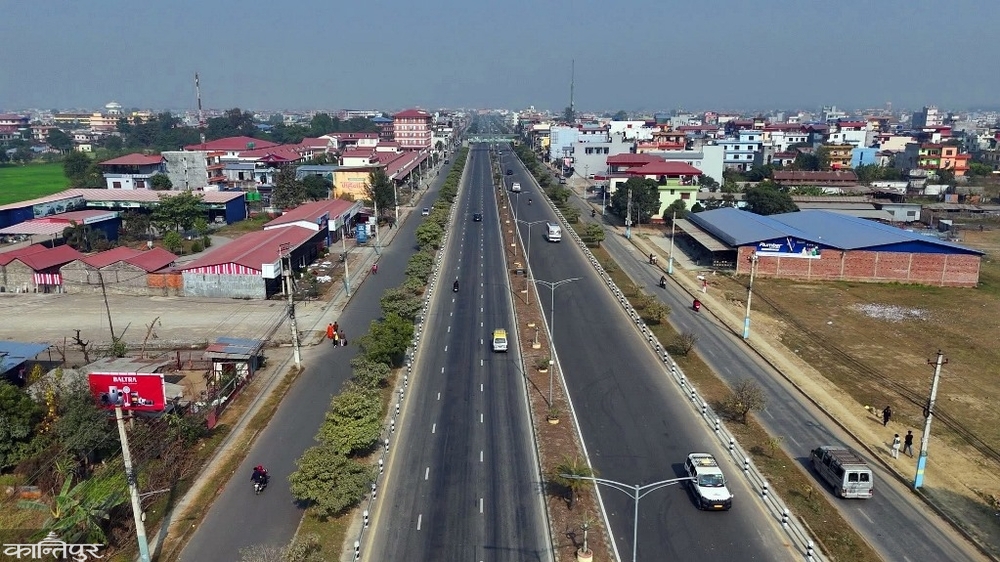
He said that in the last 10 years, about 17,000 hectares of land have become unused. Out of the 141,367 hectares of land in the district, 58.45 percent or 82,622 hectares of land is cultivable. The Butwal-Bhairahawa 7-lane model road has recently become the main road for settlement development on cultivable land. Just as this 6-lane road has become a model in the country with its wide road, greenery on the sides, lights on the divider in the middle, and Buddha statues. In the same way, it is also becoming a helper for the construction of concrete buildings by clearing cultivable land.
After Tilottama Municipality installed electric lights on the inner roads of the city and launched the 'Green Tilottama, Clean Tilottama' campaign on the highway, the attraction for settlement development and establishment of industries in this area increased. The attraction of the municipality for settlement development and industry establishment has increased in this area. The two campaigns of the municipality have truly made the Butwal-Belahiya road a model road in the country, which has helped in settlement development, said Basudev Ghimire, former mayor of Tilottama Municipality. ‘The campaign to make Tilottama ‘Clean Tilottama, Green Tilottama’ has also made the 6-lane road of Butwal beautiful,’ he said, ‘The growing urban development and establishment of large industries in Tilottama is also the attraction of the road.’
More than a dozen industries are opening on both sides every year based on the Butwal-Belahiya road. The young generation has awakened to commercial agriculture. Business has increased. The fields three/four kilometers east and west of the road are green with agricultural products. In Tilottama Municipality alone, which has moved forward with rapid development by placing the Butwal-Belahiya road in the central part, more than 1,000 youth have established industries for commercial agriculture and diversification of agricultural products. Some industries are under construction. More than 3,000 people have found employment in various industries.
This road has also become a major support for the industry that produces up to 100,000 liters of milk daily and also diversifies it and sends it to other cities of the country. There are more than 200 farmers raising more than 100 commercial cattle and buffaloes on both the east and west sides of the road. After the expansion of the width of the road at a cost of nearly 8 billion, the economic situation of Butwal and Bhairahawa has changed. This road has given Butwal the identity of an 'economic hub'. A dozen large and five-star hotels with investments of billions have opened around this road.
The Butwal-Narayangadh road section is being expanded to 6 lanes at a cost of nearly 17 billion. An international conference center has been built on the side of the same road in Ramnagar, Butwal with an investment of more than 2 billion. There is an exhibition ground next to it. Apart from that, the Lumbini-Bhairahawa postal road section of Parasi has made it easier for tourists coming by land via Belahiya to reach Lumbini quickly. SEZ, Bhairahawa checkpoint and other areas have made it easier for industrialists. The work being done by proposing the Motipur area as an industrial zone is also adding enthusiasm to industrialists and businessmen.
Rupandehi has also made progress in air transport. Gautam Buddha International Airport has been constructed in Bhairahawa and flights have started. However, tourism entrepreneurs are disappointed as flights have not yet been able to operate as intended. The tourism business is also growing due to the development in infrastructure. The Bhairahawa-Lumbini road has added facilities for tourists coming to Lumbini. The master plan of Lumbini, which was started 42 years ago, is in the process of being completed. More than two million tourists visit Lumbini annually. The number of foreign tourists is large.
Six 5-star hotels targeting tourism are in operation in Lumbini, Bhairahawa and Butwal, the birthplace of Buddha. Other small hotels are also increasing their investment. Lekhnath Bhandari, former president of the Hotel Entrepreneurs Association, Butwal, said that Rupandehi has reached a point where it can provide quality services to more than 2 million foreign tourists annually. ‘There has been an additional investment of Rs 25 billion in the hotel business here alone,’ he said, ‘and that is still continuing.’ Two cable cars are in operation in Butwal from the private sector. The tunnel route, which is in the final stages of construction in Siddhababa near Butwal, has also added attraction to Butwal’s tourism business.
Butwal is also becoming a center for health. The former Lumbini Provincial Hospital is being expanded to 1,200 beds at a rapid pace at a cost of Rs 7 billion. Patients from Lumbini Provincial Hospital, as well as from Gandaki and Karnali provinces, come for treatment at Lumbini Provincial Hospital. More than 300 patients come for OPD services at Lumbini Provincial Hospital every day. Patients from Sunauli and Gorakhpur in India also come. The process of establishing a medical college has moved forward at the government level in Tilottama. Preparations are underway to operate a community heart hospital in Tilottama. A separate building is being built at Lumbini Provincial Hospital for the treatment of cancer.
Butwal is also becoming excellent in education. Government-level Kalika Manav Gyan, Shanti Namuna, Kanti, Navin Udyog Kadar Bahadur Rita Mavi are making a name for themselves as excellent schools in the country. From engineering to Buddhist education, classes are also being taught in Butwal. Lumbini Buddhist University is conducting classes in various disciplines.
A substation has been built for the electricity transmission line in Mainhiya in Siyari Rural Municipality of Rupandehi for electrification. Through this substation, the Mainhiya-Sampatiya 132 kV double circuit transmission line has been expanded by connecting it to the Sampatiya (New Nautanuwa) substation in Uttar Pradesh, India, and electricity export has begun. Butwal-Chandrauta road expansion is ongoing. Work on the construction of a model signature bridge on the Tinau River has progressed.
An industrial area is being built on about 1,000 bighas in Motipur. Previously, the industrial area established in Butwal in 2032 BS on an area of 434 ropanis has more than 74 industries operating in the industry including plastic, grill, cable, shoes, slippers, coolers, soap, dairy products, rope, chocolate, etc.
According to Mohan Pariyar, Officer and Information Officer of the Cottage and Small Industries Office, Bhairahawa, since 2071, 12,318 industries, both small and large, have been registered and operating in Rupandehi alone. Those industries have provided direct employment to 53,032 people. ‘39,280 men and 13,752 women have found employment,’ he said, ‘only 476 industries have been registered till the beginning of the current fiscal year.’ He said that 577 young entrepreneurs have been prepared from those industries. According to the office’s records, only 1.33 billion rupees have been invested in industries with an investment of less than 50 million rupees.
The Economic Development Zone SEZ in Bhairahawa has increased the attraction of investors. As the investment possibilities for economic development increase, the number of ‘A’ class banks and financial institutions has increased in Rupandehi. Prakash Poudel, Chief Executive Officer of Sain Resunga Development Bank, said that Rupandehi is developing as an economic hub. ‘The rate of investment in Rupandehi is increasing rapidly,’ he said, ‘It is also creating employment and opportunities for the citizens.’ According to the data of the National Bank, 755 financial institutions of ‘A’ category conduct financial transactions in 12 districts of the province. Of these, 229 are in Rupandehi alone.
Rupandehi, which has a population of 121,957, has 334 financial institutions, including 77 of ‘B’ category and 28 of ‘C’ category. One financial institution is providing services to 3,350 people. The literacy rate of Rupandehi is 81.23 percent. The number of people below the poverty line in Rupandehi was 25.2 percent in 2068, while according to the 2078 census, it is 20.27 percent.
Although many infrastructure indicators are positive, the problem of drinking water is increasing for the citizens of Butwal and the southern region. The Jhumsa drinking water project, which has been a constant election slogan of political parties for 15 years, has not yet been completed. The parties have been sharing the dream of the Jhumsa drinking water project with the people of Butwal for almost 15 years. Even now, political parties are giving false assurances that the Jhumsa drinking water project will be completed. Due to the incomplete project not being completed, the people of Butwal are forced to drink dirty water during the rainy season.
Sita Bhandari, a consumer of Laxminagar, Butwal Sub-metropolitan City-4, said that the Jhumsa drinking water project is a 'gift of dreams' for the people of Butwal. She is a member of the local Laxmi Tol Bikas Sanstha. ‘Leaders are still asking for votes saying they will bring drinking water from Jhumsa, people are not in a position to trust them now,’ she said, ‘Jhumsa drinking water has become like a dream gift for the people of Butwa.’ She suggests that if the drinking water problem is solved, there will be no other major problems and employment will be created.
Similarly, complaints about the service delivery of the Land Revenue, Transport Management Office in Rupandehi and the Tourism Information Center in Belahiya remain the same. Service recipients have said that they have to face delays, unnecessary hassle and frustration from the employees. There is a complaint that the area administration cannot make national identity cards on time.
Rajesh Sunar of Malika Rural Municipality-2 Darling in Gulmi complained that it took 2 days to get his vehicle registered from the Transport Management Office. He complains that two days were spent on work that should have been done in one day, saying that the file was not found. ‘That is how our vehicle file management is at the transportation office,’ he said, ‘the employees themselves hide the files and then make us feel sad when they say they can’t find them.’ He claims that the employees are annoyed when files that were not found the previous day are found there again the next day. He said that if a job that is done in one day takes two days, it will cost an individual more than Rs 5,000.
Former deputy mayor of Butwal Sub-metropolitan City Gomadevi Acharya said that despite sufficient efforts in the infrastructure development of Rupandehi, citizens are still not satisfied. She explained that the lack of a stable government and policy-related problems have led to problems such as the management of landless people for years, the problem of drinking water in Butwal, delays in government offices, and unemployment. ‘It seems that the infrastructure development in Rupandehi is sufficient,’ she said, ‘but, there needs to be a planned development of software work, now that is the interest and demand of the citizens.’ She said that the current candidates also need to pay attention to improving service delivery, cumbersome procedures in government offices, and improving the behavior of employees.
Although the structures and infrastructure of large market-oriented development such as Butwal, Bhairahawa, Lumbini, Sainamaina, Murgiya, and Devdaha in Rupandehi are increasing, rural areas such as Marchwari, Kotahimai, Sammarimai, Majhagaon, and Manjhariya in the southern part of the Indian border area still lack infrastructure. There are problems with roads and drinking water in those areas. There is a compulsion to reach Indian markets and Bhairahawa for health. Even though it is a major area of agricultural production, farmers always have problems with irrigation and fertilizer.
Former chairman of Kothimai Rural Municipality Chandra Bhushan Yadav said that the federal and provincial governments have not yet paid attention to the villages of Marchwar, Kothimai, and Sammarimai in this area. ‘There is a shortage of drinking water, roads, and electricity here, there are not enough facilities,’ he said, ‘Although many people here are farmers by profession, there is a big problem with fertilizer. The government never provides it. The police harass us when we bring it from India.’ He said that although he had brought many plans to the center when he was the head of the local government, they have not been completed yet.
Rammangal Pal, 28, a businessman from Majhagaon, Kothimai Rural Municipality-5, said that even the roads in the village have not been properly constructed. Most of the roads are unpaved. He said that the entire road gets submerged during the rains and becomes a problem when it becomes dusty in the winter. "No matter how much development we talk about, we are in the most remote part of Rupandehi," he said. "Leaders say that everything has been developed, but Kotahimai, Marchwari, and Sammarimai in the southern region are the most backward areas." He complains that leaders who come during elections talk big about development, but do not return after winning. River erosion is another problem in Rupandehi, where the Tinau, Rohini, and Danab rivers are located.