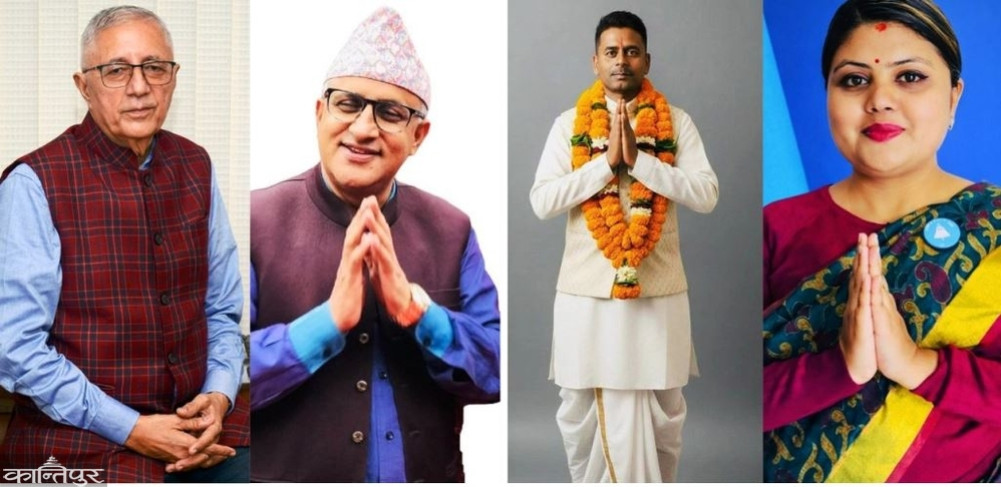
In this region, where representatives are frequently changing, voters seem to be more focused on leaders who can solve their daily problems than on party names.
We use Google Cloud Translation Services. Google requires we provide the following disclaimer relating to use of this service:
This service may contain translations powered by Google. Google disclaims all warranties related to the translations, expressed or implied, including any warranties of accuracy, reliability, and any implied warranties of merchantability, fitness for a particular purpose, and noninfringement.
The election atmosphere is currently engulfing the villages, toll plazas and city markets of Morang's Constituency No. 6. From tea shops to bakeries and from chowks to squares, the discussion is on, 'Who will we vote for this time?'
In this area, where representatives have been changing frequently, voters seem to be more focused on leaders who can solve their daily problems than on party names.
Since 2048, voters in Morang-6, which has experienced seven general elections, two Constituent Assembly elections, and one by-election, have cast their votes eight times. Except for one of them, a different representative has been changed every time. In this area, which has 137,832 voters, the debate on ‘Should we change again or keep it this time?’ has become common.
In this area, which is connected to the Biratnagar metropolis, employment, inflation, the problem of squatters, waste management, health services, and the future of the youth have become the main issues. Local voters complain that past elected representatives have not changed their living standards despite making big promises through speeches. ‘Leaders come, ask for votes, but they are not seen after winning,’ says a Biratnagar-5 resident. Sita Devi Mahato, a vegetable shopkeeper, expressed her sorrow, saying, "Leaders forget after voting."
While youth working in the industrial sector are raising issues of job stability and wages, slum dwellers are facing problems of clean drinking water and squatter settlements.
This time, 20 candidates including Shekhar Koirala of the Congress, Binod Dhakal of the UML, Opendra Raya of the Nepali Communist Party, and Rubina Acharya of the National Independent Party are in the fray. But many voters have a common question, "We need a leader who understands and solves our problems." Are you ready?
Voters have watched with great interest the repeated competition after 17 years between Koirala, the leader of the non-establishment group during the tenure of Congress President Sher Bahadur Deuba, and Dhakal, the leader of the anti-UML faction. "Both have experience, but who will do the work?" Local voter Ram Prasad Upreti of Biratnagar-12 says, ‘This time our vote will go to a working leader.’
Along with Koirala and Dhakal, NCP’s Ray and Rashtriya Swayamsevak Sangh (RSS)’s Acharya are also in fierce competition. Ray came to politics from a working-class family. Acharya has become a candidate representing the younger generation. ‘This time, voters are more interested in new and young candidates than old and old ones,’ said local Gen-G voter Sushpa Pandey.
Although the presence of new parties and young candidates has added some enthusiasm, the question of ‘is politics without money possible?’ has also become complicated at this time after 25-year-old Gen-G candidate Ram Khatri had to withdraw his candidacy due to election expenses. We will have to wait until Falgun 21 to find out how the voters of Morang-6 will take the tea shop debate to the ballot box.
The history of the ongoing public opinion
When you ask the old residents of Morang-6, they first remember the constituency number, and then the name of the representative. Sometimes called Morang-7, sometimes Morang-6, the boundaries of this geography have changed, but the political nature remains the same, the decisions keep changing.
In the first election after the restoration of democracy, in 2048, Shyamlal Tabdar of the Congress won from this geography. Then in 2051, Guru Baral of the UML and in 2056, Hari Narayan Chaudhary of the Congress were elected. After three different faces were elected in three consecutive elections, the locals started calling this area 'nobody's heritage'.
This nature did not change even after the people's movement of 2062-63. In the first Constituent Assembly election of 2064, Bijay Kumar Gachhadar of the Madhesi Janadhikar Forum won. Shekhar Koirala of the Congress was defeated. However, after Gachhadar won two constituencies, he left Morang-7, and the by-election in 2065 reversed the results, and Koirala won.
Koirala repeated his victory in the second Constituent Assembly election in 2070. At that time, the competition with Gachhadar was dragged until the final vote count. In 2074, when UML's Lalbabu Pandit won by a narrow margin, the dynamic character of this constituency was visible. Pandit got 33,941 votes while Koirala got 33,266 votes.
In 2079, voters changed their minds again. Koira won with 35,224 votes while Pandit got 22,946 votes. Yadav Kumar Pradhan of the National Independent Party came third in that election with 9,140 votes. Proportional voting also showed the changing preferences of voters. After the constituency restructuring after 2072, 6 constituencies were established in Morang. The current Morang-6 includes Budhiganga Rural Municipality, Sundarharaincha Municipality 2-7 and Biratnagar Metropolitan City 4, 5, 6, 7, 9, 11 and 12.
The legacy of the Koirala family
Biratnagar is not only an industrial city, but also the political base of the Nepali Congress. After 2048, Girija Prasad Koirala became the Prime Minister. However, his power was felt more in Biratnagar than in Kathmandu. His relationship with industrialists, workers, party workers and border politics made the Morang Congress a safe fortress for a long time.
After 2060, Dr. Shekhar Koirala's activism in Morang increased. After Girija Prasad's death, the debate about 'who carries the legacy?' intensified from here. Local activists felt that the balance of power in the Morang-Biratnagar Congress had changed with Shekhar's entry into parliament.
Shekhar, who had been raising the issue of internal democracy and leadership transfer, was moving towards institutionalization at the recently concluded special general convention, which led to the increase in both supporters and critics of this 'moderate' leader. From 2048 to 2082, the Morang Congress became a testing ground for power and organization. Maintaining the organization even in times of defeat was a specialty of the Koirala family. However, dissatisfaction also increased with time. Criticism of factions, sub-cliques, generational transfer, and 'family politics' began to be openly expressed. Young leaders who grew up in Morang have started challenging the Koirala dominance.
The influence of the Koirala family is not as undeniable as it used to be. However, their presence in the politics of Biratnagar-Morang cannot be ignored. Now, from tea shops to village councils, the same question is being asked: Can this political legacy that began in Biratnagar change over time?