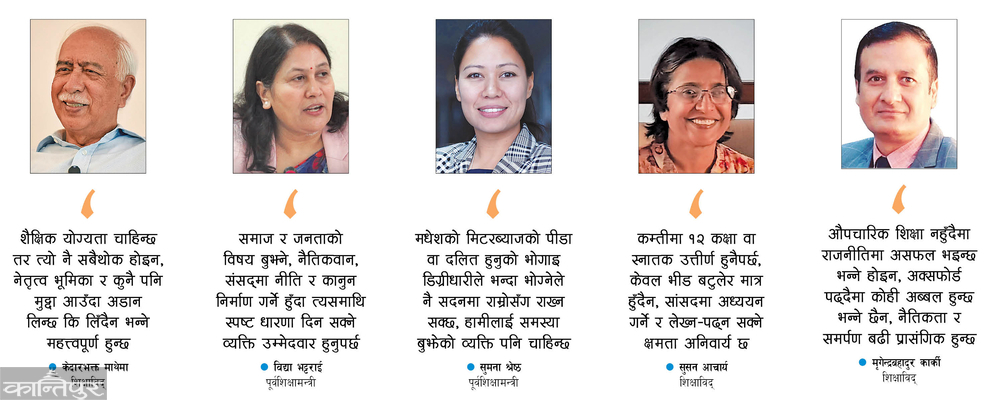
Of the 3,406 candidates in the direct phase of the House of Representatives election, the highest number, 703, are SLC or equivalent, and only 7 are MPhil candidates.
We use Google Cloud Translation Services. Google requires we provide the following disclaimer relating to use of this service:
This service may contain translations powered by Google. Google disclaims all warranties related to the translations, expressed or implied, including any warranties of accuracy, reliability, and any implied warranties of merchantability, fitness for a particular purpose, and noninfringement.
Before every election, there is a debate about the educational qualifications of candidates. This time too, various types of comments have started on social media regarding the educational qualifications of candidates for the parliamentary elections.
The educational qualifications of the candidates contesting the upcoming House of Representatives elections have been diverse. Analyzing the details submitted by 3,406 candidates to the Election Commission, they range from those with general literacy to those with a PhD degree.
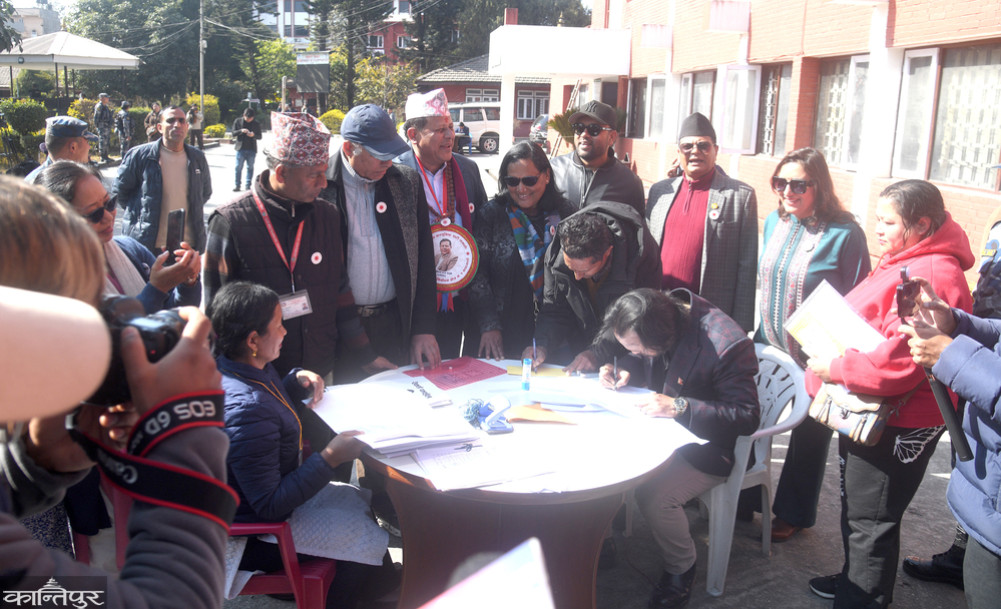
The Election Commission's code of conduct published in the Nepal Gazette on 13 Bhadra 2079 states that along with the registration of candidacy, they must also submit their personal background and educational qualifications. Accordingly, many candidates have disclosed their educational qualifications.
However, no act or law has made the educational qualifications of the candidates mandatory. For this reason, the Election Commission has data that 897 candidates out of a total of 3,406 candidates have not disclosed their educational details. Of the candidates who did not disclose the details, 645 have left them blank, while 252 candidates have not clearly disclosed their educational qualifications.
Details of educational qualifications unclear
Candidates have not clearly written the details in the remaining forms where educational qualifications are disclosed. They have written the same educational qualifications in different languages or ways. For example, some candidates who passed SLC or equivalent have written ‘10 passes’, while others have written only ‘10’. Some have written ‘SLC’.
Election Commission spokesperson Narayan Prasad Bhattarai said that this is an optional subject as no law has made the educational qualification of the candidate mandatory. ‘If it had been made mandatory, we would have made it mandatory for the candidates accordingly,’ Bhattarai said, ‘Since it is an optional subject, we did not pay much attention to it.’
Kantipur has prepared this material by categorizing the educational qualifications submitted by the candidates to the Election Commission into 9 categories: general literate, less than SLC, SLC or equivalent, proficiency certificate level, bachelor’s degree, master’s degree, MPhil, PhD and undisclosed.
How many candidates are in which category?
According to Kantipur’s analysis, the highest number of candidates are in the SLC or equivalent category, while the number of candidates with MPhil is the lowest. 36 candidates are generally literate. These candidates have mentioned details like literate and able to read and write in the form.
There are 205 candidates with educational qualifications below SLC. 703 candidates have passed SLC. Similarly, there are 618 candidates who have completed the Proficiency Certificate level, i.e. secondary level, while 563 have declared that they have completed their graduation studies.
The number of candidates who have completed their postgraduate studies is 324. When analyzing the data of the Election Commission, only 7 candidates have declared that they have passed MPhil, while 53 candidates have completed their PhD. Overall, looking at the educational details, 897 candidates have not declared their details.
Degree or perspective?
Members of the House of Representatives make the country's policies and laws. Therefore, they should be literate or not? If so, there is a debate about how much education an MP should have. Education analysts and even members of the House of Representatives have different opinions on this. Some consider formal education essential to understand the law, while others prioritize experience and honesty to understand society.
Educationist Kedar Bhakta Mathema believes that educational qualifications are necessary but not everything. In his opinion, a person with a PhD who is sitting at home should lead, rather than someone who has played an active role in society. However, he argues that some educational background is needed to understand the complex legal debates in parliament. ‘For example, in Japan, many MPs have a law degree, which helps them understand complex issues,’ he says, ‘but, along with that, what kind of stance they take in society is important.’
Former Education Minister Vidya Bhattarai also argues that although educational qualifications are not mandatory in politics, a person who becomes an MP should have a broad understanding of their subject and scope. ‘When people with subject matter expertise come, it helps to be clear and analyze any proposal,’ she said. ‘This does not confuse people when consulting experts.’
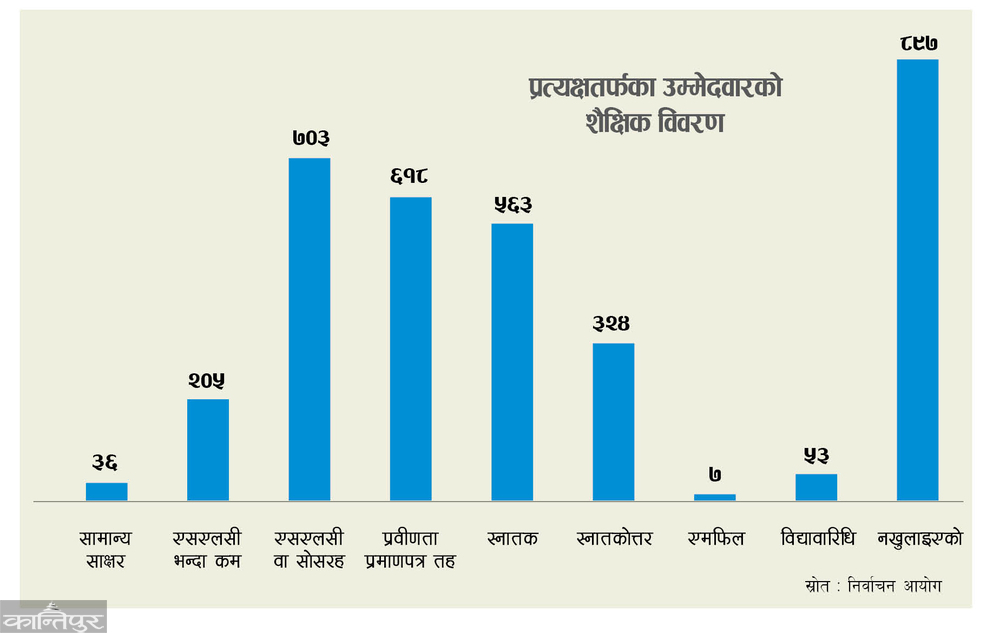
Another educationist, Mrigendra Bahadur Karki, rejects the notion that one fails in politics without education. Giving the example of Prithvi Narayan Shah and Jung Bahadur Rana, Karki argued that they were ‘organic politicians’ even though they did not go to university. ‘There is no need to sharpen the thorns of the forest,’ he says, ‘studying at Oxford does not mean that someone is good. Ethics and dedication are more relevant than a degree.’
Similarly, former Education Minister Sumana Shrestha, who has done parliamentary practice, also says that the mandatory requirement of educational qualifications only creates an ‘elite’ mindset. Pointing out the fact that the number of graduates in Nepal in the 2078 census was only 0.8 percent, she asked, ‘Will Nepal be governed by this small group only?’
According to her, having a degree does not mean having ‘clean intentions’ and ‘a sense of service’. However, she says that these qualities should be in leaders. ‘Those who have experienced the pain of the meter badges of Madhesh or the experience of being a Dalit can better convey the pain of being a Dalit in the House than those with a degree,’ Shrestha said, ‘We need not only experts, but also people who understand the problem.’
Prof. Dr. Susan Acharya, however, holds a different view. She insists that the educational qualifications of candidates should be legally specified. “To understand the world and bring weight to what is said, one must have passed at least 12th standard or graduation,” says Acharya. “It is not enough to just gather a crowd, the ability to study and read and write is essential for an MP.” She said that lifelong learning is indispensable for politicians.