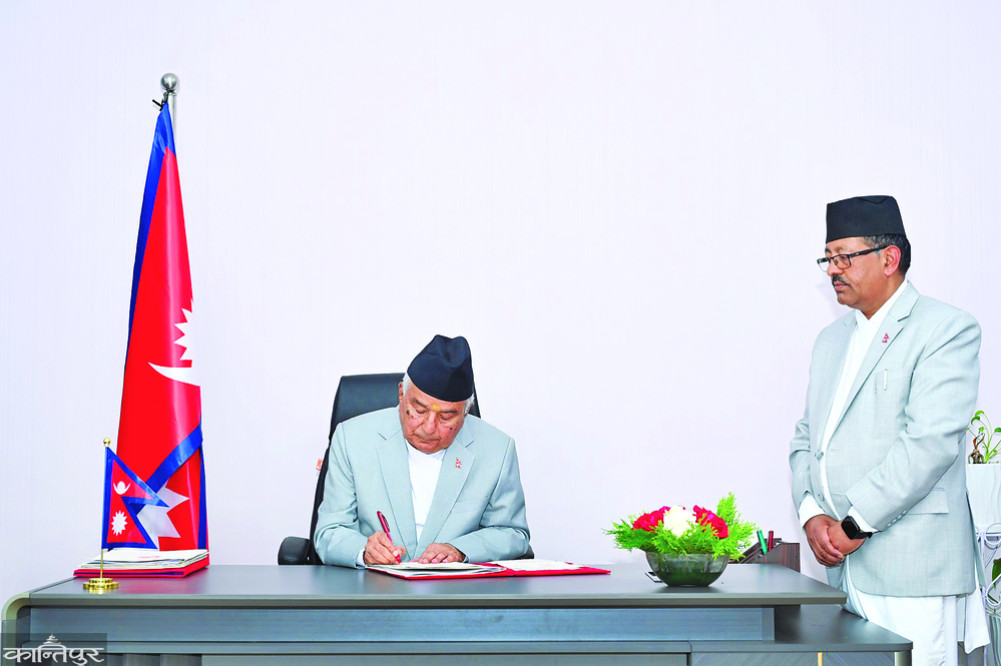
If the government chooses to bypass the regular House on a matter that the law itself envisions as being issued only in urgent cases, the very intention of the government is questioned.
We use Google Cloud Translation Services. Google requires we provide the following disclaimer relating to use of this service:
This service may contain translations powered by Google. Google disclaims all warranties related to the translations, expressed or implied, including any warranties of accuracy, reliability, and any implied warranties of merchantability, fitness for a particular purpose, and noninfringement.
The Balendra Shah-led government was dragged into controversy after adjourning the already-called parliament session and bringing in the ordinance. However, the government has called the act of issuing the ordinance a constitutional process. If issues such as issuing/not issuing an ordinance are interpreted as being entirely legal matters, the essence of the law will be lost. Because an ordinance should not be understood as much or as it is mentioned in Article 114 of the Constitution of Nepal. It needs to be interpreted ruthlessly.
Article 114 (1) of the Constitution of Nepal provides that the President can issue an ordinance on the recommendation of the Council of Ministers if something needs to be done urgently in other situations, except when both houses are in session. The constitution has given the ordinance the same status as an act.
The government, which has moved forward with a 100-point action plan, may have chosen the 'fast track' path in addressing various sectors. But if the government chooses the path of an ordinance without considering the regular House on a matter that the law itself envisions can be issued only in urgent cases, then the government's intentions are questioned. Of course, the government itself should be accountable for its activities, but in a democracy, not only the 'result' but also the process matters.
The RSP is capable of passing an ordinance or a replacement bill after its powerful presence in the House of Representatives. The House of Representatives also has the right to pass a bill even if a bill originating in the House of Representatives is not returned to the National Assembly within 60 days.
The essence of an ordinance is that if any action has to be taken immediately, it is a short legal path to be adopted to find a solution to that action. That is why it demands approval from the House. But if all laws are started to be implemented along the path of an ordinance, it is natural to question the government's activities.
The essence of the ordinance is to provide a short legal path to resolve any immediate action. But if all laws are started to follow the path of ordinances, it is natural to raise questions about the government's activities. When a law is being made by the parliament, the bill seeks the participation of the parliamentarians extensively. The discussion, debate and criticism on the bill helps to further clarify the legislative intention. Legislative intention is a very complicated subject. In the sense that it can prove the existence of the bill to be meaningful or meaningless. All the questions like where and why the bill is needed do not remain unanswered. Therefore, the need for the law is also confirmed. While the ordinance is being presented in the house, these processes are also included, but the 'hurry' of the government to bring the ordinance can be suspicious.
The ordinances issued by the government have not only amended matters that need to be addressed immediately, but also amendments to acts that will have long-term effects. There is a risk of raising doubts by issuing ordinances that should focus on immediate solutions but have long-term effects.
The executive's act of issuing ordinances, except in emergency situations, raises questions about the legitimacy of the parliament. When the ordinance is being issued, not only the general public but also the MPs themselves are not informed about the ordinance. In such a situation, there is no possibility for the voters of that area to hold the MPs they have elected from their constituencies accountable or to question them about the ordinance. Let alone the opposition MPs, the ruling party MPs also remain unresponsive. The reason is that the ordinance is issued suddenly and the ordinance does not even demand immediate discussion. The views of the opposition parties may also be 'bypassed' for the time being.
Among the ordinances recently issued by the President is the Ordinance on the Constitutional Council (Work, Duties, Powers and Procedures). This ordinance, which has become very controversial, was also in the news during the previous government. The ordinance has amended the provision regarding the quorum in the Constitutional Council Act so that meetings can now be held in the presence of the chairperson and at least three members. The council, chaired by the Prime Minister, consists of 6 members. If all 6 members are present and there is a tie, the party with the chairperson's consent is considered to be the majority. The appointment of the Chief Justice, Auditor General, heads of constitutional bodies and members is made on the recommendation of the Constitutional Council. Meanwhile, the door has been opened for Prime Minister Balen Shah to run the Constitutional Council on his own terms with the support of the Speaker and the Minister of Law in addition to the Prime Minister in the meeting chaired by the Prime Minister. In this way, a smooth environment has been created for all appointments to proceed without hindrance.
Not only in Nepal but also in the Constitution of India, the Constitution of India has envisaged ordinances in emergency situations. Therefore, the words ‘urgent’ and ‘emergency’ are not new to the word ordinance.
The entire parliament is there to make laws. From drafting to the process of verification, various laws have guided the country. The matter mentioned in the Constitution that it can be issued if necessary for the time being should not be taken lightly. The government should also be able to clarify the justification of the ordinance. The essence of good governance will be alive in that way. If the government itself panics and tries to make the path of the ordinance an easy path, it will not send a good message to the people.
It may not be beneficial for the new government to get too carried away with the issue on which the previous government was criticized the most. The RSP, which was sent to the parliament with great confidence, has no room for deviation. It should be accountable to the people while carrying out every task.
The government itself will take responsibility for the tasks it performs, there is no doubt about it. Issuing ordinances is not illegal. It is a matter clearly mentioned in the law. The constitution has given the government the freedom to issue ordinances within the law. Even if the constitution gives the freedom, if the government uses the ordinance as a weapon and moves away from the question, the distance between the people and the government may increase. Therefore, the question is not only about the law, but also about destiny.