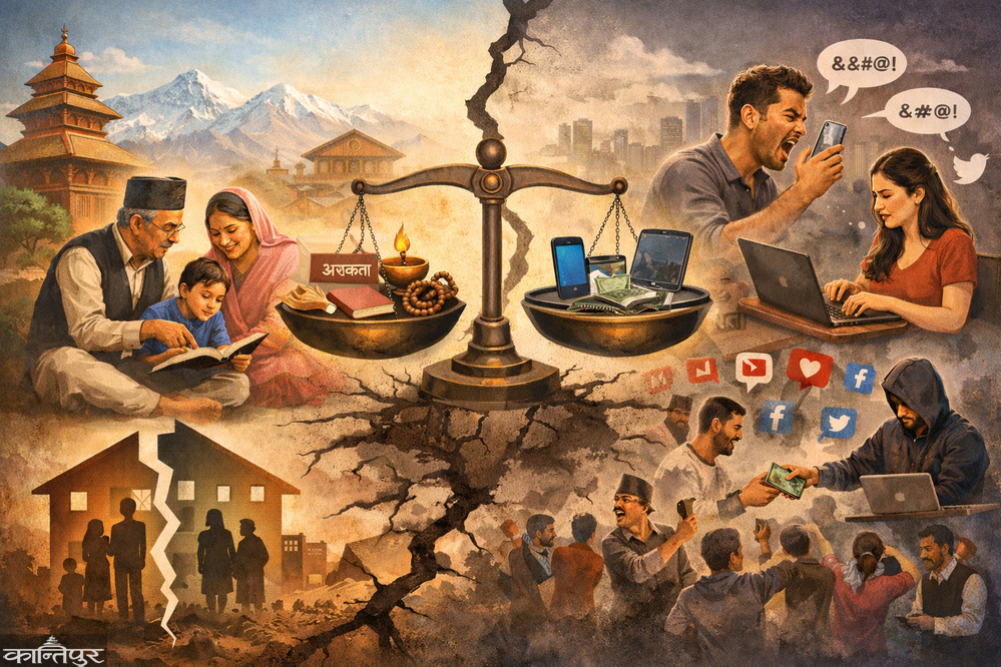
Another issue related to basic social ethics is that we Nepalis often criticize economic corruption, but we neglect adequate debate and discussion about moral and cultural corruption.
We use Google Cloud Translation Services. Google requires we provide the following disclaimer relating to use of this service:
This service may contain translations powered by Google. Google disclaims all warranties related to the translations, expressed or implied, including any warranties of accuracy, reliability, and any implied warranties of merchantability, fitness for a particular purpose, and noninfringement.
The historical development of Nepali society is not just a series of political changes. It is also the continuity and transformation of social values, customs, behavior and ethics. This has made Nepali society disciplined, co-existent and coordinated. The high moral values that have been passed down for generations have made the social structure alive.
However, today's society has become objectionably reactive and impulsive. Even the tendency to make minimal analysis when reacting to any event, idea or information has become weak. This has not only made social discourse superficial, but has also erased the distance between truth and illusion.
The erosion of social morality and increasing lack of culture is becoming the reality of Nepali society. In the past, values such as shame, hesitation, respect, tolerance and dignity were clearly visible in practical life. These values shaped the personality and made it responsible. But these days, such aspects are eroding. Intolerance and aggressive behavior are increasing. Although social media in particular has expanded the scope of freedom, the toxicity and irresponsibility seen in its use have tarnished the sanctity of social dialogue. Personal attacks, abusive language, and obscene expressions in the name of criticism have become commonplace.
The main trend seen in today's Nepali society is the contradiction between social values and modernity. On the one hand, there is a strong desire for modernity, which is providing individuals with freedom of expression, opportunities, and facilities. On the other hand, there is a fundamental social culture, which is teaching them 'lessons learned' of discipline, dignity, and collectivism. But if coordination between the two is not established, society is in danger of reaching a state of 'cultural crisis'.
The combination of chaos in public criticism
The basis of democracy is criticism and questioning. In a healthy democratic society, criticism should be logical, evidence-based, and dignified. Real criticism shows the way to reform. But in the current Nepali society, the form of criticism is becoming distorted. There is an increasing tendency for disagreements to turn into personal hatred, and for logic to be replaced with provocation and anger. This has weakened the foundation of democracy and also damaged social tolerance.
In this context, the changes in family structure have also had a profound impact on the process of passing on culture. The joint family system, where experience, discipline and values were directly passed on from the eldest generation to the younger generation, is now gradually disintegrating. Due to the expansion of single-parent families, the busyness of parents and foreign employment, children are losing the opportunity to learn from the previous generation and gain knowledge.
Even though the education system should be a powerful means of building culture, it does not seem to be able to play the expected role. The subjects of morality and character building in school education are theoretically limited, and their practice is weak in practice. The examination-centered education system has limited knowledge to certificates, while culture and morality are aspects that should be manifested in practice. As the gap between education and culture widens, the process of building responsible citizens in society is being affected.
However, understanding the current situation only in a completely negative way would be wrong. There are foundations for positive change in Nepali society, but in a very limited way. Expanding access to education, awareness of human rights, policy efforts on gender equality, awareness and aspiration for change at the citizen level are the bright sides of society. The challenge is to balance these positive changes with culture and morality. Similarly, modernity and tradition should be seen as complementary essences, not as conflicts.
In this situation, a timely reinterpretation and restructuring of culture is necessary. There is a need for parents to teach practical morality by making the family the first school of culture. The education system should focus on character building. Social media and media should link freedom of expression with responsibility. The state should focus on effective implementation of the law and the development of moral leadership. Only through joint efforts of all levels and parties of society can a balance between culture and modernity be achieved.
A few days ago, the government's announcement in its 'National Commitment' to prioritize moral education at the school level seems very relevant in the current social context. Amidst the increasing indiscipline, impulsive behavior, and erosion of values in society, such an initiative has raised hopes of at least strengthening the new generation on a moral basis. This indicates a positive direction in the direction of developing the values of discipline, responsibility, and coexistence from the student level. However, it is not enough to limit this initiative to schools alone.
Another issue related to basic social ethics is that we Nepalis often criticize economic corruption, but we ignore adequate debate about moral and cultural corruption. While these invisible contradictions have become increasingly counterproductive for society. Visible economic corruption creates immediate debate, but invisibly spreading moral corruption gradually distorts thinking, behavior, and culture. When wrong is considered normal and moral honesty is limited to formality, then the basic character of society begins to decay. Which is the most contagious situation.
Nepali society has probably never stood in a sensitive time structure like now in terms of morality, culture, exaggeration and anarchy. It seems that today we are stuck in the dangerous position of 'digital anarchy'. Where uncontrolled impulses and weightless reactions are becoming more prevalent than conscience. When performance prevails over dignity and superficial use of freedom over responsibility, the moral foundation of society is fading.
Finally, Nepali society is now at a challenging point where it is necessary to revive social culture, morality and dignity. If we fail to understand the essence of culture and restore it in the contemporary context, the tragic fear of chaos and fragmentation in society will increase. But if a conscious balance can be struck between modernity and cultural values, challenges can be transformed into opportunities. This balance will guide Nepali society towards a civilized, disciplined, prosperous, orderly, dignified, and dynamic future.