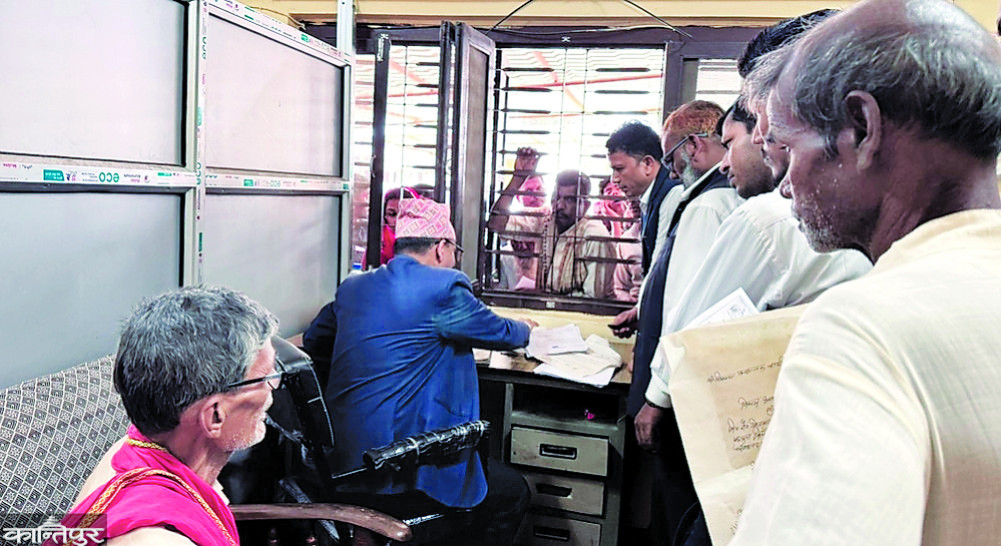
The Wallen government has been ruthless towards good governance. The government seems to be taking steps to make the bureaucracy accountable, people-oriented and service-oriented. After the government was formed, the government has taken steps to follow it literally after the 100 agenda for governance reforms was made public.
We use Google Cloud Translation Services. Google requires we provide the following disclaimer relating to use of this service:
This service may contain translations powered by Google. Google disclaims all warranties related to the translations, expressed or implied, including any warranties of accuracy, reliability, and any implied warranties of merchantability, fitness for a particular purpose, and noninfringement.
The Wallen government has become ruthless towards good governance. The government seems to be taking the initiative to make the bureaucracy accountable, people-oriented and service-oriented. After the government was formed, the government has taken the initiative to follow it literally after the 100 agenda of governance reforms was made public.
We have seen a practice of forming an Administration Reform Commission at various times, but the recommendations and suggestions are not strictly implemented and are kept in a drawer. This article discusses the suggestions given by various reports recently to improve administration.
Efforts to improve administration
More than two dozen commissions, committees and task forces have been formed since 2009 to improve the administration system alone. Similarly, this government is also responsible for implementing the report of the Land and Immovable Property Report of Tribhuvan University-2081 under the coordination of former Secretary Sharada Prasad Trital and the report of the Investigation Report on the Abuse of Study Leave of Tribhuvan University-2082 prepared under the coordination of Dr. Jeevan Kafle.
After the advent of multi-party politics in Nepal, the High-Level Administration Reform Commission-2048 was formed under the leadership of Prime Minister Girija Prasad Koirala. It proposed reducing the number of ministries from 21 to 18, forming a National Commission for Women and Children, and reducing the number of employees by 25 percent to 77,000 by the end of 2050-51. Former Secretary Dr. Dwarikanath Dhungel has written in his book 'Kotparva in Civil Administration' that the 29th amendment to the Civil Service Regulations, 2021, removed employees who had reached the age of 58 and 30 years of service in the civil service, and in one fell swoop, more than 3,000 employees were removed, creating a 'Kotparva' in the civil administration. Since then, after the advent of the republic, the Administration Reform Commission-2065 was formed under the coordination of Madhunidhi Tiwari, as well as the Report of the Administration Reform Suggestion Committee-2070 under the coordination of administration expert Kashiraj Dahal, and the Report of the Empowered Federal Administrative Restructuring Committee-2074.
Similarly, the Public Expenditure Review Commission Report-2075 led by Dilliraj Khanal had suggested abolishing 32 councils, boards, institutes and offices. Similarly, it was said that only official trade unions of employees should be maintained and union members should be made responsible for the functioning of the institution, the trend of giving subsidies to public institutions to any institution should be ended, it was said that the union and the province should clarify what kind of institution should be run, the process of charging additional allowances for doing the work of the institution and providing different service facilities to each institution should be stopped.
Similarly, it was suggested that the Police Administration Association should not be large and that the number of current police should not increase by forming the municipal police (local level), provincial police and federal police and developing a system of necessary coordination. There was also a suggestion to arrange two statistics employees to collect data at the local level. It was said that three employees, including two law officers and one from the fifth level, should be arranged for legal work.
Similarly, the 7-member Federalism Implementation Study and Monitoring Parliamentary Special Committee Report-2079, coordinated by Khimlal Bhattarai, has made 99 different recommendations. Its recommendations include reducing the number of provincial ministers to 5 and limiting it to 10 percent of the total provincial assembly members, ensuring women's representation in direct elections to the House of Representatives and provincial assemblies, reviewing the decentralization of work by maintaining more clarity in the responsibilities between the levels of government, forming a joint parliamentary committee to monitor federalism implementation, formulating a federalism implementation action plan, facilitating people's access to public services to ensure good governance, enacting laws related to accountability for employees, and eliminating middlemen in areas where service recipients are overcrowded.
Rameshwor Khanal and Karki Commission's recommendations
The High-Level Economic Reforms and Recommendations Commission Report-2081, coordinated by economist Rameshwor Khanal, is also based on the Public Expenditure Review Commission report-2075 on many issues. The commission has suggested that even though it is a public corporation, the government should retain more ownership and transfer shares to the private sector as much as possible, that all public corporations should be audited on time, that Nepal Airlines Corporation should be restructured and managed professionally by bringing in external strategic partners, and that foreigners should be allowed to manage such corporations for some time to make them professional, and that the Dairy Development Corporation should be converted into a public corporation of the provincial government, with the Dairy Development Corporation being in all seven provinces.
The RSVP had said in its pledge that the issues of this report would be implemented. It is hoped that its implementation aspect will be seen in the upcoming budget.
Similarly, the Gauri Bahadur Karki Commission report suggested that a secretariat should be formed under the leadership of a secretary to strengthen the National Security Council, that the current National Investigation Department should be placed under the National Security Council, that the government should make the police an institution with judicial powers, that the police chief should be present in the National Security Council, and that since the expenditure on security agencies is mainly an investment, adequate budget should be allocated to the army, police, and National Investigation Department.
The question of reforming the judiciary and judicial administration
The government has recently made public the Good Governance Roadmap-2082. According to the Good Governance Roadmap, the people can only experience good governance, justice and development if the performance of all three organs of the state, the executive, judiciary and legislature, improves. The 1049-page roadmap identifies practical problems and challenges seen in the development management and service delivery carried out by public bodies, assesses the issues expected by the people from those bodies, and discusses in detail the practical and implementable suggestions to be taken for reform, and also presents an implementation plan for these suggestions.
The Gauri Bahadur Karki Commission Report-2082, among its suggestions on the judiciary, has shown that the composition of the constitutional bench is flawed, public trust in the courts is declining, the suggestions of the Judicial Reform Study Suggestion Task Force are not being implemented, and lawyers who advocate for accessible justice are making justice expensive by increasing fees.
Similarly, the suggestion is that the Supreme Court itself should take the lead in removing public disaffection towards the judiciary, make justice accessible and protect it from becoming a paradise for lawyers, tighten the Bar Council examination, speed up the implementation of judgments, conduct an immediate 'O&M' (Organization and Management) survey to arrange human resources and resources in the judiciary and deliver justice quickly, even by amending the constitution, keep the composition of the Judicial Council free from party interference, and the court itself should be ruthless in reforms to be made in the judiciary.
In conclusion, for good governance, the government's 100 agendas related to governance reform and reports on judicial sector reform, including administrative reforms of various times, should be implemented. From reforming our electoral system, corruption can be reduced by increasing the salaries of employees. Comprehensive reforms are necessary in the administration, but it is easier to lay the foundation of good governance only by taking the bureaucracy into confidence.
(Ojha and Panthi are advocates and researchers)