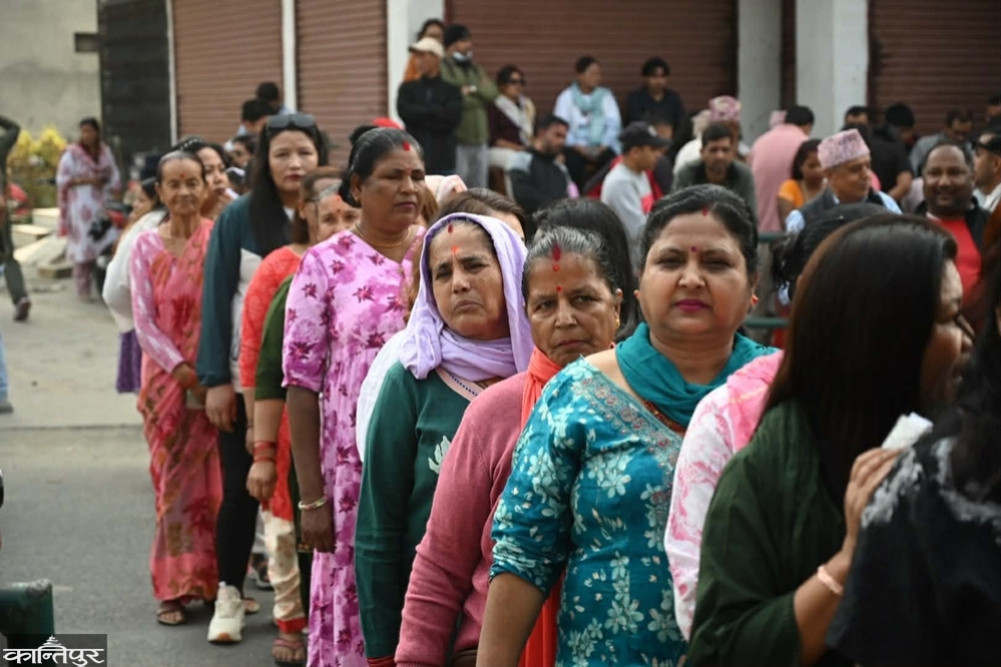
What does uniformity achieve? Is it enough to lump all politicians together and criticize them? Is it enough to see one leader as a hero? These are the questions that need to be seriously analyzed today.
We use Google Cloud Translation Services. Google requires we provide the following disclaimer relating to use of this service:
This service may contain translations powered by Google. Google disclaims all warranties related to the translations, expressed or implied, including any warranties of accuracy, reliability, and any implied warranties of merchantability, fitness for a particular purpose, and noninfringement.
‘What happens if the people unite?’ – This is not just a curiosity. It is a solution to the structural crisis of Nepali politics. But before searching for the answer to this question, it is necessary to understand a basic truth. In the context of a democratic state system, the people unitedly expressing hatred for someone or unitedly expressing support for someone, both of these tendencies are an attack on the basic values of democracy. Because the very soul of democracy lies in pluralism, dialogue, and institutional respect for disagreement.
When the citizens of a nation are so attracted to a single personality, a political party, or an ideology that they close their eyes to other possible alternatives, that is not just superstition, it is intellectual surrender. Similarly, when the people are so consumed with hatred for a single person, a party, or an idea that they stop seeing any positive aspects of those sides, that is not just bigotry, it is the abandonment of rational conscience.
What does uniformity achieve? Is it enough to lump all politicians together and criticize them? Is it enough to see a single leader as a hero? These are the questions that need to be seriously analyzed today. In both these situations, the people not only lose their capacity for discernment, they also lose the very essence of democracy – open debate, reasoned dialogue and institutional protection of dissent. This is the tipping point from which the journey of democracy’s erosion begins, which gradually paves the way for the suppression of minority political opinions, the weakening of constitutional institutions and ultimately the rise of a fascist regime.
In the context of Nepal, the republic established after the 2062/63 people’s movement had raised great hopes among the people. But over the course of two decades, corruption, incompetence of leadership and lack of accountability to the people have turned that hope into despair. This same despair is pushing the people towards a path of homogeneity, some are uniformly attracted to a new leader or a new force, while others are uniformly hating all politics. But what does this homogeneity achieve? Is it enough to simply lump all politicians together and criticize them? Is it enough to simply see one leader as a great hero? A serious analysis of these questions is the need of the day.
When the people are homogenous, whether in hatred or in love, they cannot tolerate the voice of dissent. The opinion of the minority, which is the lifeblood of democracy, begins to be trampled on. This process happens gradually, not all at once. A study of Italian fascism shows that the fascists maintained a ‘permanent ambivalence’ towards minorities. On the one hand, they claimed that the assimilation of minorities was inevitable, while on the other hand, they had a deep distrust of them. This ambivalence kept minorities in a marginal position.
This history also warns Nepal. When we say ‘all leaders are thieves’, we erase the distinction between good and bad leaders. When we say ‘this system is useless’, we also forget the achievements of the constitution and democracy. This same uniformity eliminates minority opinions, dissent and alternative thinking, which are the first conditions of fascism. Fascism does not come overnight. It gradually, using the language and logic of democracy, becomes generalized.
This is called the ‘gradual rise of fascists’. In this process, fascists succeed in building their good image and gaining influence in society. Through exaggerated rhetoric, they direct negative emotions such as fear and dissatisfaction to issues of ethnic, linguistic, regional and cultural identity and make them ‘scapegoats’ for wider social problems.
Because as Jason Stanley says in his book ‘How Fascism Works’, ‘Fascism is a cult of leaders and nations that vows to avenge perceived insults from immigrants, minorities, and leftists.’ There is a big difference between being a victim of this cult and being an informed citizen. The core elements of modern fascism (or ultranationalism) are – elevating a particular segment of the local population above others, attacking minority and individual rights and undermining the liberal democratic system. Racism, authoritarianism, control over the media, and the use of violence – all these are the hallmarks of fascism. The Capitol attack on January 6, 2021 in the US is a vivid example of this. Defeated President Donald Trump incited his supporters, and they attacked the temple of democracy itself. This was not a one-day event, it was the culmination of years of racist rhetoric, hatred of minorities, and distrust of democracy.
A similar danger is beginning to emerge in Nepal as well. When the people, in unison, lose faith in democratic institutions like the courts, the media, and the Election Commission by saying ‘all leaders are crooks,’ then they can easily fall for the deception of a dictator. Similarly, when the public is so attracted to a leader that they start justifying his every mistake, then he too reaches a dangerous state.
Because Jason Stanley says in his book ‘How Fascism Works’, ‘Fascism is a cult of leaders and nations that vows to avenge the perceived insults inflicted on them by immigrants, minorities and leftists.’ There is a big difference between being a victim of this cult and being an informed citizen.
It is necessary to distinguish an important difference here – the people being united and the people being informed are not the same. The united people blindly shout the same slogan. But the informed people question, debate and respect disagreement. The united people look for enemies, the informed people look for solutions.
But should we be disappointed? Does this unity inevitably lead to fascism? It is not. Looking at history, democracy shows the capacity for self-improvement. This requires an informed citizen and an informed society. First, we need to improve the level of political dialogue. Not by saying ‘all leaders are thieves’, but by going deeper into policies and programs and analyzing them. We need to distinguish between good and bad leaders and encourage good leaders.
On the other hand, we need to strengthen democratic institutions. The courts, the Election Commission, the media, civil society – all these institutions are the guardians of democracy. Weakening them means weakening democracy itself. Also, we need to respect the opinions of minorities. Listening to the opinions of those who do not stand on our side, debating, and sometimes disagreeing is also the beauty of democracy. Finally, we need to strengthen local media and community organizations. Because, while the national debate often tends to be extreme and polarizing, at the local level, people can communicate about mutual problems and solutions.
‘What happens when people unite?’ This question is for us to answer ourselves. If the people remain indifferent, whether in the form of blind support or blind hatred, and are unable to create any constructive alternative, it inevitably leads to fascism. It ends minority opinion and ultimately loses its own freedom. But if the people become aware instead of being indifferent, can turn discontent into constructive change and defend democratic institutions and values, then democracy will become stronger.
Nepal is a country where the people have written their own destiny many times in history. The people's movement of 2062/63, the establishment of the republic, the drafting of the constitution through the Constituent Assembly – all these were the results of the conscious participation of the people. Therefore, we can see this current indifference either as a sign of the end of democracy or as an opportunity to build a stronger, more inclusive and more accountable democracy.