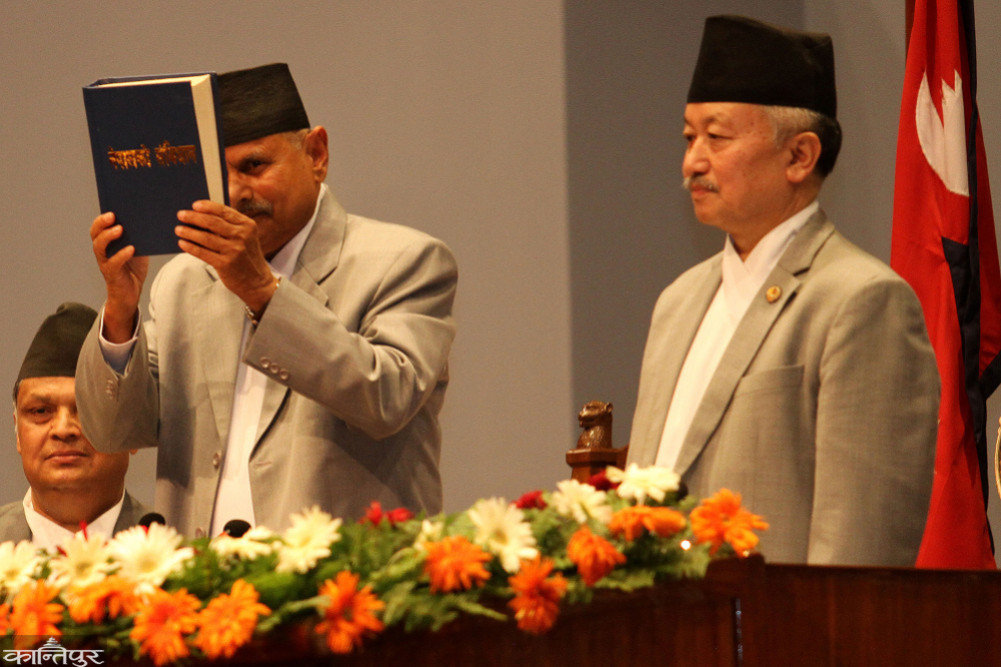
Only skilled leadership and good political parties can decide the fate and future of the country. A task that is linked to national interests like amending the constitution is possible only through national consensus and collective efforts of those political parties.
We use Google Cloud Translation Services. Google requires we provide the following disclaimer relating to use of this service:
This service may contain translations powered by Google. Google disclaims all warranties related to the translations, expressed or implied, including any warranties of accuracy, reliability, and any implied warranties of merchantability, fitness for a particular purpose, and noninfringement.
This time, the people provided the newly-named Rashtriya Swayamsevak Sangh (RSS) with almost two-thirds of the seats in the House of Representatives. This is the first time that any single political party has received so many votes and seats since the promulgation of the constitution by the Constituent Assembly. Despite repeated warnings from the people, the old major political parties that have not been able to make timely reforms within the party and have not brought changes in policy and leadership in time have been punished.
The constitution is the main collection of rules for running the state system. The constitution is also called the main political and legal document of any country. Constitutionalism develops a system that respects the constitution, adheres to the constitutional spirit and spirit, protects the democratic system, and protects civil liberties and rights.
The constitution defines the governing structure of the state, determines the policies for running the government, and defines the functions, duties and rights of the state structure. It ensures the rights of citizens and also sets limits on the authority to govern and the people who live under the rule.
The constitutional history of Nepal began with the statutory law of the Government of Nepal during the reign of Rana Prime Minister Padmashamsher in 2004 BS, which could not be implemented. So far, seven constitutions have been issued in Nepal as a result of political achievements at different times. In 2072, the constitution was issued for the first time by the Constituent Assembly.
Almost ten years have passed since the constitution was issued by the Constituent Assembly. During the implementation of the constitution, there was a demand from the general public to review the achievements made in the past ten years and address all the problems in the constitution. As political parties failed to formulate the necessary policies for its implementation in accordance with the spirit and spirit of the constitution, questions were raised about its legitimacy. At the time of the promulgation of the constitution, Madhesh-centric parties were dissatisfied. Some celebrate the day the constitution was issued as a black day.
The political leadership ignored the implementation of the rights of citizens granted by the constitution and emphasized only the implementation of political rights. This did not develop good governance, transparency, accountability and responsibility towards the common citizen. This led to anger among the youth of the country. On 23 and 24 Bhadra, the Gen-G rebellion took place.
The election was held on 21 Falgun before the term of the House of Representatives in 2079 ended. In this context, the question has arisen, has the situation for amending the constitution arisen in Nepal?
The constitution is not an abstract and unamendable subject. It is a dynamic document. Amendments to the constitution should be made in a way that addresses the current time, period, situation, political, economic, various events, and obstacles seen in the implementation phase of the country. If the errors in the constitution are reviewed in a timely manner, the constitution becomes sustainable and implementable. Achievements in accordance with the spirit of the constitution can also be achieved.
Amending the constitution is not just adding or removing two or four words in the constitution. It is also the responsibility of depicting a beautiful path for the nation according to the expectations of the sovereign people. If we look at the constitutional practice of the world, the country in which the constitution has been amended to the necessary extent has progressed and developed on the right path. The US Constitution, which was promulgated in 1887 as the world's first written constitution, has been amended many times.
In the past, although the major political parties of Nepal expressed their views on amending the constitution, they used it as a political issue and a means to reach power rather than implementing it. Political parties have put forward the issue of constitutional amendment as an election agenda. It was also speculated that the majority would not be obtained in the election. Therefore, there was also a fear that the constitution would not be amended. But the RSVP has won almost two-thirds of the seats in the election. This seat will prove to be a milestone for the implementation of the constitution. Since a national consensus is needed on the issue of constitutional amendment, the RSVP needs to cooperate with other political parties.
In their election manifestos, the old parties, which are now seen as weak, have also put forward the agenda of constitutional amendment. Their priorities include reform of the electoral system, restructuring of the Constitutional Council and the Judicial Council, the issue of appointments to commissions, and the form of governance.
The RSVP has also put forward a different view than other parties. In which a directly elected executive, a fully proportional parliament, a system where MPs are not ministers, non-partisan local governments, and a reformed provincial government are the main agendas of the RSVP for constitutional amendment. While we are amending the constitution, we should not forget that republicanism, federalism, inclusiveness, secularism, democratic values, complete freedom of the press, and an independent judiciary are the unspoken and unamendable provisions of the constitution. Which are also the basic principles of the current constitution.
Even though Nepal has not been colonized by other countries at any time in its history, the geopolitical impact on Nepal cannot be denied. The incident of a neighboring country blocking the constitution at the time of promulgation of the constitution by the Constituent Assembly, saying that it did not have a constitution that suited its needs, is a recent one. There are two powerful emerging nations in the world to the north and south of Nepal. Today, powerful nations of the world are also connected to us. The main challenge for us is to amend the constitution while balancing their geopolitical influence and taking into account the changing world political situation.
It is true that we are at the stage of amending the constitution. In the process of amending the constitution, we must put national interests, self-interest, and the people above all else. Only skilled leadership and good political parties can decide the fate and future of the country. A task that is linked to national interests like amending the constitution is possible only through national consensus and collective efforts of the same political parties. They will set the blueprint for building a prosperous nation and will make the constitution dynamic and sustainable by protecting the constitutional essence.