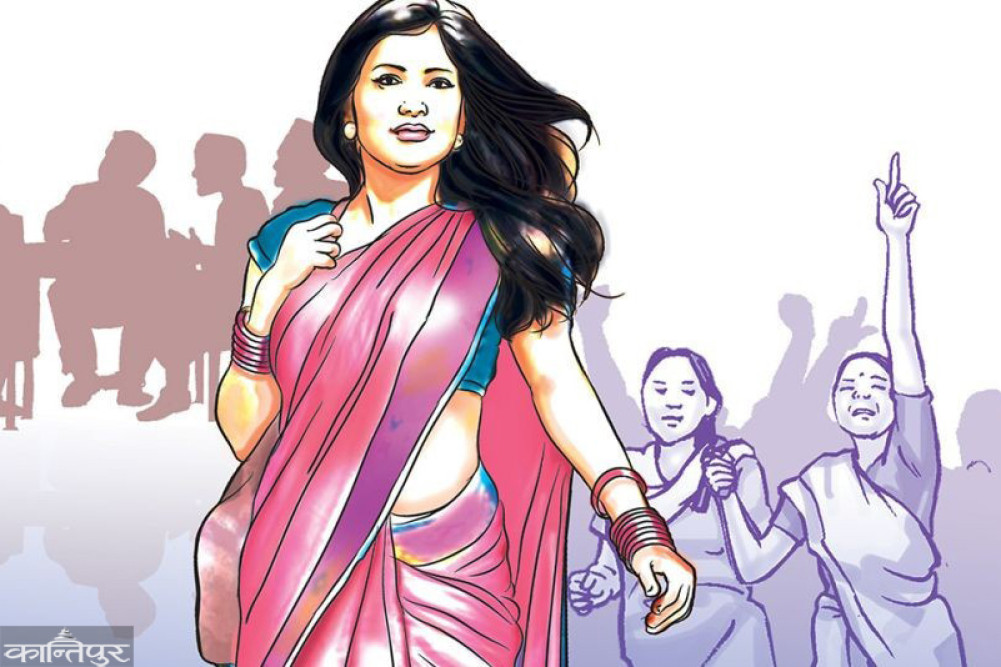
Deepa Nepali writes, ”If elections are to be truly democratized, a legal system is needed to ensure female candidacy according to population within the direct election system.”
We use Google Cloud Translation Services. Google requires we provide the following disclaimer relating to use of this service:
This service may contain translations powered by Google. Google disclaims all warranties related to the translations, expressed or implied, including any warranties of accuracy, reliability, and any implied warranties of merchantability, fitness for a particular purpose, and noninfringement.
If a party wins a large number of seats in an election, it is considered a victory of democracy. If winning an election is democracy, then what is democracy in the sense that it is understood by those who have not had the opportunity to contest the election? How democratic are the political parties themselves before the election debate is limited to the mathematics of the parties' victories and defeats? How honest and democratic have the new and old political parties become to ensure women's representation in this election?
From where should the point of change for women
begin in the history of the suffrage movement to leadership claims? From democratic practice or from demonstration-oriented ideas? The result of this has been made clear by the number of women candidates in this election. According to the Election Commission, 165 constituencies were determined for the direct elections across the country on Falgun 21. A total of 3,486 candidates from 68 political parties had registered their candidacies in the direct elections, of which 3,089 were male candidates and 396 were female candidates. Of this total number of candidates, 88.6 percent are men and 11.4 percent are women. The number of male candidates is 8 times more than that of female candidates.
Thus, the control over women's representation is not only seen in today's elections, its roots are deep in history. In Nepal's first election, women had neither the right to vote nor the right to be a candidate. After the then 3rd Prime Minister Padmashamsher announced the 'Legal Law of Nepal 2004' in the name of governance reform, the first election of Kathmandu Municipality was held, where both candidates and voters were men. At that time, only men who had reached the age of 21 were allowed to vote. As a result, women were deprived of both the right to vote and be a candidate. Against that injustice, women raised their voices and demanded the right to vote from the then Prime Minister Padmashamsher, but the women were told, 'This time it is not possible, we will consider it next time.' Thus, there is a history of women being excluded from democratic rights in Nepal's first election.
Similarly, in 2007, the 104-year-old Jahaniya Rana regime ended and democracy was established. After that, women got the right to stand as candidates and vote like men. Three years after the establishment of democracy, the election date for Kathmandu Municipality was set for Bhadra 17, 2010. There were a total of 19 wards in it. The total number of representatives elected one by one from each ward was 73 in the election. Of these, only 1 was a female candidate, Sadhana Pradhan 'Adhikari'. She was a candidate for a member from Kathmandu Nagar Panchayat Ward No. 8.
According to the election history of Nepal, the number of female candidates in the first parliamentary (House of Representatives) general election of 2015 was 6. One female candidate, Dwarika Devi Thakurani, was elected. She was a Nepali Congress candidate from Dadeldhura District Constituency No. 1. She became the first female MP and the first female minister of Nepal.
According to the Election Report 2048, after the restoration of the multi-party system, 80 women candidates stood in the 2048 House of Representatives general election. Of which 6 (2.9 percent) were elected. According to the Election Report 2051, there were 86 women candidates in the 2051 House of Representatives mid-term election, of which 7 (3.4 percent) were elected. According to the Election Report 2056, there were 140 women candidates in the 2056 House of Representatives election, of which 12 (5.8 percent) were elected. From 2015 to 2056, the number of women candidates remained limited to less than 6 percent. At that time, there were 205 constituencies across the country. At that time, there was a direct election system, not a proportional election system.
The letter of the constitution and the spirit of inclusiveness
Proportional inclusive representation in Nepal began after the establishment of the republic, which was legally regulated by the Interim Constitution of Nepal, 2063. The issue of proportional inclusion, which has become the main issue of the political movement, could not be implemented in practice. In the first Constituent Assembly election in 2064 after the establishment of the republic, out of the total number of 3,946 candidates, 3,578 (90.7 percent) were male candidates. Of these, 368 (9.3 percent) were female candidates. Similarly, in the second House of Representatives election in 2068, out of the total number of 6,124 candidates, 5,457 (89.1 percent) were male and 667 (10.9 percent) were female candidates. Similarly, in the 2074 House of Representatives election, out of the total number of 1,925 candidates, 1,781 (92.5 percent) were male candidates and 144 (7.5 percent) were female candidates. In the 2079 House of Representatives election, out of the total number of 2,412 candidates, 2,187 (90.7 percent) were male and 225 (9.3 percent) were female. So far, women's candidacy in the House of Representatives elections has not increased beyond 11 percent. Thus, women, who constitute 51 percent of the total population, were legally reduced to 33 percent representation. Yet, the right of women to leadership as provided for in the law has never been established. This is an insult to the women's movement, contribution, struggle and sacrifice.
Why has the number of women candidates in direct elections not reached 33 percent? The answer lies within the provisions of the constitution itself. Article 38 (4) of the Constitution of Nepal ensures the right to participation of women in all state bodies on the basis of the principle of proportional inclusion, while Article 42 makes the participation of women, Dalits, indigenous people and backward communities in the state structure mandatory. Similarly, according to Article 84, there is a provision for 275 members in the House of Representatives, of which 165 members are elected through direct elections and 110 members are elected through the proportional system. However, Article 84 (8) only stipulates that at least one-third of the total members elected to the Federal Parliament from each political party should be women. Since there is no clear provision that women candidates should be mandatory for 33 percent in the direct election, even if the parties directly nominate fewer women, they can still meet the one-third women representation by adjusting the number from the proportional closed list. This constitutional structure has left room for women's representation to be weak in the direct election.
If elections are to be truly democratized, a legal system is necessary to ensure women's candidacy according to population in the direct election system. In addition, an environment must be created where women themselves can be the decisive factor in women's leadership. To make the republic a success in practice, the male leadership of political parties needs to rise above patriarchal thinking because women are not only entitled to elections, but are also partners in every political movement. Therefore, women's representation should be ensured on the basis of empathy, not sympathy. Where the shadow of patriarchy, not the picture of real democracy and change, should be visible.