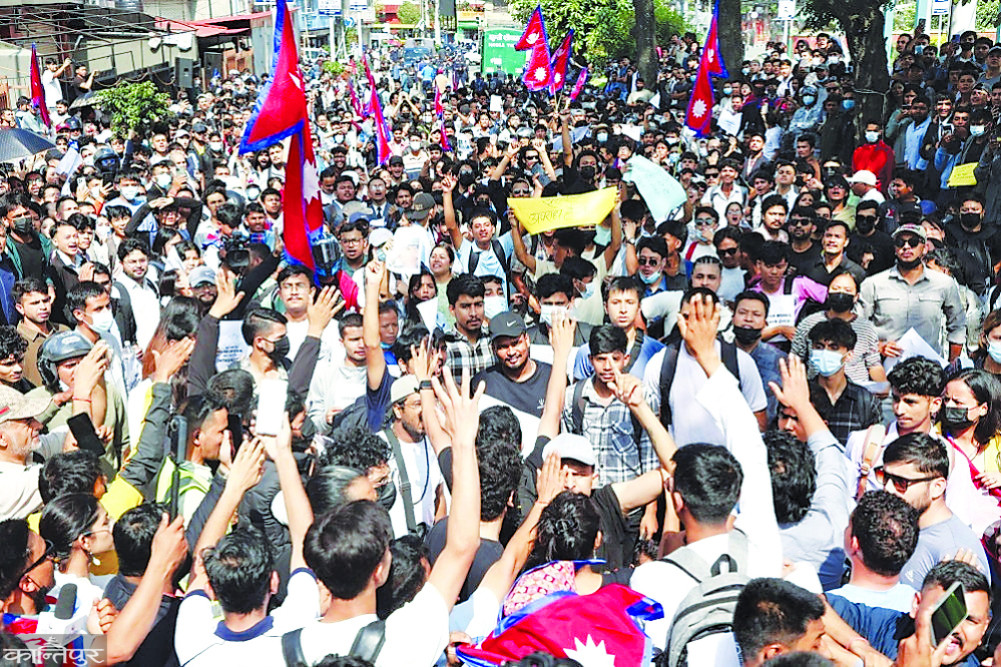
The 2082 elections and the rise of Gen Z have raised a fundamental question—will identity politics, born of historical struggle, now become a tool for short-term ‘branding’ by political parties, or will the younger generation give it new meaning and direction?
We use Google Cloud Translation Services. Google requires we provide the following disclaimer relating to use of this service:
This service may contain translations powered by Google. Google disclaims all warranties related to the translations, expressed or implied, including any warranties of accuracy, reliability, and any implied warranties of merchantability, fitness for a particular purpose, and noninfringement.
‘Identity’ has always been a question in Nepal’s political history, whether as a tool of governance or a basis of authority. The journey from the Rana era of ‘one country, one guise’ to modern ‘pluralist federalism’ has continually defined this question.
The 2046 People's Movement made it a subject of public debate, the 2062/63 movement gave it constitutional recognition, and the Maoist People's War established it as a central principle of state restructuring.
Now, in the era of Gen-G, this same historical identity politics is being defined by new technology, global consciousness, and the new tension between the 'individual' and the 'group'. Standing on this historical ground, with what political consciousness and responsibility will the younger generation now advance their identity politics?
In the context of the 2082 elections, 'identity' is no longer just the voice of historically oppressed communities, it has become a strategic tool for gaining power and building political alliances. Traditional parties are using identity as a primary weapon to protect their base and new parties to gain rapid political heights. This shows the danger of reducing identity politics to electoral calculations rather than questions of rights and inclusion.
Direct examples of this are already being seen before the elections. Some new ‘nationalist parties’ are using simple but effective slogans like ‘One Madhesh, One Identity’ to transform the spirit of the historical movement in Madhesi districts into a new political ‘brand’.
Their strategy is clear, to challenge the parties that have long represented Madhesis as ‘compromisers’ and to present themselves as ‘unwavering’ and ‘pure’ protesting alternatives. This has created a competition for ‘identity purity’ within Madhesi politics. Where who seems more radical than policy, program and implementation is becoming more important.
A similar trend is also seen in the major alternative forces. Some parties are trying to build a vote bank by linking ethnic pride with direct political interests, while others are using regional identity as a means to pit them against central politics. Instead of strengthening a pluralistic national identity, such practices are raising walls of political identity against each other. Instead of building a long-term state, ‘identity’ seems to be used like a ‘commodity’ for electoral success.
Gen Z stands as a crucial but complex group in this whole equation. They are conscious of identity, but that identity is often expanding beyond single ethnic or regional boundaries (intertwined with digital citizenship, gender equality, environmental justice and a global perspective).
But political parties are trying to reduce this complexity to a simple political formula. Strategies to raise identity-based issues that are ‘trending’ on social media, promote ‘young faces’ of certain communities and capture voters through targeted digital content are on the rise. In this way, Gen Z is seen as a strategic target rather than an agenda setter.
This approach is not new. Nepali youth have been ‘produced’ for various political purposes throughout history. Student youth were at the forefront of the 2007 democracy movement, but their aspirations were often pushed to the background during the long process of peace and the Constituent Assembly.
Similarly, the People's War launched by the Maoists used the anger and energy of rural youth as a military and political tool, the long-term humanitarian evaluation of which was not as expected. These examples show that the trend of making youth power the 'fuel' of political change and avoiding long-term responsibility has persisted in Nepal's political culture.
The 2072 constitution expressed a historic commitment to identity-based inclusion. But the 2082 electoral exercise has exposed the gap between the spirit of the constitution and practice. The constitution attempted to make collective identity the basis of empowerment through group rights, but current politics has indicated that it will be limited to a group vote bank. While the successful implementation of the federal structure remains challenging in itself, many parties are making it a mere tool for their 'updated' candidacy framework.
The solution to this problem is not possible by blaming political parties alone. The solution must be multi-layered. First, it is necessary to develop a culture of dialogue by challenging the tendency to make identity a zero-sum game. The youth should be involved not just as voters, but as co-creators of a democratic future.
Second, a new chapter in the definition of civic literacy must be started. Constitutional rights, federalism, digital media literacy, and critical thinking must be brought to the center of educational and public debate. This will enable young people to understand both the opportunities and abuses of identity politics. Third, issue-based politics must be emphasized.
Issues such as employment, education, the environment, and technology-friendly policies are no less important than identity. Politics will only be guided when young people start using their voices not on slogans, but on the basis of policy clarity and implementation capacity.
Ultimately, Gen-G can pave the way for a balance between group identity and individual freedom. When young people present themselves as multidimensional individuals, not ‘data points’ of a single identity, then politics is forced to accept the same complexity.
The 2082 elections and the rise of Gen-G have raised a fundamental question – will identity politics, derived from historical struggles, now become a tool for short-term ‘branding’ of political parties, or will the younger generation give it new meaning and direction? The answer to this will determine the future shape of Nepal’s politics.