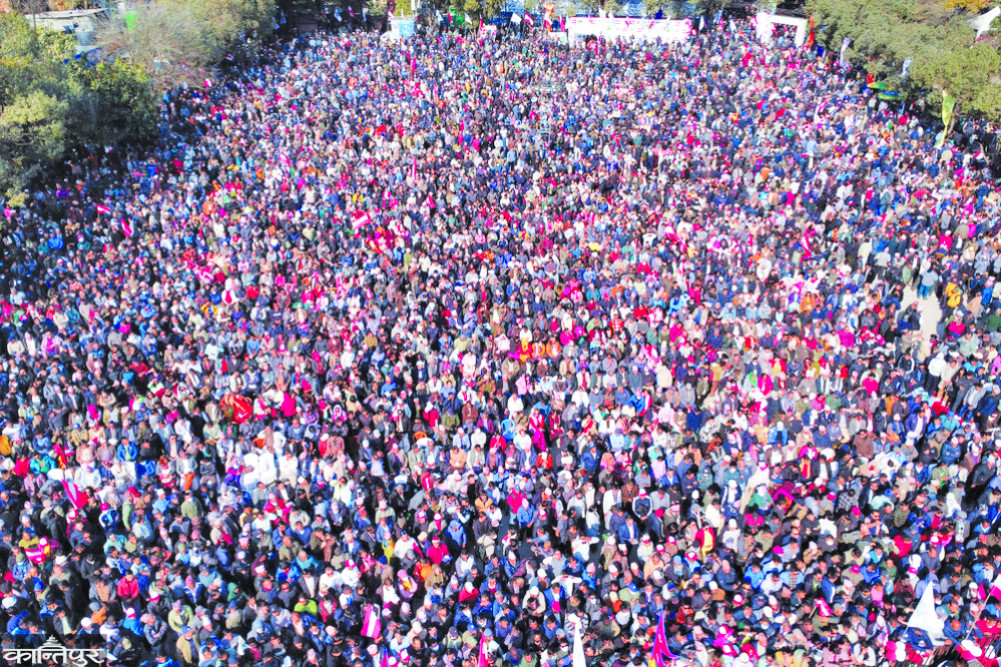
The dictatorship of a single person in any political party is not democratization, but embracing authoritarianism.
We use Google Cloud Translation Services. Google requires we provide the following disclaimer relating to use of this service:
This service may contain translations powered by Google. Google disclaims all warranties related to the translations, expressed or implied, including any warranties of accuracy, reliability, and any implied warranties of merchantability, fitness for a particular purpose, and noninfringement.
In a country where a democratic system is adopted, political parties are considered the foundation of democracy. Parties also promote themselves as democratic. To further strengthen and empower the system, internal democracy is needed within parties. Parties should adopt a policy of implementing principles, policies, and ideals in practice to protect the reputation of internal democracy.
Political parties are considered the driving force of democracy. However, political parties are often criticized for not being able to put their ideas, policies, and strategies into practice. When it comes to making major decisions, they still have to rely on the leaders at the top and highest levels of the party.
Due to which there is a high possibility of erosion in the adjustment of ideas and inclusion. Similarly, the dictatorship of a single person in any political party is not democracy but embracing dictatorship.
Democracy has become even weaker due to the lack of practice of internal democracy within the party. There is a legal provision that the leadership selection process should be in accordance with the rules and regulations of democracy. Political parties use the general convention as a medium to select leadership.
Although the general convention has been made a main way to select leadership, the main leaders of the party have always found it difficult to transfer leadership. Although the general convention has been made a way to transfer leadership legally and theoretically, it has not been fully implemented.
Article 269 of the Constitution of Nepal contains provisions related to political parties. Where it is mentioned that ‘the party’s statute should provide for the election of each office bearer of the party at the federal and provincial levels at least once every five years’.
However, it is also mentioned that ‘if special circumstances arise and the election of office bearers cannot be completed within five years, there shall be no obstacle to making provisions in the statute of a political party to allow such an election to be held within six months’. The Political Parties Act, 2073 BS states that participation should be ensured on the basis of the principle of proportional inclusion in a manner that reflects the social diversity of Nepal while making elections, nominations or appointments to party committees. In terms of women’s participation, it has been specified that it should be one-third.
While the constitution has forced parties to hold regular general conventions, the act has sought to make it more inclusive and transparent. In which women’s representation has been made mandatory and the Election Commission has been given the right to monitor the parties.
If parties do not comply with these provisions, action can be taken according to the constitution and the act. But it seems that the parties have moved forward on their own. When new ideas, policies, and ideals should be discussed at the general convention, political parties are often embroiled in the issue of leadership selection and who will take power.
What makes parties democratic? Some scholars have compiled a list of characteristics that characterize internal party democracy in party membership relations as well as party structures and institutions. These characteristics include the ability of members within the party to select leadership, select party candidates for public positions, and equal and proportional representation of minorities within the party.
Similarly, they have emphasized the protection of the basic rights of party members, the right not to be expelled without fair action, the right to information and transparency in party management, especially financial accountability, freedom of expression and association within the party.
Due to the factions and sub-groups that appear within political parties, no discussion or decision on any issue is possible with unanimous consent. This weakens democracy within the party, and on the other hand, political parties have not been able to remain clean due to the actions of high-level leaders who treat political parties as their personal property.
When parties focus only on elections, the resolution of conflicts that arise within the party is often overlooked. If nepotism and favoritism are adopted while selecting representatives to represent in elections, the entire nation is dragged behind. But the parties have not been able to contemplate this truth. Instead of handing over leadership to a competent representative as per the demands of the time, making the person who has done the most work within the party a representative undermines internal democracy within the party.
Another quality that should be present in a political party is accountability. Accountability should be sought from within the party itself. The decisions made by the central committee, what the plans are and what impact they have should be investigated by the party cadres. This makes the top leaders more responsible and accountable. Undemocratic practices such as trying to suppress questions raised, trying to expose internal conflicts within the party, trying to bring opposing voices under the purview of action, etc. only develop political instability, and the democratic system does not flourish.
It is found that some parties in the country blame the political system. To stabilize the political system, the parties have not been able to understand that they need to improve their tendencies first, and even after understanding, they have been lagging behind in implementing them.
Problems have also been seen in the leadership transfer due to the inability to change themselves according to the changing times. Although the general convention has been made the means of selecting leadership according to the constitution and legal provisions, the same old faces have been seen for a long time. When young leaders with potential are sidelined, the youth complain that they have no future in politics.
The debate that political parties have always been run by old leaders who could not change the party according to the times is an old one. There is rarely a discussion within the parties on how to attract the youth in the country to politics. After the implementation of federalism in the country, the government has reached every village.
There are people's representatives in every village, who raise and adjust local issues. If the youth in the villages are taught to evaluate the situations that may arise in the future by discussing politics and the current situation of the country, the gap between political parties and the youth can definitely be reduced.
There is a need for participatory decision-making and discussion to establish an internal democratic structure in political parties. If the central committee is not limited to the committee itself but also gives space to the views and analysis of lower-level leaders and cadres, inclusion is seen in the decision-making process. As a result, criticisms such as the central committee becoming the center of the party's decisions do not arise. The autonomy and diversity of political parties are also very important for democracy.
There is no other option but to embrace democratic practices to make the leadership selection process in parties transparent and inclusive. Elections alone cannot restore the vitality of democracy. However, if the leadership is not responsive to the aspirations of the people, the public's trust in the political party is certain to decline.
Similarly, if there is no internal democracy and commitment to following the rules in political parties, democracy cannot move on the right path. The closer the leadership gets to the people before the election, the closer it needs to get to the people after winning the election. This helps restore the waning trust in the leadership.
Political parties have a key role in shaping the democratic system. Political parties should embrace participatory, inclusive practices. The main role of political parties in today's current situation should be to protect the rights and interests granted by democracy by adjusting fair competition, accountability, and transparency within the party. It is appropriate to advocate for democracy, order, and system by restoring democracy within ourselves.