The delegates to the General Convention should focus on building a new leadership by exercising the powers granted by the statute. A special general convention that ends without announcing a new leadership will not be fully meaningful.
We use Google Cloud Translation Services. Google requires we provide the following disclaimer relating to use of this service:
This service may contain translations powered by Google. Google disclaims all warranties related to the translations, expressed or implied, including any warranties of accuracy, reliability, and any implied warranties of merchantability, fitness for a particular purpose, and noninfringement.
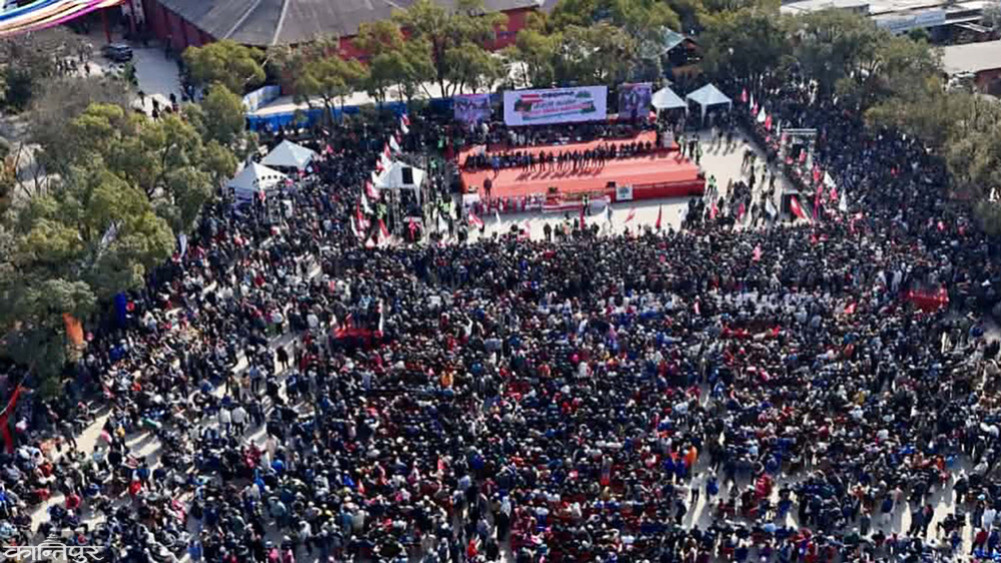
Despite pressure and obstruction from the establishment, the special general convention of the Nepali Congress began on Sunday. The organizers claim that the attendance at the special convention, which was in line with the demands of about 54 percent of the delegates, was higher than expected. There are also those who are absent following the order issued by the establishment.
The supporters of the special general convention amidst such adversity have interpreted it as a sign of political victory. This is because of two reasons. First, the establishment faction led by President Sher Bahadur Deuba is believed to be strong in the Congress.
Second, after Shekhar Koirala, who became ambivalent in the name of mediation, did not stand in favor of the special general convention, many expected that attendance would remain weak and the special supporters would become defensive. However, the opposite has happened. The supporters of the special general convention are excited and the establishment side has become defensive. By organizing it, the supporters of the special general convention have not only sent a message against the establishment's tendency to violate the constitution, but have also given a strong response that the tendency to violate the constitution is unacceptable.
But, is organizing a special general convention the only achievement for the Congress, which is caught in the vortex of political crisis? Can this party confirm its relevance and relevance only by organizing it? Can this general convention draw a clear blueprint for the future destination of the Congress? If so, what is that blueprint? What are the issues that need to be raised and addressed? The central question, can the special general convention bring about a new leadership? What will be the policy reforms? Or what should be? Many such questions have become the subject of most interest on the second day today.
In its eight-decade-long political history, the Congress has accomplished a historic task by holding a special general convention for the second time. However, the decisions and path it takes will determine how historic or formal it will be. In that sense, the importance of this second day of the special general convention is even greater.
The Congress is not just in the usual factional or organizational dispute at the moment. There is a conflict between the tendency to follow the statute and not. There is pressure for participation and boycott. There is a challenge of choosing between 'outdated' and new leadership. Along with policy clarity and reforms, the main thing is how strongly this party accepts democracy in practice. The Congress is in a time of comprehensive testing of all these. To prove itself in this test, the special general convention has three main tasks. Which are discussed here.
Political White Paper
First of all, the Congress will have to conduct a deep and ruthless introspection about itself. It is widely known that this special general convention is taking place in a special environment. The events of 23 and 24 Bhadra are the background for this. After the street protests called by Gen-G on 23 and the chaos and destruction on 24, Nepali politics suddenly reached a critical juncture. Efforts are being made to resolve the political and constitutional crisis through elections.
While new and alternative forces/characters are appearing with many dreams for the people, the so-called big and old parties are not making much progress towards correcting and refining themselves. Or rather, they have not been able to convince the people that they can take the lead in the crisis. Moreover, the Congress is suffering from internal strife.
The establishment party has descended to the lowest level of violating the constitution. Sectarian interests have reached the peak. In this context, the challenge of this special general convention is formidable. On the one hand, it should identify the causes of the internal crisis of the Congress, where did the leadership go wrong? It should be able to draw an honest roadmap of what the Congress will be like in the future by correcting those 'blunders' (major mistakes), and at the same time, it should be able to announce a political white paper addressing the dissatisfaction, anger and expectations that have arisen at the public level. This should become the basic agenda of the special general convention.
Policy renaissance
No one can deny the leading role of the Congress in the democratic movement of Nepal. The Congress blew the trumpet of revolution against the 104-year-old Rana regime. It was born advocating for the minimum and basic democratic rights of the citizens. It established itself as the leader of the revolution. In that sense, it is a party that is aware of the revolution. Amidst many ups and downs and transitions, it has also established itself in history as a rebel force. When it arrived in 2046 BS, it became a coordinating and coordinating force.
It took the lead in the movement to restore democracy together with the communists. It played a guardian role in the second people's movement in 2006 and the subsequent peace process and constitution-making. However, none of these characteristics exist in today's Congress. The Congress is hurt by factionalism, power-oriented character and reactionary politics. The Congress has not been able to make itself dynamic in political/ideological terms either. The Congress, which has come this far wearing the turban of BP's socialism, is now in a state of necessity to refine it in a policy-wise manner in accordance with the changed times and context.
When it comes to policies and principles, the Congress always turns to BP Koirala and repeats BP's socialism. BP Koirala was a towering figure not only in the Congress but also in Nepali politics. He could guide Nepali politics. But, does the Congress always remain alive just by using his name? As time, context and dimensions change, the Congress needs to redefine itself in terms of policies. And, this general convention is the right platform for that.
General Secretaries Gagan Thapa and Bishwaprakash Sharma should be able to make this platform a place to endorse their policies and political programs. It is a generally accepted fact that there is very little ideological churning in the Congress. In the past, when Pradeep Giri and Narahari Acharya were discussing politics, it seemed as if the party was saying, 'There are still some ideas left'. Recently, Gagan Thapa has raised that issue. He has launched a 'discourse' that the Congress should make the concept of social democracy its theoretical destination. If this special general convention approves his political program after debating it, it should be considered an achievement.
Similarly, Bishwaprakash Sharma has proposed that some arrangements should be made in the constitution to make the party agile and accountable. For example, the 1, 2, 3 and 4 models, i.e. a leader cannot be the President once, the Prime Minister for two terms, a minister for three times and an MP for more than four times. There are proposals to make other organizational arrangements transparent, including the system of electing the leadership from active members. It has been raised that the provision of 'lateral entry' should be included in the constitution if people with different expertise want to enter the Congress.
In essence, the Congress should focus the debate on clarifying the ambiguous provisions in the constitution in this general convention. The question that cannot be ignored is the working style and accountability of the leadership. Is it appropriate/inappropriate to place the president at the center of power? What has practice shown? It should be discussed. There should be a debate on the conflicts and crises caused by the use and misuse of the constitution. Is it for compliance with the constitution or for control and interpretation to suit oneself? Are cadres just a means to mobilize for elections or do they also have sovereign decision-making rights? Is the issue of generational transfer a lip service or should it be adopted in practice? After intensive discussions on many such questions, the Congress should be able to chart its political path and make clear legal provisions.
'Visionary' leadership
Even so, the question remains alive. Does political/ideological clarity on paper alone make a party dynamic? Don't you need certainty that they will be implemented? For the party to be vibrant, leadership in line with the political ideological 'spirit' is also indispensable to implement policy arrangements. At this time, the special general convention of the Congress seems to be in a dilemma whether to elect a new leadership or just pass a resolution on some issues.
Perhaps some are inspired by the purely emotional argument that if the party splits, they will have to bear the consequences, while others are trying to deprive the special general convention of electing a leadership by fearing a split. However, the general convention delegates should use their rights granted by the statute to focus on building a new leadership. A special general convention that ends without announcing a new leadership will not be fully meaningful.
The Nepali Congress has had leadership with three main characters during its lifetime. The leadership of the Congress during BP was established against the backdrop of revolution and rebellion. In that era, the Congress received idealistic leadership, which laid the theoretical foundation of the party. It is thanks to that leadership that sacrificed for political struggle that the Congress has become what it is today. It is not that there were no conflicts and disputes between the leaders who emerged after BP, such as Ganeshman Singh, Krishna Prasad Bhattarai, and Girija Prasad Koirala. However, despite the conflicts, these leaders also played the role of transitional leadership. They played a coordinating role in national politics.
In the days that followed, individualism and authoritarianism dominated the Congress. It is not unnatural to have ideological groups within the party, but the growth of unhealthy factions is a curse. The Congress has been losing its relevance as it focuses on power-oriented, factional, and division politics. President Sher Bahadur Deuba, who has been the Prime Minister for five times and still wants to keep it under his control, sometimes partners with UML Chairman KP Oli for power and sometimes takes Prachanda's side.
After the Gen-G movement, there are two streams in Nepali politics. One says that the demands for change raised by this movement should be addressed, while the other thinks that it should be ignored and grown. Gagan Thapa has strongly raised the need to address the demand for change, while UML Chairman Oli has made a statement that ignores the Gen-G movement. However, Congress President Deuba's behavior and working style are close to Oli. After the Gen-G movement, Deuba seems to have become even more dependent on Oli.
The other leadership around him also did not show the thought and energy to take the Congress forward from a new direction. Therefore, at this time, the Congress needs a leadership to restore ideology. General Secretary Gagan Thapa has shown a glimpse of being able to fulfill that. He has said, 'Congress should keep the past history alive and connect the party with the expectations of the new generation.' He may be the appropriate person for this.
Some character traits may be essential for a reformed and change-oriented Congress leadership. First, Congress needs a leader with competence and political character, not factionalism and unhealthy thoughtless competition. Second, Congress needs a leadership that strengthens processes and systems, not individuals. Third, we need a leadership that does not look at favoritism and immediate political gains, has moral courage and the courage to take the right decisions.
Fourth, the Congress needs a leadership that has the ability to understand the changed world dimension due to the extreme development of information technology, has the ability to communicate with people at different levels and strata, and can take mature diplomatic steps in complex geopolitical situations. In essence, the Congress needs a leadership that is not power-oriented, but that can restore the lost public trust. These political characters and tendencies cannot be expected from Deuba or the leadership of that generation.
That is why not only the majority of Congressmen, but also from the people's level, are wanting the leadership of the transformed Congress to be transferred to the generation of Gagan Thapa and Bishwaprakash Sharma. This pair, who were tested as the party's general secretaries, have now moved the issue of Congress reforms through a special general convention. Bishwaprakash has started a very commendable tradition of promoting Gagan as the main leader. Therefore, they are the ones who have the qualifications to become the leader of the Congress now.
At least they must get an opportunity to be tested. In that case, the leadership of the Congress will also be established by the policy of the Congress. It is not enough for the delegates of the special general convention to just say 'No more Sher Bahadur', they should be able to say goodbye to the Sher Bahadur trend and choose a leadership by understanding the footsteps of the times. Only then will this special general convention be a historic turning point for the Congress.