No country can embark on the path of real change as long as the goal of education remains limited to obtaining a degree. A degree is not the end point of knowledge, but our education system has made it the ultimate truth.
We use Google Cloud Translation Services. Google requires we provide the following disclaimer relating to use of this service:
This service may contain translations powered by Google. Google disclaims all warranties related to the translations, expressed or implied, including any warranties of accuracy, reliability, and any implied warranties of merchantability, fitness for a particular purpose, and noninfringement.
Gurukul education taught a philosophy of life, modern schools expanded knowledge, and universities should foster research and critical awareness. However, when universities are limited to certificate distribution centers, education becomes a formality rather than a means of development. Such an education system may create individuals, but it does not produce citizens who can change society.
Technology is writing the future, but we are still memorizing notes or being made to memorize them. The world is moving towards the rapid development of artificial intelligence, data economy and automated decision-making systems, but we Nepali students are still forced to pore over the pages of books and lines of notes. This is not only educational laziness, but also a historical irony and an indicator of the country's decline. Time has moved forward a lot, but the curriculum has not even been able to keep up with the times. Education has become a burden rather than a guide.
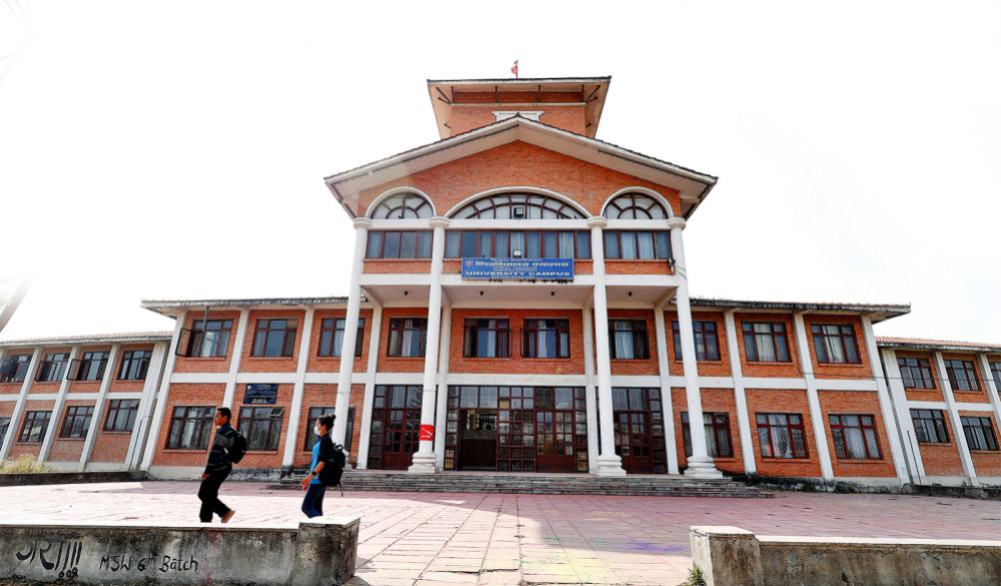
Tribhuvan University, considered the backbone of Nepal's higher education, is today huge in terms of numbers and access, but it seems weak in terms of innovation and practical efficiency. The courses are disconnected from theoretical and practical reality.
Many subjects taught at the university still carry archaic thinking and context. While the world has built question-asking machines, we have been taught to remember the answers. Artificial intelligence is doing the work of analysis, prediction and creativity, our examination system still evaluates who memorized the most notes. Such an education policy does not produce innovators, only adaptive followers.
The most serious problem is that the education system is teaching students to endure rather than teach them to think. Passing exams has become the goal, asking questions seems like a risk. It is not producing citizens, but only livelihoods that can compromise with the system.
No country can embark on the path of real change as long as the goal of education is limited to obtaining a degree. A degree is not the end point of knowledge, but our education system has made it the ultimate truth. In today's era, computers can collect, remember and analyze vast amounts of data more than the human brain.
In such a situation, holding a competition for memory power is not education, but wasting human capacity for the wrong purpose. The practice of awarding marks based on shoddy education is not new in our society, but considering this practice as academic success is an institutional form of intellectual laziness. When the examination system only asks ‘How much did you remember?’, then the student loses the courage to ask ‘Why?’ and ‘How?’. In this way, education becomes not a means of expanding consciousness, but only a tool of regulation.
Only when the way of thinking changes, does policy change, and only when policy changes, does structure change. Development is not seen only in the physical structure, but also mentally. If thinking is static, then structural change is only superficial decoration. Therefore, the center of development is the brain, and the most powerful tool to build that brain is education. If the country is to change its face, the educational approach must be changed. Development is not possible without setting the goal of producing analysis rather than memorization, critical awareness rather than obedience, and responsible citizens rather than degrees. When education becomes a force for changing thinking, only then does the citizen become a nation-builder, not a spectator of history.
Today, the university has become not just a center of education, but a political arena, a laboratory of party-based power structures and influence. Party representatives interfere in the appointment of professors, departmental leadership, and budget distribution to expand their influence. This not only weakens academic and intellectual freedom, but also directly affects the path of building the future of students, their thinking ability and leadership development. Political pressure interferes with the curriculum, examination system and research, which limits students to party loyalty and formality instead of experimental thinking and innovative practice. Not only the reputation of the university, but the development of the nation's youth consciousness itself becomes a victim of political games. Such an education system distributes degrees, but it completely defeats the main objective of producing empowered, independent and innovative citizens.
It is not uncommon for even a national sports organization like the recently launched Nepal Premier League to politically interfere with the national educational heritage and turn the educational campus into a partisan arena. This is political interference and the indifference of the university, where education, sports and even student life are held hostage in the name of showing power. The university is for educational development, but when the same place becomes a center of slogans, obstruction and showing power, the question arises: is the fundamental right of students to study in a peaceful environment really protected?
Political movements may be part of democracy, but occupying the education sector is not a democratic practice, it is an attack on the education sector itself. Sports activities like the Nepal Premier League are linked to the energy, discipline and national identity of the youth. Using it for political strategy means directly playing with the mental peace, attention and future of students. When classes, exams and studies are affected, the loss is borne not by any party, but by an entire generation.
In this way, when universities and educational premises are repeatedly turned into political arenas, the ‘right to study in a peaceful environment’ given to students by the state is limited to a paper commitment only. Writing the right in the constitution and implementing it in practice are two different things. When politics loses control and permeates everywhere, then education cannot remain free, sports cannot remain fair and students cannot remain safe.
Ultimately, the question is not only about the Nepal Premier League, but also about political culture. If politics does not understand the boundaries between education and sports, then the right of students to study peacefully will not be fulfilled. The power of democracy lies not in slogans and obstacles, but in restraint, dignity and respect for boundaries. If this is not understood, universities will become political laboratories, not places of knowledge. Universities and sports should be places of knowledge, discipline, and national identity, not political arenas. The power of democracy lies not in slogans and obstruction, but in restraint, dignity, and respect for boundaries. Only if this is understood can education and sports truly build a bright future for society.