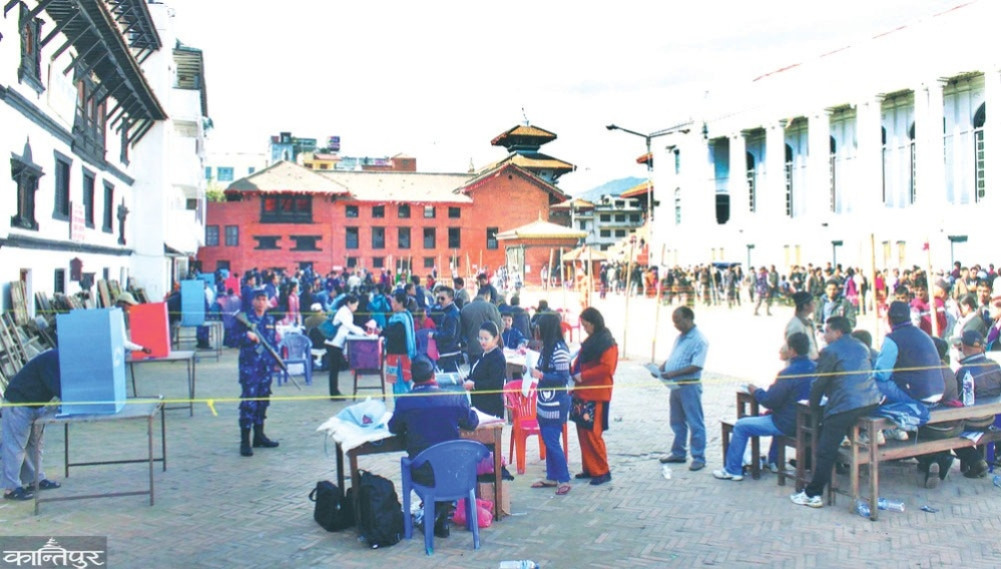
Out of 165 constituencies, 85 constituencies can be made open and 80 reserved. This will also ensure proportional inclusivity and allow strong voices from inclusive groups to reach parliament through direct election.
We use Google Cloud Translation Services. Google requires we provide the following disclaimer relating to use of this service:
This service may contain translations powered by Google. Google disclaims all warranties related to the translations, expressed or implied, including any warranties of accuracy, reliability, and any implied warranties of merchantability, fitness for a particular purpose, and noninfringement.
The ‘Nepo Baby Trend’ had been going on on social media since early September. But the government banned social media shortly after the ‘trend’ began. As a result, a coincidence was created for the youth of the Gen-G age group to launch a massive mass movement demanding good governance through TikTok.
After the Gen-G uprising of 8 and 9 September, i.e. 23 and 24 Bhada, there seems to be strong support for the demand for a form of governance in Nepal with a directly elected executive. But I myself had participated in the movement of 23 and 24 Bhada. I had also been closely following the agenda raised on TikTok regarding the movement called for 23 Bhada from the beginning.
In my understanding, the issue of directly elected executive was first raised on 7 September (22 Bhada) by Miraj Dhungana, who is currently seen as a Gen-G leader, on TikTok saying, ‘Guys, our movement from now on will be a two-agenda movement, first end corruption and second directly elected executive’.
When I myself reached the Everest Hotel from Maitighar Mandal on 23 Bhada, there were no slogans or posters about directly elected executive. It seems that after the then government collapsed due to the massacre carried out by the state on 23 and the natural infiltration during the retaliation on 24, the demand for directly elected executive was raised by various groups and individuals.
It seems natural that the main factor hindering the overall development of Nepal is the electoral system within the current form of government. Therefore, efforts should be made to improve the stability within the current parliamentary system and the option of directly elected executive should be addressed through constitutional amendment. However, according to Article 274 of the Constitution of Nepal, a two-thirds majority of both the House of Representatives and the National Assembly of the Federal Parliament is required to amend the constitution. However, since the House of Representatives is currently dissolved, the constitution can only be amended after the election and the House of Representatives is formed.
The parliamentary system itself can also be improved to achieve stability. For that, it is necessary to understand the current electoral system. Article 84 of the Constitution provides for a total of 275 members of the House of Representatives, consisting of 165 members from 165 constituencies under the first-past-the-post system and 110 members from the closed-list proportional electoral system. According to Article 76 of the Constitution, the member who wins the majority in such a House of Representatives will be the Prime Minister and the Council of Ministers will be formed under his/her chairmanship.
Many people seem to understand that the proportional electoral system is the cause of the current instability. In addition, since only the loyal people desired and desired by the top leaders of parties including the Congress, UML and Maoists reach the House of Representatives through such a system, the voice of inclusivity does not seem to be raised in the House. Since the distribution of proportional inclusion groups is limited to 110 instead of 275, the current proportional electoral system does not seem to be able to address the essence of inclusivity. Therefore, it seems that the proportional electoral system based on the closed list needs to be reconsidered.
However, if there is an attempt to completely negate the issue of proportional inclusion, the issues of inclusivity will further flare up and rebellions may occur, leading to increased ethnic, class, gender and regional complications.
Therefore, it seems necessary to ensure proportional inclusion when amending Article 84 of the Constitution of Nepal. For this, the system of electing 110 out of the 275 members of the House of Representatives from the closed list based proportional representation can be removed and reserved seats (reserve quota) can be moved towards. To do this, it is appropriate to make the first 165 directly elected members, which have already been organized by the Constituent Assembly, the total number of members.
By doing this, the issue of constituency restructuring does not even arise. Out of the 165 constituencies, 85 constituencies can be open and 80 reserved. The 80 reserved constituencies should be determined for Khas-Aryans, women, indigenous/tribal tribes, Dalits, Madhesis, Tharu, Muslims, minorities, sexual and gender minorities, persons with disabilities, and the poor as per Section 28 and Schedule 1 of the House of Representatives Election Act, 2074 BS.
For example, if a constituency is reserved for Khas-Aryans, arrangements should be made for competition only between candidates from the Khas-Aryan community in that constituency. For example, currently, 31.2 percent reservation is maintained for Khas-Aryans in Schedule 1 of the House of Representatives Election Act, 2074 BS, in that sense, the corresponding proportion of seats out of the 80 reserved constituencies can be reserved for Khas-Aryans. The same seats should be reserved for Dalit community, Madhesi, Tharu, Muslim, etc. in proportion to the population. But in this way, the reserved area can be determined in a cyclical system.
Let us also understand the reserved area based on the cyclical system. For example, if there are 10 constituencies in Kathmandu district, constituency numbers 1, 3, 5, 7 and 9 of Kathmandu can be reserved in the first election. These reserved areas will be open in the next election. The areas that were open in the first election can be reserved. This is what is called the reserved quota. In our neighboring country, India, this reserved quota has been maintained for Scheduled Castes (Dalit community) and Scheduled Tribes (Tribals) in a cyclical system for decades. This can be taken as a successful example.
By doing this, if the closed-list proportional electoral system (which does not seem to be able to address the real representation and voice of inclusive groups) is removed as a factor of instability and reserved quotas are established, the factor of instability can also be removed, proportional inclusiveness can also be ensured, and strong voices of inclusive groups can be directly elected and reach the parliament.
In addition, if 165 constituencies are maintained as is, the controversy of constituency restructuring will not arise, and it seems that removing 110 members from the closed-list proportional system out of 275 and maintaining 165 will also reduce expenses. The same practice as in the House of Representatives can be adopted in the provincial assemblies. This will reduce expenses and ensure stability in the provincial structure.
Further discussion is needed on all these possibilities. It is also necessary to discuss whether a directly elected executive is suitable for a country with a sensitive geography and diversity like Nepal. This discussion needs to be held in the manifestos, discussions, and general meetings of political parties in the upcoming House of Representatives elections. If approved by the people, it would be necessary to have an in-depth discussion in the upcoming Federal Parliament, including the House of Representatives, and adopt the appropriate form of governance.