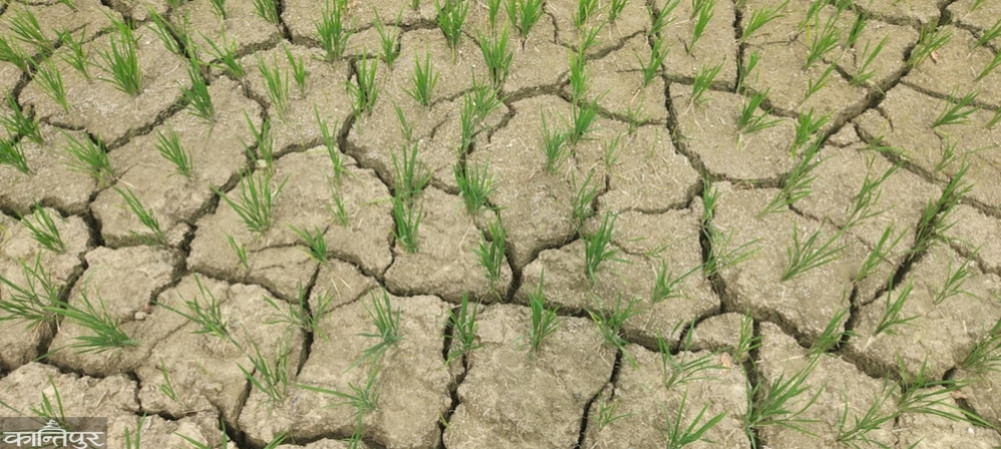
It is the basic duty of the government to bring relief programs immediately after declaring a crisis area, but no relief programs and long-term strategies have been announced.
We use Google Cloud Translation Services. Google requires we provide the following disclaimer relating to use of this service:
This service may contain translations powered by Google. Google disclaims all warranties related to the translations, expressed or implied, including any warranties of accuracy, reliability, and any implied warranties of merchantability, fitness for a particular purpose, and noninfringement.
It is estimated that there will be a 20 percent reduction in rice production across the country due to the impact of the drought in the Terai/Madhesh region, known as the grain storage area. Despite the average growth of rice, the demand cannot be met and the import is expected to increase further this year. Last year, 20 billion 35 million rupees were exported in the import of rice (including seeds). 82 billion is likely to go abroad this year.
It is worrisome that farmers' fields in agricultural countries remain barren, productivity decreases and large sums of money go abroad to buy rice. As more money has to be spent on buying food, other basic plans of the family such as education, health, clothing are reduced. There are natural reasons for such a situation, the state's working style is also responsible. Farmers have to depend on Akash because the irrigation projects under the government plan are not completed on time.
In the last fiscal year, a total of 59 lakh 55 thousand tons of rice was produced. According to the support price set by the government, the total value of rice produced by farmers at an average rate of 34 rupees per kg is 2 trillion 2 billion. But this alone does not satisfy the demand for rice in Nepal. Last year alone, a total of 1.2 million tons of rice was insufficient for Nepal. According to which 533 thousand tons of rice (including seeds) was imported last year. In this process, 20 billion 35 million rupees went abroad. Similarly, 8.666 billion went abroad while importing 241,000 tons of rice (including rice). This year, due to the drought, rice production is expected to decrease by 20 percent, and Nepal will lack about 2.4 million tons. 82 billion will be exported based on last year's average price of 38 rupees per kg.
The exploitation of Chure area has also accelerated the drying up of Madhesh's water sources. The water level is getting lower. Traditional sources of drinking water have dried up in wells, wells and chapakals. The water in the river is decreasing. National, regional and international cooperation is needed to deal with the rapid impact of climate change, but state-level intervention is mandatory to utilize the available water resources. To increase production in Terai/Madhesh through irrigation, the government has initiated dozens of projects out of which half a dozen irrigation projects are said to be of national pride. However, these projects have been under construction for decades. After the completion of Sunkoshi-Marin Diversion multi-purpose project of national pride, irrigation facility will reach 1 lakh 22 thousand hectares of Bara, Rautahat, Sarlahi, Mahottari and Dhanusha. Although the tunnel of this project, which is supposed to be completed in February 2077 and completed by August 2081, only 10 percent progress has been made in the work of the dam. Although the construction of the Babai irrigation project, which will provide irrigation facilities to 36,000 hectares of Bardia, started 38 years ago, only 82 percent progress has been made. The construction of Sikta irrigation project, which aims to provide irrigation to 42 thousand 766 hectares of Banke, started 21 years ago. Its progress is 45 percent.
Similarly, the Rani Jamra Kularia irrigation project, which will reach 38,300 hectares of Kailali, has been started since 2066/67, but only 74 percent progress has been made so far. Even though the Mahakali irrigation project, which will reach 33,225 hectares of irrigation facilities in Kanchanpur, was started in 2063/64, only 26 percent progress has been made. Even though the Bheri-Babai Diversion Multi-Purpose Project to irrigate 51,000 hectares of Bardia and Banke was started in 2068/69, only 69 percent progress has been made. More than 100 billion has been spent on these projects and the time to complete the construction of all of them has been completed. But the cycle of extension continues. Government funds have been being spent on such projects for years, which could have been spent on other projects if they had not been spent there. At the same time, billions of rupees have been spent abroad in the purchase of food grains due to the reduction in productivity due to failure to benefit from the project on time. Mainly, if the construction work could be completed in the time specified in the beginning, the land touched by the project could easily be planted. On the whole, there would not have been a chaotic situation like today.
As the drought continues, the state government has declared Madhesh as a drought-prone area and the federal government has declared it as a disaster-prone area. It is the basic duty of the government to immediately bring relief programs after declaring itself a disaster area. However, the government has not announced any program of relief and long-term strategy at that time. Although the government has announced a program to dig 500 deep borings in Madhesh, the farmers are confused because it takes time to bury the borings and it cannot meet the demand of such a large area. Therefore, the government should announce a relief program that will benefit the farmers. At the same time, priority should be given to programs like conservation of wetlands, land and water use policies, implementation of artificial measures of water recharge. For this, the state and local governments should also be made active. For irrigation, all efforts should be made to complete the maintenance of the completed irrigation projects and the projects under construction as soon as possible. When the project is completed, the farmers will get relief next year, even if not this year.