For us, the culture of stimulation is not a matter of growing up today or tomorrow. It is the result of a poison ivy grown over a long period of time. To solve this, the country needs a strong 'social engineering'.
We use Google Cloud Translation Services. Google requires we provide the following disclaimer relating to use of this service:
This service may contain translations powered by Google. Google disclaims all warranties related to the translations, expressed or implied, including any warranties of accuracy, reliability, and any implied warranties of merchantability, fitness for a particular purpose, and noninfringement.
Since the seven-year revolution, seven decades have passed since the establishment of democracy in the country. If the first written constitution of Nepal is to be added to the 'Statutory Law of the Government of Nepal 2004', the country has had seven constitutions during this period. A demographic structure of about seven generations in terms of age currently exists. In which 'GI Generation GI' is the almost inactive population while 'Generation Alpha' is the latest generation.
The time since 2007 is understood as the starting point of modern Nepal. Because even though the construction of Nepal is far advanced geographically, the work of connecting Nepal emotionally was made possible by the seven-year revolution. Therefore, if we do not understand the practice of seven years of revolution, seven generations of struggle and seven constitutions, it cannot be said that the next two decades of the country will not be quadrupled.
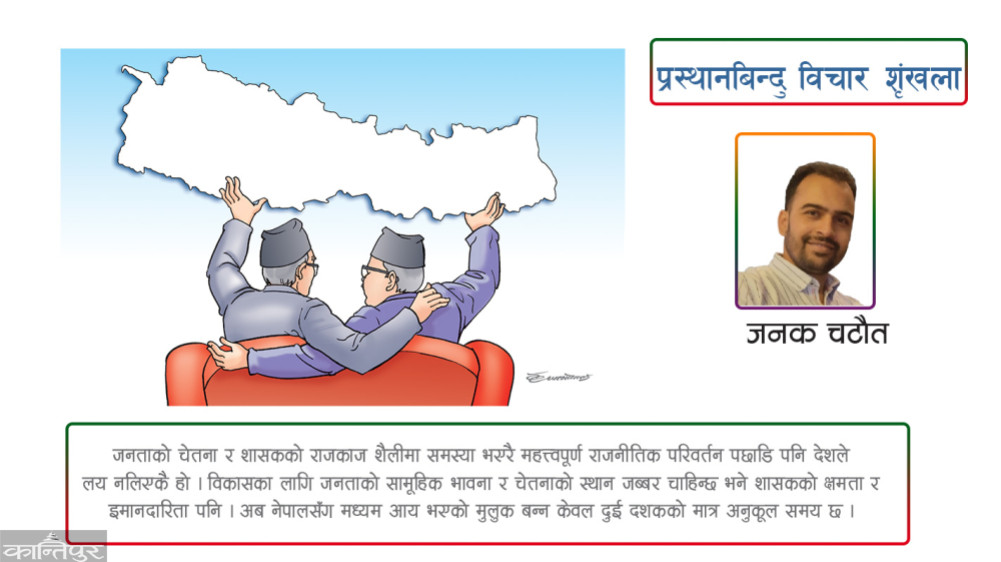
Currently the population of the country is young. In a few years, our population will gradually age. There will be more mouths to eat and sick bodies than hands to work. If you think of BP Koirala's statement that 'whether you call it a country or a nation, it is not the geography, it is not the soil, it is actually the people', it can be said that the country is the people. This means that the people are at the center of the country. Therefore, development requires the collective spirit and consciousness of the people, as well as the ability and integrity of the rulers. Due to the problems in the people's consciousness and the ruling style of the ruler, even after the important political changes, the country has not taken the rhythm according to the people's wishes. Now Nepal has only two decades of favorable time to become a middle income country.
Our common problem
A large part of the Nepalese society has been a victim of agitation in different periods. Unnecessary excitement is rampant in the society even on issues that have little to do with our country. Along with the developments in the country, the issues outside the country also get an unnecessary place here. On January 3, 2020, Iranian General Qasem Soleimani was killed by a US drone strike. The reason may be strategic, which was beyond our concern. However, our social landscape has heated up in such a way that it is assumed that Nepal itself is in a war. (a) Social media experts are employed in large numbers. The pace of reading and teaching was accelerated. Most of the Nepalese were talking about Iran attacking America. While Iran wanted a settlement of the incident.
The political and social environment of Nepal should understand where its national interest lies. When the national interest is greater with the US, we like Russia. As people move into Israel, the political mood shifts to Palestine. When the Gurkhas stay in Britain, the Nepali mind goes to Venezuela. Dishonesty, rights without duty, position without ability, the thought of gaining prestige and the social structure made in the form of return without investment are causing greater difficulties. From placing the burden of one's guilt on the head of others to not trusting power alliances more than the rainy season, the dishonesty is the same.
Before the general election of 2079, a topic was very popular. That glimpse was also seen in the by-elections. It was said about the tendency of Nepali people to vote for the old party - 'Look at the menu, finally, masham, chowmin'. They were told not to eat masham, chowmin for lunch, but they were not taught how to eat it. As a result, young people started choosing unhealthy snacks. The same scene was repeated in Nepali politics. The old political parties were Masham and Chaumin, while some new parties came out as 'laughing'. Their activities have been observed for the past one and a half to two years. It is enough to understand the comfort in his silence on the issue of constitutional amendment on the electoral system and other issues.
short-term and long-term solutions
After the general election of 2079, the House of Representatives and the State Houses remained as 'Hong Parliament'. No party was seen as a majority or anywhere near a majority, nor was the coalition culture strong. During this period, the Federal Parliament made only one law by spending crores of rupees. The chief minister changed nearly two dozen times in the provinces where billions were spent. Seasonal alliances at the center continued to form and break.
During this period, the results in almost all areas of the country remained zero. Therefore, breaking the long silence, the two major political parties in the Parliament, Congress and UML, reached an important agreement on June 17. In principle, the issue of forming a government with the first and second parties in a parliamentary system is uncomfortable, but the implementation of the point of agreement that 'after the implementation of the constitution, after reviewing the strengths and weaknesses and complications that have appeared in practice, give priority to the necessary amendments to the constitution and the creation of appropriate laws for political stability', the country is about to lose two There seems to be plenty of room for facilitating conditions to bring the decade back on track.
However, with this agreement, Prachanda, who reached the opposition bench for the first time after 9 years from power, does not seem to be in a state of silence. Which he has indicated. When the country is about to move on the issue of constitutional amendment, he may get the support of some foreign powers who do not want the good of Nepal. They can bring along the new so-called populists who are sitting on the fence and submit some issues of populism in politics. There will be an attempt to find the support of Balen, one of the popular characters of current politics. Balen, who is trying to understand the secrets and rap of politics, will not support it.
Balen may remain a bitter critic of the government on other issues, but on the issue of constitutional amendment, he may remain silent or stand in favor of the amendment. The efforts of Prachanda and other populists will be different. He will find a formula for political division. They will try to stop the amendment of the constitution somehow. Because one of the worst aspects of this constitution is the proportional system including retail and large political structure, which is the strong support of his politics. He has a bigger fear of losing his political support if the constitution is amended than the country and inclusiveness. While there is a strong possibility that the state can become more inclusive if the constitution is amended. It also shows the commitment of the parties.
The general election has just been held in the UK. Only the Labor Party got a majority of nearly two-thirds on the strength of the popular vote of about 34 percent. Where there is no election system like in Nepal. Policies, leaders and parties that cause political chaos in the name of reserved genders and communities are not there. The party there fielded significant women candidates. As a result, the largest number of women in British history won direct elections. This time, the presence of women in the British Parliament was around 40 percent. Therefore, inclusion should be projected not only as a begging vessel, but also on the battlefield. The meaning of the
statement in the context of Nepal is that the parties should consider the candidature of backward communities including women in the direct election system. It is a hindsight to say that the only way to create an inclusive and participatory parliament is the one currently adopted by Nepal. Rather, the sense that country-friendly options should be sought in the matter of inclusion is a forward-looking thought. Those who accept the fact that there is complexity in the constitution and reconsider it are pioneers. Especially RSVP, Unified Socialists and Maoists should not walk on the backward path of 'twelve cents of my bull'. Help resolve constitutional deficiencies. That is, participate in the issue of constitutional amendment and participate in the national campaign by using the two decades of time of the country that is about to be lost.
The country will take a rhythm in order to overcome the possible obstacles that may arise while amending the constitution. For that, the two big parties will have to emphasize greater national understanding rather than strength of numbers. Perhaps the situation would be much easier if Prachanda was not the war-time Prachanda but the person responsible for adjusting the army and who had been the prime minister of the country three times. If that doesn't happen, it will be beneficial for the two big parties to trust other national powers and move forward. It is necessary to amend the constitution, and even though the concept of proportionality is necessary for the country, the fact that the currently adopted process is not in the country's interest from any angle should be explained to the people.
With us, the culture of excitement is not a matter that has grown up today. It is the result of a poison ivy grown over a long period of time. To solve this, the country needs a strong 'social engineering'. For that, a radical change in education is necessary. For example, rather than the question of how many madrassas there are in a particular local body, if one starts asking what the sources of income can be there, the situation of the country can be changed by the answer.
The country's latest generation, Generation Alpha, is the population born after 2010. The maximum age of which is currently 14 years. Now this population of the country should be converted into an aware people. If all the stakeholders stop worrying about the upcoming elections and start worrying about the new generation, the situation of the country will start looking different within a decade. Before the general election of 2084, if the errors in the constitution and laws can be corrected and the current state of education can be changed and the curriculum can be prepared to help create a positive attitude in the new generation, the excitement parameter among the youth will be greatly reduced. Then the citizens will look at the political party's responsible leader and party's policy, not the flashes and flashes while voting.
The personality, morals, social life, conduct, ability to lead the country, his understanding of policy making and his entire past record will be looked at. For this, the concept of a thrifty state system is a minimum condition to meet the basic needs of the common citizens with easy access to improved quality education and health.
– Chatout is a scholar of electoral system and international relations and diplomacy.