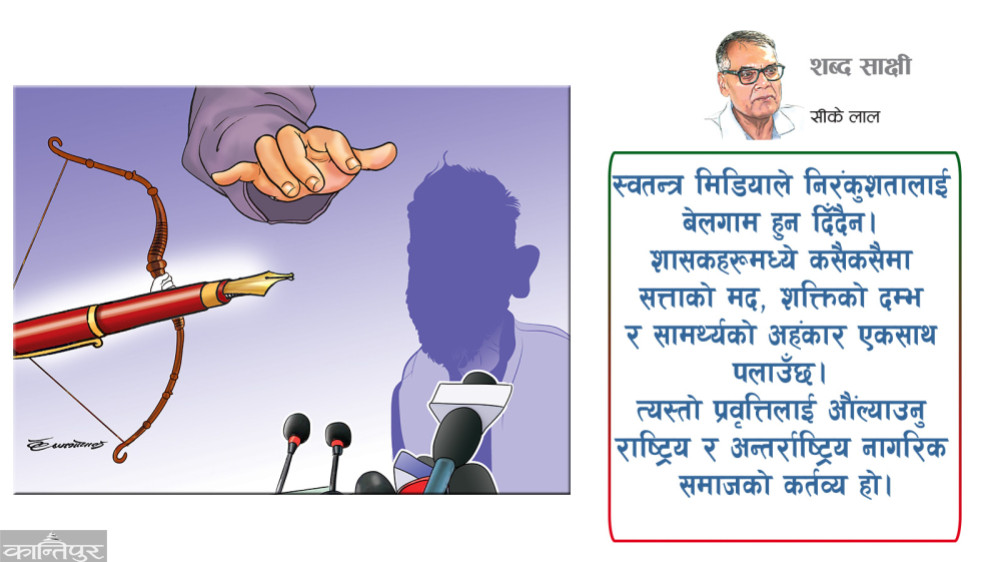
A free media does not allow tyranny to run rampant. In some of the rulers, the pride of power, the pride of power and the arrogance of power grow together. It is the duty of national and international civil society to point out such trends.
We use Google Cloud Translation Services. Google requires we provide the following disclaimer relating to use of this service:
This service may contain translations powered by Google. Google disclaims all warranties related to the translations, expressed or implied, including any warranties of accuracy, reliability, and any implied warranties of merchantability, fitness for a particular purpose, and noninfringement.
Pastor Martin Niemöller (1892-1984) was a spectator, sufferer and witness to the excesses of the 'God Complex' rulers in Germany. A person with delusional psychosis has a strong belief in his abilities, competence and influence. Fascinated by Hitler's divine personality, Niemöller first became a proponent of the Nazis' 'National Socialism' proposition. However, no one can be fooled by a harmless term like 'National Socialism', but a conscious person observes, assesses, grieves and cannot act like he has not seen the atrocities.
Niemöller's short poem of guilt and remorse, composed in a Nazi concentration camp after being imprisoned for free speech, is one of the most quoted poems in the world. The mournful weariness of his poem seems equally relevant even now to shake the apathetic citizens who ignore the footsteps of despotism - 'And they came for me / And, there was no one left / To speak for me.' Wherever the ruler is, the desire to be despot is hidden in him. Only those in power are forced to balance due to tradition, public pressure and popular culture. Being the conduits of public freedom of expression, a free media does not allow tyranny to run rampant. In some of the rulers, the lust for power, the arrogance of power and the arrogance of power grow together. It becomes the duty of national and international civil society to point out such trends.
Kantipur Media Group Chairman Kailash Sirohia's arrest case, the conclusion of the massive civil movement that government power has been misused to seek revenge is not baseless. For the verification of the citizenship issued by the government of Nepal, an investigation should be started by the relevant government agency. The certificate holder may be requested to assist in the investigation. Since the general public does not have access to government documents, there is no compulsion to arrest and investigate citizens. However, Nepal has not yet been freed from the tradition of the Rana and Shah rulers, who "shut down before listening". That is why the Asian Human Rights Commission issued a statement calling Sirohia's arrest "Nepal: Personal vendetta against the media". However, the facts, arguments, and Vivek Begar's citizenship allegations against Sirohia can be categorized as physicist Wolfgang Pauli's baseless preamble, "That's not even wrong." Even if Tal Na Tuk is wrong, it is considered a waste of time and energy to prove it wrong, so those with a scientific mind dismiss it as unfit for testing with the conclusion that 'it is not even wrong'.
The allegations against Sirohia have been widened by 'nationalist jihadists' who broadcast public frustrations from Chinese smartphones. The collective self-infatuation of ethnic arrogance is not going away while living in a foreign country and making the status of carrying an 'i phone'. The problem is that in the post-truth world, the misperceptions on the Internet can be likened to the stench spread by bringing a scumbag to the surface—there is no alternative to walking around with your nose shut. Around 2013, Italian programmer Alberto Brandolini, seeing the power of fake information, proposed the 'Bullshit Asymmetry Principle' (Bullshit Asymmetry Principle). According to the theory, also called the Brandolini method after its proponent, it takes many times more energy to refute the nonsense. As if 'Sirohia's citizenship is not valid', if not, there will be a process to correct it. It is public knowledge that the person who became an American citizen by throwing his citizenship in the trash and who regained his citizenship through the fast track by following the court order, joined media houses and cooperatives and became the home minister and deputy prime minister. No one has even objected that Sirohia renounced Nepali citizenship. An easily rectifiable flaw may have crept into Sirohia's Nissa, as it has with many other people's citizenship certificates. It is not possible to make serious accusations like misuse of citizenship without facts and evidence collected from intensive research.
The sociality of hatred
Janakpuria may be the one who can speak most factually about Sirohia's citizenship authenticity. He was born in Janakpur. Studied at Saraswati High School. Ramswaroop may have watched movies like Hanuman or Bachhar Takiz after 'class bunk' from Ramsagar College. When he went to Ratna Sagar with his friends, he might have been scolded by his family. Like other relatively affluent Madheshis, he may have been in a hurry to get a citizenship certificate to buy and sell property. Until the mid-1980s, life in Janakpur was flat. Sirohia's life must have become dynamic only after entering Kathmandu to build a future. However, even though Sirohia left Janakpur, Janakpur did not leave him. As former Supreme Court judge and Janakpur resident Girish Chandra Lal said, 'Kailash Sirohia is as much a citizen of Nepal as Janakpurdham is of Nepal.' Lamichhane has not received a new citizenship for a long time) There may be various reasons behind the animosity and arrogance of politicians.
Like the Sinhalas of Sri Lanka and the Bamars of Burma, Nepal's hegemonic Khasarya community is rife with the stigma that their ethnicity is only 'Khanti Nepali'. Like other warrior communities, the Gorkhalis also look down on Vaishya Karma. Sirohia also falls into the category of 'a trader, a Marwari at that'. His enterprise is communication. If there is no conflict in the relationship between the hypocritical state power and the honest journalist or media entrepreneur, then collusion should be suspected. Media workers who have cordial relations with the ruling party may be indulging in cover-up rather than uncovering the facts and truth.
Sirohia, who has created a separate and independent identity by breaking away from his ancestral business, is an example of a self-made success. In the high society of Kathmandu, where the history of fathers and sons connected with the court of this or that Rana, Shah or their Bhardar is sold, the custom of insulting self-made personalities as 'spawned' still persists. However, the concept of editorial freedom cannot hold the media entrepreneur responsible for the content of the media. But the challenging Rabaiya embraced by the Kantipur group towards the Satasins also made the actual head of the executive (defacto chief) Khadga Prasad Sharma Oli, Letterhead Prime Minister Pushpa Kamal Dahal and political 'sparrows', but being in charge of the administration and the police, political figures like Madamat Griha and Deputy Prime Minister Lamichhane may have gained the reputation of 'showing Sirohia his worth'.
As expected, national and international press freedom advocates protested Sirohia's arrest. Organizations like Amnesty International and the Asian Human Rights Commission have criticized the government's misguided actions. The main opposition party, the Nepali Congress, has pledged not to allow press freedom to come to an end. Despite some bitterness in the past, the umbrella organization of journalists has stood by Kantipur with Dahro. But as Sirohia of Janakpur was tried to be murdered in Janakpur, he got the most sincere support from Janakpuria. On the surface, such goodwill toward one's predecessors may seem ironic.
The Kantipur media group, which has taken responsibility for blowing the trumpet of nationalism, is not biased. Because the first, second and third Madhesh revolts were trying to create an atmosphere in favor of hegemonic ethnicity, the most frequently burned newspaper in Janakpur and Madhesh was perhaps Kantipur. However, not if the media owner can completely control the bias of the editor, the ethno-nationalism prevalent in the newsroom and the opinion of local correspondents that 'it is not successful if they tell what Kathmandu wants to hear'. Even after his arrest, Sirohia, who was taken to Janakpur, must have started to understand the truth that although he is of Marwari origin, he is practically a Madhesi. Limitations of
Following
It is not uncommon for aspiring individuals from subordinate communities to desire to blend in with the dominant community. The cultural values and norms of the dominant community are defined as 'national mainstream'. Therefore, dung and cow urine are considered sacred, but beef is considered non-vegetable and prohibited by the satasins who set the standards of political dignity. Once the slogan of restoration of democracy was considered a crime, now a campaign has been launched to prove that federalism is unsustainable. Social practices are also given legitimacy by the dominant community. The practice of calling Labeda-Suruwal as Nepali dress and Dhoti-Kurta as non-Nepali has gained more legitimacy of practice than what is written anywhere. Like other aspiring Madheshis, the feeling of 'Nepali bole Nepali bainha' may have developed in Sirohia as well. What did he know at that time, even the three-generation Marwaris of Vatu and Indrachowk, who grew up listening to Nepali language from Kokro, are not considered 'Khanti Nepali' by the ruling community.
Maharani Kantavati, who kept Shah Raja in her stomach for nine months, is still dismissed by ethnic historians as the 'Maithil widow'. There was no attempt to make the then President Ramvaran Yadav a Gopalvanshi or Mahishapalvanshi and make him a tradition bearer of the Nepal Valley, just like Mayor Balen Shah is cheering now. Fearing that he would lose his dignity by wearing a Maithil headdress and taking off the Dhaka cap, he chose to wear a cap for an event. Jayaprakash Prasad Gupta, a genius of unity and beloved of the Koirala family, also had the illusion of being 'like other Nepalis'. On the other hand, Upendra Yadav, who was established by politics in the name of Madhesh, despised the concept of Madheshism and tried his best to become national and socialist. All such outward campaigns will automatically disintegrate once the purpose of the dominant community is over.
Even though the Madhesi identity has received constitutional recognition, there are also some internal constraints behind the inability to get cultural and social acceptance. To paraphrase the warning of the pioneer of critical pedagogy, Paolo Freire, if the subordinate community does not have a comprehensive conception of liberation, it will not take long for their potential saviors to turn into fagots. In such neo-nationalists, the desire to blend in with the dominant community is more visible. Ultimately, the inclusive concept of nationhood crumbles to the ground. Marwaris, Muslims and Tharus among the subordinate communities of Nepal have a slightly higher desire to become 'Khanti Nepali' than other Madhesi. There can be various reasons behind it. In Madhesh, a capable group of intellectuals (organic intellectuals) who can influence the thoughts, behavior and actions of the common people has not yet been prepared. Even if politicians raise the issue of a multi-nation state, cultural and social awareness must be developed to build the intellectual base needed for that. People who can take that kind of intellectual responsibility are even more tempted to go with the so-called 'mainstream'.
Nationalists in favor of a single identity may question - 'Why is there a need to expand awareness of sub-nationalism in Nepal?' The question is not unnatural. The answer is not easy. In order for the process of natural integration to be effective in a multinational society, it is necessary to develop harmony, equality and solidarity instead of prejudices such as collective self-infatuation and racial entitlement prevalent in the dominant community. It takes a long time for that kind of attitude to spread in the society as a whole and even if it is established in some way, there is still the risk of ethnonational backsliding. America's Trumpism, India's Modiism, and the Sinhala ethnocentrism that hollowed out Sri Lanka can be seen in any country where the dominant community maintains sole control. Another attendant risk of ethno-nationalism is the emergence in the leadership ranks of people who are victims of deva disorder, the disease of extreme self-infatuation and delusional beliefs.
The Rana and Shah rulers were considered to be incarnations of Vishnu in this world. Ever since he completed his journey to Ujjain to free himself from the ghost of Mao, the letter-bound Prime Minister Dahal has been a descendant of Chandrasekhar Upadhyay, the signatory of the Sugauli Pact. As a result of the financial control, the ethnic protection of Sharma, "Baal's hair called 'has not been able to be free from the Scriptural care of' Balcat Buy.
reaches US citizenship would have been a "contributor of the gad Complax 'Lamichhane, Lamichhane, who had given up US citizenship. This type of leadership groups are voluntary. Therefore, the nomolor's territory, mentioned by the Asian Human Rights, and I did not talk about, and I was not a citizen society / then they They came for laws and judges, and because I was not a lawyer or eventually, it was not anyone left to speak. 'It is automatically clear that it cannot be saved for me. Maintain such a public mechanism, a public mechanism, and the best of the Republic Day.