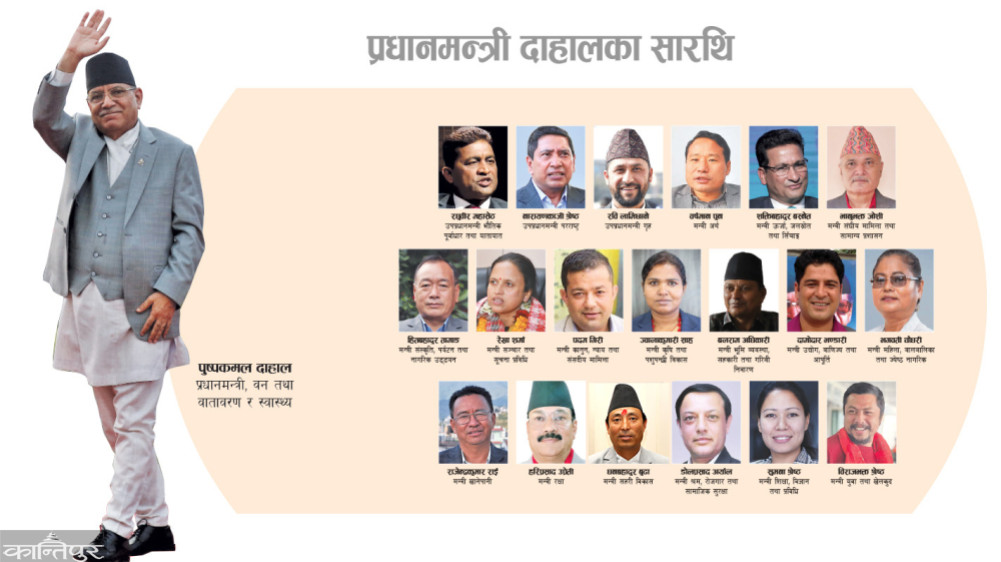
What results will the next cabinet give? The whole country is anxiously waiting for the answer to this question rather than Prime Minister Dahal. If the government fails in this, there will be a big threat to the system.
We use Google Cloud Translation Services. Google requires we provide the following disclaimer relating to use of this service:
This service may contain translations powered by Google. Google disclaims all warranties related to the translations, expressed or implied, including any warranties of accuracy, reliability, and any implied warranties of merchantability, fitness for a particular purpose, and noninfringement.
Five years of government has become an unfulfilled dream for Nepali people. It was a different matter that Bhimsen Thapa ruled for 31 years when the government was not organized and Jung Bahadur and Chandrashamsher ruled for three decades during Jahanian Rana's rule. But in the seven decades since the 2007 change, no prime minister has been able to complete a five-year term.
Even during the Panchayat period, when the king appointed the prime minister in Tajbiz, no prime minister managed to run the government for five years. Surya Bahadur Thapa, who became the Prime Minister for the second and third time in 2021 and 2036, ran the government for four years each. The same Thapa could not last even one year for three more terms.
The panchayat was an undemocratic, unreliable and unaccountable regime, so the accounting of who came and who went under the king's command is not great in itself. However, the more relevant the question of how many times the government has changed in a democratic system, why it is happening and what difference it has made, the answer should also be logical. However, Prime Minister Girija Prasad Koirala's tenure of 3 years and 6 months in the year 2048 among those elected through the democratic method is the biggest record so far. Even though Girija Prasad five times and his successor Sher Bahadur Deuba became the Prime Minister five times, the government has always changed within a year. Individuals may consider this as an achievement, but for the country, this ups and downs is very good.
How did the country suffer? The bigger question is how long will this state of the country last? The misfortune of changing governments and alliances in five years, three years, or even two years, but year/year, is seen as incessant. Realizing that the country is lagging behind in government building and manufacturing, the new constitution has taken some initiatives for stability. The purpose of arranging that a motion of no confidence cannot be brought for at least two years after the formation of the government was to protect the system and not the individual. However, now the position of Prime Minister and Minister will be preserved, but there is a growing disaffection towards the system. The fact that the government changed three times in the last one year makes this fact clear.
Some ministers left the centre, some came in. The subject is no longer just that. As the federal coalition and the government go down, governments fall in one wave from Far West to Koshi, there will be political/non-political exercises to form a new coalition and the general frustration of the people will increase. Voters are tired of this process. As the companions of the center have changed, the existence of the governments of the seven provinces is now at stake. Now, what kind of political drama will be staged to save, overthrow and re-establish the government, the citizens have to suffocate even while guessing. Moreover, changing power coalition means that the primary functions of the government are also affected. The 'Lariats and Leaders International Summit' scheduled for next Monday and Tuesday in Lumbini has been postponed due to the reshuffle of the power alliance. The sudden cancellation of the program in which 10 Nobel laureates and about 150 distinguished people from different countries will participate has damaged the reputation of the country.
Prime Minister Dahal, who became the Prime Minister at the initiative of UML after the parliamentary elections held 15 months ago, chose to join forces with the Congress within two months. However, exactly one year later, he has joined UML's hand. Despite the four-party government formed by the UML, Maoist, Rashtriya Swayamsevak Sangh and United Socialist Party, today the alliance has only 139 MPs, which is just one point more than the 138 seats needed to sustain the government. In a country with such an unreliable political culture, it is difficult to predict what the future of the government will be when one or two MPs are at the top. Not only that, if the government is upside down, how much stability will the alternative government provide? Will that situation create a wave of frustration in the center and the state again? It is really interesting that the leaders of the parties involved in the power game do not think about it.
Changing the government according to the democratic system is not unusual. However, when the country is going through an economic recession, the private sector is not enthusiastic about investment, employment opportunities are shrinking and even self-employment is proving to be a nightmare, it is not good for political parties to focus only on power politics. Prime Minister Dahal has argued that he is not allowed to fail, but because the efficiency of his colleagues, including the finance minister, did not produce results, he had to change his companions. Apart from the Minister of Finance and the minister of the allied party, the prime minister should also self-examine how the performance of the minister of his own party was as well as the people. Only if he can find a reasonable answer to that question, he can make the new team result-oriented. What results will the next cabinet give? The whole country is anxiously waiting for the answer to this question rather than Prime Minister Dahal. If the government fails in this, there will be a big threat to the system.