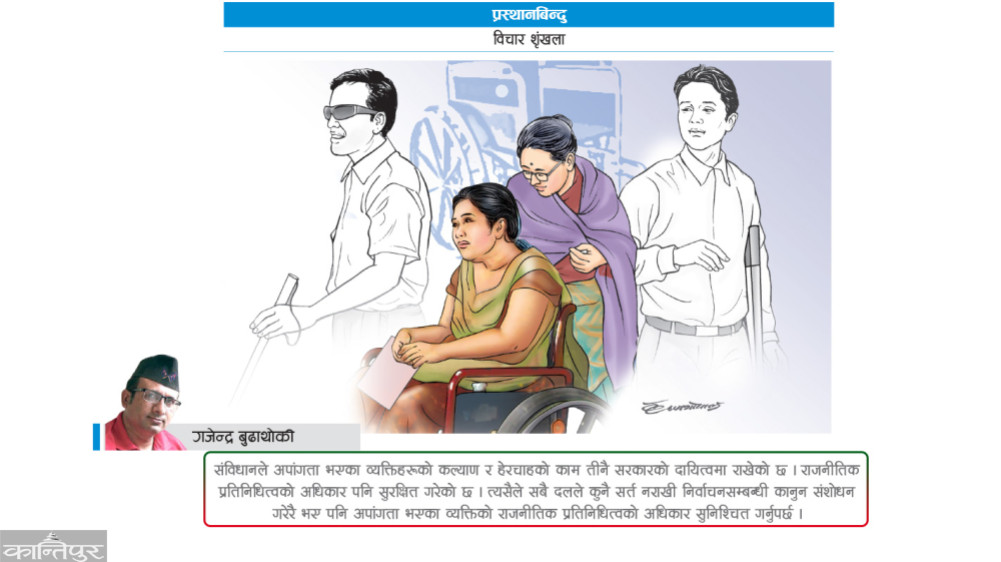
The constitution has put the welfare and care of persons with disabilities under the responsibility of the three governments. The right of political representation has also been secured. Therefore, all parties must ensure the right of political representation of persons with disabilities, even if it means revising the electoral laws without any conditions.
We use Google Cloud Translation Services. Google requires we provide the following disclaimer relating to use of this service:
This service may contain translations powered by Google. Google disclaims all warranties related to the translations, expressed or implied, including any warranties of accuracy, reliability, and any implied warranties of merchantability, fitness for a particular purpose, and noninfringement.
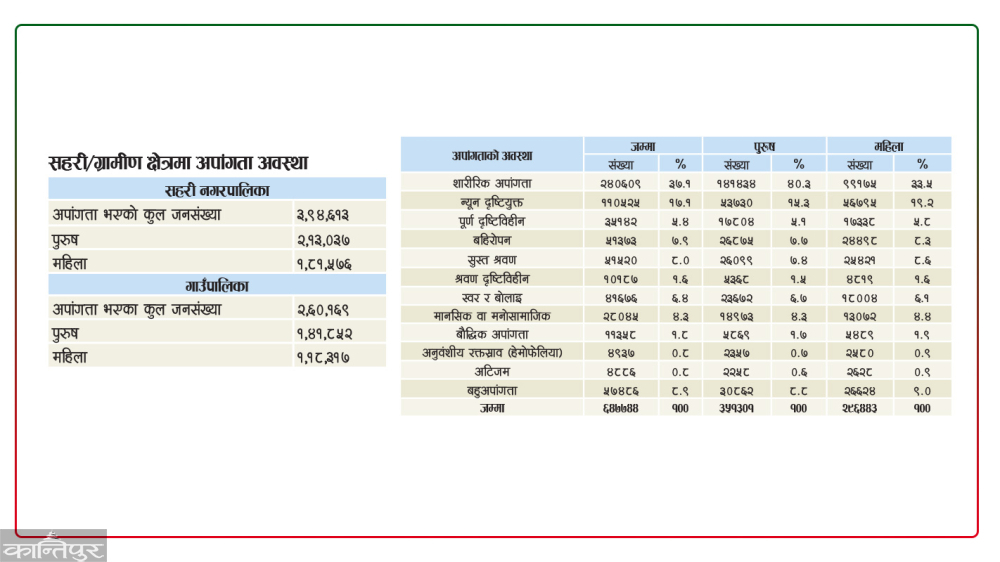
When it comes to the issue of disability in Nepal, there are various differences regarding the number itself. Census 2078 has shown that 2.2 percent of the total population has some kind of disability or 647 thousand 755 people have disabilities. While the Nepal Population and Health Survey-2022 has shown that 6.7 percent of the total population has some form of disability.
Similarly, a survey conducted by the Sharecast Initiative Nepal has shown that 6.7 percent have disabilities. Officials of the National Statistics Office themselves admit that the population is in a state of disability more than the information shown by the census because the last two figures are target-surveys. This is confirmed by the Social Security Allowance (which will later be called mother-in-law allowance) to be distributed by the Government of Nepal.
According to the National Identity Card and Registration Department, there are currently 24,547 people with disabilities receiving the mother-in-law allowance provided by the Nepalese government. This facility is available only to persons with disabilities of category A and B, while all of them do not even receive allowances and identity cards. Category 'A' is classified as total disability, category 'B' is classified as severe disability, category 'C' is classified as moderate and category 'D' as normal disability. However, since this classification is unscientific, there is a growing need to determine percentages based on physical, mental, and intellectual disability, and to do different types of classification for different classes, social security allowances, auxiliary materials, rehabilitation facilities, etc. to be given by the state along with identity cards. For this, first of all, there should be real data of people with disabilities. This work is not so difficult now. The National Statistics Office (NSO) can not only conduct surveys with the help of local municipalities, but also map the actual situation of people with disabilities.
 Why can't the federal and state ministries of finance, which can allocate budgets for many political programs, allocate budgets for surveys and mapping of such a serious nature? For the National Disability Status Survey, which is included in the action plan, it is not appropriate for the NSO to sit on the ground that "there is no budget" and "the Ministry of Finance has not given its consent". If the government does not agree to the 'National Disability Status Survey' then why and why should be explained to the Parliament. Otherwise, it will be considered as another serious discrimination created by the state and may be raised before national/international judicial bodies.
Due to non-availability of other reliable data, in this article, all three data of Census, Population and Health Survey-2022 and National Disability Survey of Sharecast Initiative (Nepal Disability Survey-2022) have been analyzed.
Current situation
According to the National Census-2078, there are about 6.5 lakh people with disabilities across the country, considering that 100% of them are disabled, the highest level of disability is seen in Bagmati province, where 19% of the total number of people with disabilities live in the country. Then 18/18 per cent in Koshi and Lumbini, 12 per cent in Gandaki, 11 per cent in Far West and 8 per cent in Karnali. Looking at the ratio of the population of the province, 2.4 percent of the total population of Koshi, 1.5 percent of the population of Madhesh, 2 percent of the population of Wagmati, 3.1 percent of the population of Gandaki, 2.4 percent of the population of Lumbini, 3.1 percent of the population of Karnali and 2.6 percent of the population of Far West. A percentage has a disability.
Looking at the municipal basis, 60 percent of people with disabilities live in urban municipalities, while 40 percent live in rural municipalities. The reason for this is that people are forced to leave the village and live in the city because there are disabled-friendly services in urban areas. This is also the reason why Wagmati has the highest number of people with disabilities. This fact is also confirmed by the National Population and Health Survey. According to the results of the Population and Health Survey, the urban area of Wagmati has the highest number of people with disabilities (4.5 percent) in the country. The main reason for this is that the number of people with disabilities living here is higher due to education, health, employment, income generation and other livelihoods due to low access for disabled people outside Kathmandu.
Disability and Literacy
If you look at the literacy situation of people with disabilities, the situation is dire. In the last one decade, the state of literacy in the country has improved and almost 76 percent of the citizens have become literate, but only 50 percent of the citizens with disabilities are literate. Out of which the male literacy rate is 60 percent while the female literacy rate is only 38.5 percent. According to the condition of disability, the most literate are visually impaired (63.4 percent), 60 percent are physically disabled, 40 percent are deaf, 41.5 percent are hearing impaired, 44.6 percent are visually impaired, 46 percent are multi-disabled, and the lowest are 20 intellectually disabled. Only percent are literate. The main reason for this is that people with disabilities do not get the opportunity of education because educational institutions such as schools and universities are not accessible.
Disability and poverty
Although the Nepal Living Standard Measurement Survey measures poverty and analyzes its condition, poverty and disability have not been analyzed in all the four living standard measurement surveys so far. Therefore, for this study, the data of Nepal Population and Health Survey-2022 and National Disability Survey conducted by Sharecast Initiative Nepal have been taken as basis.
According to Nepal Population and Health Survey-2022, 3.4 percent of the highest poor class, 3.4 percent in the second income class, 2.8 percent in the middle income class, 2.6 percent in the fourth income class and 1 in the rich income class. 6 percent are disabled. Similarly, according to the results of the National Disability Survey-2022, 11.2 percent in the monthly income category below 10,000 rupees, 8.4 percent in the monthly income category up to 20,000 rupees, 7 percent in the monthly income category up to 30,000 rupees, and 7 percent in the monthly income category up to 40,000 rupees. 6 percent in the category and 5.1 percent in the category earning more than 50,000 rupees per month.
The results of these two surveys show that there is a close relationship between poverty and disability. The conclusion of this study is that in the family where there is a household member with a severe disability, the income of that family will be low and the situation of poverty will be high and the situation of food security will be weak. A closer look at this from empirical evidence shows that people with severe physical disabilities, total blindness, speech and hearing disabilities, intellectual disabilities and multiple disabilities have higher levels of poverty because they have less opportunities for income and employment.
This is further encouraged by poor educational conditions. According to Nepal Population and Health Survey-2022, 15.1 percent of people with complete disabilities have no school education, 3.6 percent have studied up to 8th standard, 1.5 percent have studied up to 10th standard and only 0.1 percent have passed 12th standard. As the condition of disability decreases, the condition of education also looks better. However, the study shows that among those with an overall disability (moderate to complete), about 30 percent are illiterate. This simply means that people with disabilities have very poor access to education.
No disability-friendly infrastructure
The Universal Convention on Human Rights, the Universal Convention on the Rights of Persons with Disabilities, makes this a priority. In the case of Nepal, when talking about the rights, rights, services etc. of the disabled people, the first question is that where is the right of the disabled people to live a humane life protected?
Few roads, buildings, public places are not accessible to people with disabilities. In the year 2034, Nepal made the first Disability Rights Act, was one of the first countries to sign the Convention on the Rights of Persons with Disabilities in 2006, the rights of persons with disabilities were protected in the Constitution of Nepal 2072 through the Interim Constitution 2063, and a separate Act on the Rights of Persons with Disabilities was issued in 2074. However, people with disabilities are still struggling with basic problems. Even though the National Building Construction Code 2060 has been further refined in the amendment of 2071 to ensure that disabled accessible buildings and other infrastructures are made, public buildings are still not fully accessible to people with disabilities.
Overall access for people with disabilities from education, health to employment is poor. Since the year 2064, the Public Service Commission has applied the principle of inclusion and started recruiting in the civil service under the quota system, although the entry of disabled employees into the civil service has increased, the situation is not satisfactory. At present, the total number is considered to be 100 and 45 percent of the reservation is allotted. There is a provision to separate 5% of that 45% to 100% for people with disabilities.
The way forward
The current situation does not only show despair. The entry of people with disabilities into the civil service is increasing, albeit in small numbers. Access to education is gradually increasing. The most important aspect is that the rights are constitutionally and legally protected and the main responsibility for their implementation will now be. There is a need to create more opportunities for education, health employment and social integration.
Government's responsibility
The Constitution of Nepal 2072 has placed the responsibility of the welfare and care of persons with disabilities on all three governments. The Constitution has protected the right of political representation of persons with disabilities at all three levels. Therefore, all political parties should ensure the right of political representation of persons with disabilities, even if it is by amending the electoral laws on today's date, without any 'and', 'or', or 'if' condition. which acts as the first step in the protection and enforcement of rights.
There is no need for disability inclusive policies, action plans and overall framework of programs etc., such policies, action plans and programs have been in the making for years. The problem is implementation. of the executing agency. What is the agency that deals with issues or issues related to the rights of persons with disabilities? Which is the official body (nodal agency) to listen to their grievances? Which is the agency that provides aids such as wheelchairs, white canes, hearing aids? The Union Government cannot get away with showing a small subsidiary structure like an NGO.
For the implementation of the United Nations Convention on the Rights of Persons with Disabilities (UNCRPD), create a legal and empowered high-level body that can address key areas such as national policies, plans, action plans, full access, education, health services, employment and social security ( For example, initiatives to create a National Authority on Disability Affairs or Disability Rights Commission) and provincial and local bodies of a similar nature have been delayed. Such a body will formulate and implement policies, plans and programs for the welfare of persons with disabilities, act as the primary coordinating body for disability-related initiatives, and advocate for disability rights and inclusion. In addition, it may advise the government on disability issues, and may also implement tailored assistance schemes that address the needs and goals of persons with disabilities. For this, if necessary, the Parliament may have to take initiative to amend the existing law.
is another important budget. A mechanism with sufficient budget is needed for the construction of disability accessibility infrastructure, full access to education, health care facilities, rehabilitation programs, assistive materials and assistive technology and specially targeted social security schemes. Improving the living standards of people with disabilities, rehabilitation and public welfare will not be possible with the current budget allocation. For this, first of all, those in the government have to loosen their mentality and thinking base.
The Union Government will create a legislative framework for the inclusion of disability rights and improve livelihoods, implement equal opportunities, non-discrimination and accessibility standards in areas such as education, employment and health services, promote inclusive education, provide vocational training and employment through agencies such as CTEVT. The existing social security schemes should be expanded along with the system. State and local governments should formulate and implement policies, strategies and action plans according to the specific context and needs of their respective states. While the problems are not the same everywhere, the numbers and conditions of people with disabilities may vary. A policy of addressing the main cases of the demographic, geographical and socio-economic characteristics of the state should be addressed. & Nbsp; & nbsp;
Monitoring, sub-metropolitic, municipalities and villages are the closest government of people with disabilities. The main obligation is also in the local government to conduct improvement, community-based researciation and folklore based programs in their livelihood. Ironically, now girls are now considering their decision to be completed by the center. By widening the scope of this thinking, the local government must now take the initiative for the welfare and rights of people with disability in their sanlets. The first thing can be mapping people with disabilities. A pair of scholarships can make a work plan about the facilities, services that need to set up the profile of people with disabilities through each ward office. Parlians can provide assistant materials, educational examinations in three months, supporting assistance, education, health and employment from medication. It is important to make an effective provision to establish community based assistance services and employment opportunities and employment opportunities to promote social and economic inclusion effective to promote social and economic inclusion. Thinking that the United States is not only written in the National Compensation Plan, it is not effective thinking that it is not effective in the lower level. The local government should also play a role in increasing the opportunity to provide access to necessary services, community in community development and to contribute to local development efforts. Need is necessary to run awareness campaigns and the sensitivity training in people with disability with disability with disability with disability.
(Not only politics, but industry, business, agriculture, education, health, tourism, banking, cinema, literature, there is disappointment everywhere now. The country cannot bear the burden of this disappointment for a long time. To promote lively faith, Kantipur has started a series of ideas- A 'starting point' where different experts will write proposals for reform, continuously.)