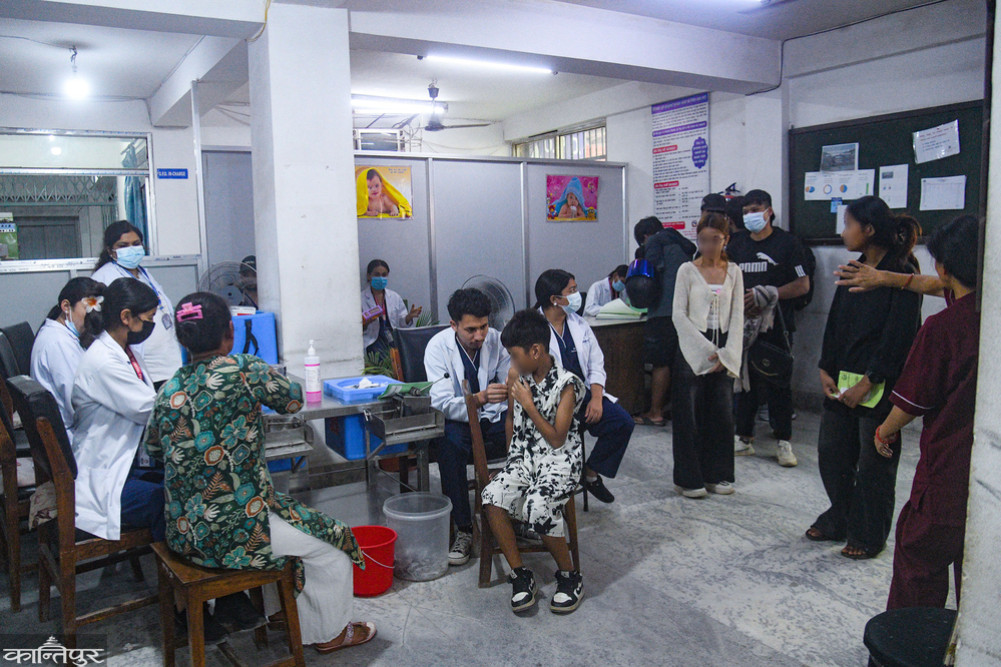
Patients are losing their lives due to the lack of rabies vaccines, which are being provided free or at a low cost in government hospitals. The government's inability to supply them is causing problems for poor and economically weaker patients who have to buy them from private pharmacies.
We use Google Cloud Translation Services. Google requires we provide the following disclaimer relating to use of this service:
This service may contain translations powered by Google. Google disclaims all warranties related to the translations, expressed or implied, including any warranties of accuracy, reliability, and any implied warranties of merchantability, fitness for a particular purpose, and noninfringement.
Patients are suffering due to the lack of anti-rabies vaccine (ARV) given after being bitten by animals like dogs and foxes in government health institutions. Patients have even started losing their lives due to the lack of this vaccine, which is being given free or at a low cost in government hospitals. Poor and economically weak patients who cannot afford to buy it from private pharmacies are suffering due to the government's failure to supply the vaccine.
A person died of rabies infection in Chandragiri Municipality, Kathmandu, last Saturday. A 48-year-old man who was admitted to the Shukraraj Tropical and Communicable Diseases Hospital (TEKU) after contracting rabies died during treatment. He had not been vaccinated against rabies even though he was bitten by a dog a few weeks ago. Doctors said that the man died due to the lack of vaccine available at local health institutions and negligence by his family. “We all thought that the vaccine was not necessary because he was bitten by a small dog,” said a health worker at Teku Hospital, quoting a relative of the victim. “If the vaccine had been available at the nearest health post, we probably wouldn’t have lost him.”
Despite the acute shortage of rabies vaccines in government hospitals across the country, officials say the Ministry of Health and Food Security has strictly prohibited the release of information about it. A few days ago, an employee of the hospital’s emergency department said that the ministry had questioned and alerted officials who spoke to the media about the vaccine shortage. The employee said, “The situation is very serious. We don’t have a single dose of the vaccine to be given to patients bitten by dogs. But we are prohibited from speaking to the media about it.”
Lumbini Provincial Hospital, Butwal, which receives up to 100 dog-bite patients daily, has been short of rabies vaccine for the past three months. The hospital is providing this vaccine service by making patients purchase it from private clinics. On Monday alone, 28 people came to the hospital seeking treatment for dog bites.
Pragyan Dumre, 5-year-old son of Anantaraj Dumre of Dipnagar, Butwal Sub-metropolitan City-7, was bitten by a dog on 31 Jestha. He was immediately taken to the emergency room of Lumbini Provincial Hospital in Butwal. After learning that there was no vaccine against rabies, he went to various private hospitals and clinics in Butwal. The vaccine was found in private clinics. However, it was found that the vaccine, which needs to be kept in cold temperatures, was being sold openly, and that too was written as ‘Only for India’. The doctor at Lumbini Provincial Hospital advised not to use it as it was not effective. He then said that Tilottama Municipality had purchased and kept the vaccine for the city residents.
‘After receiving information about the shortage of vaccines at Lumbini Provincial Hospital for three months, I also asked the Provincial Health Ministry, the Federal Ministry and the National Public Health Laboratory in Teku. As a resident of Tilottama, I was able to vaccinate my son,’ he said. He said that many citizens have suffered greatly due to the long-term shortage of this essential vaccine in government health institutions.
Tilak Gautam, head of the vaccination section against Rabies at Lumbini Provincial Hospital, said that there has been a shortage of vaccines at the hospital since the second week of Chaitra. When the hospital had sufficient vaccines, 80 to 100 patients with dog bites used to come, but now 28/30 people are coming daily even amid rumors of vaccine shortage, he said. ‘Only 28 people came on Monday,’ he said. ‘The Provincial Health Supply Management Center, which used to provide us with vaccines, has not provided them since the third week of Chaitra.’ He said that patients are being vaccinated by having them bought from private institutions.
Mohan Joshi, who works for an NGO at the Health Supply Management Center in Lumbini Province, said that although the supply division of the federal health ministry was supposed to provide the province with the vaccine, it was not provided after Chaitra. ‘Information has come that the vaccine will not be available throughout Asar,’ he said, ‘Now, after tendering for procurement in the new fiscal year, it will be easy until Shrawan.’ He said that the anti-rabies vaccine was not available in government hospitals in Lumbini Province throughout Asar.
Patients in remote areas are more affected by the lack of vaccine. Rohit BK of Dhakari Rural Municipality-1 in Achham reached the district hospital two weeks ago after being bitten by a dog. He has not been able to get the anti-rabies vaccine yet after the hospital returned it saying that it was out of stock.
He is living in fear as there is no option to get the vaccine in the district. He said that he is planning to go to India for work and get it there. ‘I have been bitten by a dog for 15 days, I have been living in fear without getting the vaccine in the hospital, now it is time to go to India, so I will go there and get it,’ he said, ‘The government should not be so careless with a serious vaccine that is not easily available everywhere.’
District Hospital Achham issued a notice on 29 Jestha stating that the provincial health supply management center has not been supplying the vaccine against rabies regularly. According to Ganga Budha Magar, senior nursing officer and information officer of District Hospital Achham, 2/3 patients who need to get the vaccine against rabies come to the hospital every day. He said that due to the lack of vaccine, the patients have to be turned away empty.
Similarly, 20 to 30 people come to Narayani Hospital in Birgunj every day for rabies vaccination. The hospital has been turning them away empty for a month. People from Bara, Parsa, Rautahat and even India come to this hospital for the vaccine against rabies. There was a shortage of this vaccine for three months before. The hospital has said that it has been a month since the vaccine that came after that was finished. Prahlad Sah, rabies focal person at Narayani Hospital, said that 500 to 600 vials of vaccine are consumed here per month. Patients who buy it from a private institution usually pay Rs 650 per vial.
Due to the shortage of rabies vaccine in the hilly districts of Koshi Province for the past two months, patients bitten by animals including dogs, cats, and foxes have been dying. After the vaccine supply stopped at Panchthar District Hospital, patients have to buy the vaccine themselves and bring it to the hospital and the health workers administer it.
According to Ahab Somnath Dangal of Panchthar District Hospital, no rabies vaccine has been received in any hospital in Koshi Province, including Panchthar, since April 15. He said that due to the shortage of vaccine in government institutions, patients who come for treatment have to depend on private health institutions.
A month ago, Iksa Kerung of Phidim-4 said that she bought the vaccine for Rs 630 per dose after being bitten by a dog. She complains that she had to bear additional expenses due to the lack of free or subsidized vaccines in government hospitals. According to Panchthar District Hospital, 188 people were vaccinated against rabies in Chaitra. Only 88 more people were vaccinated until April 15. Since then, the service has been affected due to the lack of new vaccines. The hospital does not keep a separate record of the vaccines purchased by patients. Dangal also said that the Koshi Province Health Supply Management Center has assured to send 200 doses of the vaccine by Asad 9.
Treatment services have been affected due to the lack of rabies vaccine in government health institutions in Bagmati Province. The anti-rabies vaccine purchased by Hetauda Hospital has also run out.
There is a shortage of anti-rabies vaccine in other health institutions under Bagmati Province. After the vaccine stock ran out at the Provincial Health Supply Management Center in Hetauda, the vaccine has not been available in hospitals and primary health centers in 13 districts of the province, including Hetauda Hospital under the Madan Bhandari Institute of Health Sciences.
According to Ishwar Mahara of the Provincial Health Supply Management Center Vaccination Branch, there has been a shortage of rabies vaccine for the last three months. 'There is a continuous demand from health institutions across the province, but the center has not been able to distribute it due to lack of stock,' he said.
In the current fiscal year, 15,000 vials of anti-rabies vaccine were received for Bagmati Province from the Federal Ministry of Health and Population. Even though about 500 vials of vaccine were distributed last year, no new supply has been made since then. Although about 10,000 vials of vaccine are required monthly across the province, they cannot be supplied as per demand, so patients are deprived of vaccination.
The Provincial Health Supply Management Center says that since the federal government alone has the authority to purchase vaccines, the province has not been able to supply them on time despite the provincial government's request. Since the vaccine is not available from the federal government, the province's health institutions have been forced to find alternative solutions.
Amid the vaccine shortage, Hetauda Hospital had purchased about 1 million rupees worth of rabies vaccine from its own resources and operated the service. According to hospital spokesperson Utsav Chaulagain, the process of purchasing 200 vials of vaccine worth about 1 million has been resumed. It will take a few more days for the vaccine to arrive. Currently, the hospital only has enough vaccine for 2/3 days. 7 to 10 people come to Hetauda Hospital for rabies vaccination daily.
Patients are forced to go to private hospitals and clinics after not receiving vaccination at government health institutions. A single vaccination at a private health institution costs around Rs 675, while three to five doses of the vaccine are required for complete treatment.
Bagmati Province Health Minister Kiran Thapa said that the provincial government is preparing to invite tenders to immediately end the shortage of rabies vaccines. He said that the situation of vaccine shortage has been created due to dependence on the supply from the federal government.
According to doctors, rabies is one of the most deadly infectious diseases in the world. If the vaccine is not administered on time after being bitten by an infected animal, the chances of saving lives are very low. Therefore, the need for immediate initiatives by the concerned bodies to ensure regular and adequate supply of vaccines has been highlighted.
Ramesh Lodh of Gulariya Municipality-10 said that due to the lack of rabies vaccine at Bardiya Hospital, they are forced to buy it at a high cost. ‘Yesterday, when my nephew was bitten by a dog and went to Bardiya Hospital, he did not get the vaccine,’ he said, ‘I paid 650 rupees per dose at a private clinic.’
Keshav Neupane, information officer at Bardiya Hospital, said that up to 10 people who are bitten by animals suspected of having rabies, including dogs, come to the hospital every day. ‘The hospital has not had rabies vaccine since 19 Falgun,’ he said, ‘Patients have been returning after the vaccine did not arrive from the Provincial Health Supply Management Center, Butwal.’ He said that the hospital requires about 300 vials of rabies vaccine per month. Information Officer Neupane informed that 840 vials of rabies vaccine have been received from Shrawan to the second week of Falgun of the current fiscal year.
Chiranjivi (Bhavuk) Yogi, chairman of the management committee of Thakurbaba Basic Municipal Hospital, said that there is enough vaccine until the third week of Jestha. ‘We were purchasing and providing vaccines from the municipality’s budget, and during this period, we received as much as we requested for purchase,’ he said, ‘but there has been a shortage of vaccines since the third week of Jestha. When we requested 100 doses for purchase, only 30 doses were received.’
Similarly, Thakurbaba, Barbardia and Rajapur municipalities are purchasing and providing rabies vaccine with their own investment, informed Information Officer Padmakumari Shrestha of the Health Office.
Due to the lack of supply in government institutions, rabies patients are now forced to buy the vaccine from private pharmacies at high prices. Getting vaccinated on time can prevent rabies. But once symptoms appear, doctors say that the disease is always fatal. According to officials at Shukraraj Hospital, Teku, more than 500 patients are now being vaccinated after being bitten by dogs every day.
Since there is no vaccine at the district-level health institutions, patients have no option but to travel to Kathmandu or buy the vaccine at a high cost at a private pharmacy. Due to the acute shortage of vaccines, Teku Hospital had earlier demanded a quantity of vaccine from the Gandaki Province government and Kathmandu Metropolitan City. Teku Hospital, which used to provide rabies vaccines 24 hours a day in the past, has now stopped the second dose of the vaccine given by the emergency department due to the shortage. The hospital has started urging patients to come to the OPD for the second dose.
What kind of disease is rabies?
Rabies is a deadly viral disease transmitted through the saliva of animals such as dogs and foxes. To prevent rabies, a regular course of four doses of this vaccine must be completed. Each dose must be administered at the prescribed time. The working class is especially at risk of being bitten by street dogs because they have to move around during work. Since private treatment is expensive, they are the ones who suffer the most when services are affected in government hospitals. In Nepal, more than 60,000 people are vaccinated against rabies annually from government health institutions alone, while thousands more receive treatment in private hospitals.
As per the World Health Organization (WHO) target, Nepal has committed to reducing rabies caused by dog bites to zero by 2030. However, the Ministry of Health's own data shows that the number of dog bites is increasing every year. According to the WHO, one person dies of rabies every 9 minutes worldwide, most of whom are children and the poor. It is estimated that more than a hundred people die of rabies in Nepal every year.