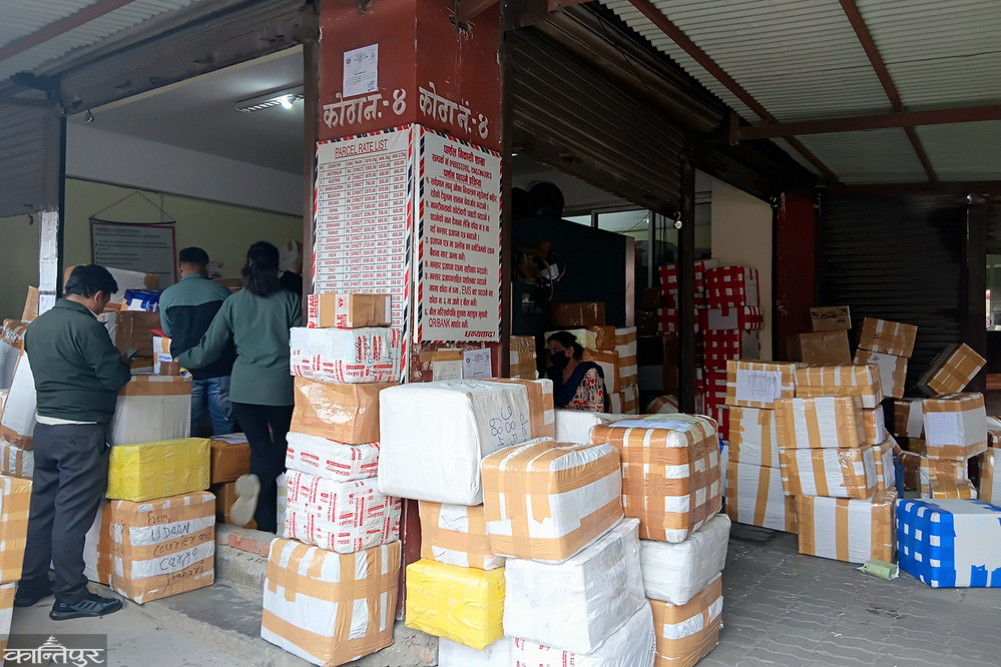
Now, personal updates and love letters have completely disappeared, while letters requesting loans from banks and microfinance institutions and 'Google Adsense' codes for the new generation of YouTubers are arriving by post.
We use Google Cloud Translation Services. Google requires we provide the following disclaimer relating to use of this service:
This service may contain translations powered by Google. Google disclaims all warranties related to the translations, expressed or implied, including any warranties of accuracy, reliability, and any implied warranties of merchantability, fitness for a particular purpose, and noninfringement.
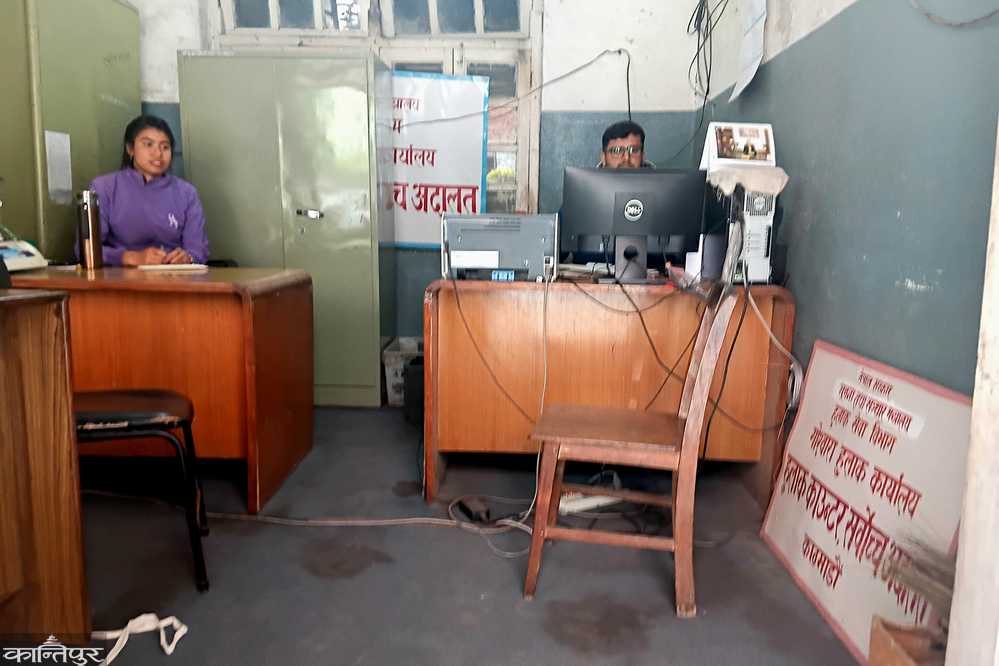
Last year, during the Gen-G demonstration on Bhadra 24, the Supreme Court premises was engulfed in flames. Most of the building was burnt, important documents were burnt, and rooms and structures were destroyed. However, a small corner was saved from the fire, the postal counter. A half-filled blue water jar still stands at the door of the counter. A board with the name of the counter is placed on the floor next to the small door. There are burnt walls around, but the service connecting courts across the country continues to run from that small room.
Buyer Hridaynarayan Jha and Halkara Manisha Tharu are found inside the counter. After the earthquake, this counter was moved from near the Attorney General's office to the current small room. Now, after the construction of the new Supreme Court building is completed, preparations are being made to move the counter there.
Hridaynarayan has spent eight years sitting at this counter. Manisha Tharu has been working here for 2 and a half years. Their daily responsibility is to ensure the safe transportation of files, orders, correspondence and other court documents exchanged between the district courts, high courts and the Supreme Court of 77 districts across the country.
'We do not transport court documents within the valley,' says Hriday Narayan, 'but we make arrangements so that documents that need to be sent outside the valley reach the relevant court within seven days.' If court orders, files and government documents do not reach their destinations on time, the judicial process itself can be affected. A lesser-known but essential link in the judicial system, this counter has been maintaining administrative contact between the courts for years.
This service has also changed with time. Until a few years ago, every letter that came here was registered manually. Bills were written by hand. A postage stamp was affixed to every letter. To get information about the status of documents, one had to rely on phone or direct contact. Now, the scene has changed. 'Earlier, a stamp had to be affixed to every letter,' recalls Hriday Narayan, 'now, online software with a tracking number is used. The system shows where each document has reached.'
The change at this Supreme Court counter is just one small example. The nature of postal services across the country has changed in recent years. Post, which was once the main medium for personal letters, greeting cards and exchanging news, is now mainly limited to government service delivery. With the spread of mobile phones, the Internet and social media among the general public, the culture of personal correspondence has almost disappeared. But that has not eliminated the post. On the contrary, the post has redefined its role.
Most official documents from government offices are now transported through post. The Postal Department is handling the responsibility of exchanging documents between government agencies by operating the 'Government Courier' service. Under this service, important documents like passports and citizenship are also being delivered to the doorsteps of citizens, said Jamuna Mishra, Director of the Postal Service.
Door-to-door government service The postal service used to deliver passports only from the Passport Department to 33 district administration offices. But now its scope of work has been expanded, said Mishra, Director of the Postal Service. The Balendra Shah-led government had put forward a plan to modernize the postal service and develop it as a 'Government Courier Service' in the 27th point of its 100-day agenda with the aim of providing government services at home. Through which it aims to deliver government documents including passports, citizenship copies, licenses to homes.
Accordingly, the government 'courier' service has been expanded to 61 districts across the country, said Mishra, Director of the Department. She says, 'We have already started the work of delivering passports to homes in about 61 districts.' According to Mishra, out of 7,916 passports carried by the post office so far, 2,626 have reached the homes of citizens. This number is after the government decided on April 30 to modernize the postal service and develop it as a 'Government Courier Service'.
Director Mishra said that she had been doing this work even before the government put it on its agenda. 'We had been doing this work for a long time. The postal service has been neglected for some time, but it has been doing its job,' she said. 'The service has also been neglected due to the lack of information among citizens that the post office is doing this work.'
But the post office's work was not only about carrying citizenship or passports. Once upon a time, the postman carried a person's news and concerns. With the rapid development of technology bringing mobile and internet to everyone's fingertips, distance has now become a matter of geography, and it does not pose any problem in exchanging feelings. However, this modern era of video calls seems no less than magic to 78-year-old Ranglal Upadhyay. Having moved to Kailali from Doti in the Far West in 2022, he has a vivid experience of a time in Nepali society when even a simple piece of news had to be waited for months.
When Ranglal remembers those old days of letters, a distinct image of the past flashes in his eyes. At that time, most people from the villages of the Far West used to go to India in search of work. The only way to stay in touch with their children, siblings and family was through that postman's letter. Since there was no facility to send messages instantly like today, it used to take one to one and a half months for a letter to reach its destination. There was a wait of months while sending and receiving letters from here and there, and people used to sit on the road waiting for the postman to come and get news of their relatives.
From the decade of 2025 to 2030, the price of a postage stamp used to be only 10 to 20 paisa. The postage stamp on the stamp confirmed the authenticity of the letter. Although Ranglal's memory is now hazy about what exactly was marked, he says that the rules for receiving letters at that time were very strict. When receiving a letter from the postman, the person concerned had to sign it, otherwise the letter would not be received. If the person concerned could not be found, the letter would be returned to the post office.
Ranglal also has an interesting and amusing reference to the slow pace of the post office. His uncles had sent a letter to his nephew in India saying, 'I am coming', but the man himself arrived home before the letter. Only 15 days after his uncle arrived home, the postman came to his house and asked him to sign for a letter from so-and-so, which he still laughs at. Nowadays, with phones everywhere, we get instant news and although it is not as painful as before, he feels that the intimacy of a letter sent with a 10 paisa stamp has been lost in today's era.
Like Ranglal, many generations of Nepali society have a deep emotional connection with the post office and letters. In ancient times, kings and emperors relied on pigeons, hawks and horses to send news from one place to another. Over time, that traditional way of exchanging information transformed into the postal service. If we look at world history, it is found that the postal service was started institutionally after the then King Charles II of Britain established the 'General Post Office' in 1660. In Nepal, its history is more than a century and a half old. With the establishment of 'Nepal Post Office' in 1935 during the reign of the then Rana Prime Minister Ranoddeep Singh, the postal service officially started in Nepal.
Nepal's postal service stepped into the international world only decades after its establishment. Nepal's postal service was connected to the global network after it became a member of the Universal Postal Union in 1974. To make it more systematic, effective and people-oriented, the 'Postal Act' was issued in 2011 and the 'Postal Service Act' was issued in 2019 during the reign of the then King Mahendra Shah, on the basis of which the Postal Service Department has been managing it properly. In the early days, it carried personal letters, news, government documents and newspapers, which were the responsibility of the Halkara to deliver to the doorsteps of the citizens.
Baburam Bharti, 61, of Bhojpur, has a long experience of carrying the same letters up and down the mountains. For Baburam, who worked as a Halkara for 37 years and 5 months, it was not just a job, but a living document that closely monitored the transformation of Nepali society over four decades. Baburam, who took compulsory retirement on 21 Baisakh 2080, has experienced the political and social changes from the Panchayat period to the republic through the letters. At that time, it took three days to walk to deliver letters from Bhojpur to Dhankuta. The sight of postmen reaching their destination via Pyauli, Legua, and Hille is still fresh in Baburam's memory. He remembers that even though it took at least five days to a week for letters to reach the people, there was a kind of anticipation and sweetness in that delay.
The postman did not only carry news of happiness and home and country, but also had to carry messages of fear when the country was in crisis. Being a postman during the Maoist conflict was a separate pain and fear. Letters asking for donations used to reach the big businessmen of Bhojpur Bazaar through the postman's hands. Baburam recounts the old days when the businessmen would panic as soon as they saw them and would fear whether the postman had brought a letter or had come to demand money. 'The businessmen would panic as soon as they saw us,' Baburam recalls those days, 'they would fear whether the postman had brought a letter or had come to demand money.'
Carrying letters in the village not only reflected the change in the country's system, but also the sorrow of the youth leaving the village. Baburam, who usually carried letters from within the country during the Panchayat period, started carrying many letters from abroad after the arrival of Bahu Dal, especially after 2050 BS, which were months old.
At that time, not only letters but also money were sent safely through the post. In this medium called 'Bima', money was placed inside the letter and tied with a needle and thread, and lacquer was applied at seven places around the letter to prevent anyone from opening it. That insurance system was so reliable that there was no fear that anyone would steal money. Apart from this, there was also a system of 'Dhanadesh' or money order to deposit money in government offices, but some people would send money even inside ordinary 'registry' letters without realizing it.
With the passage of time, technology has taken a big leap and after mobile phones reached the hands of people, the tradition of exchanging personal letters, love letters and family news became confined to the pages of history. Personal letters have now completely stopped coming from the post office. Nima Rai Basnet, a 33-year-old light worker working at the post office in Bhojpur, feels that the face of the post office has changed.
Although she has worked in the post office for 17 years, she does not have much experience, but she has witnessed the great changes that have come to the post office in a short time. According to Nima, who carried a lot of personal letters in her initial service, personal letters and love letters have completely disappeared. Nowadays, letters requesting loans from banks and microfinance companies are more common, while the 'Google Adsense' code for the new generation of YouTubers also comes from the post office. This shows the changing role of the post office.
The postal service, which was once the only reliable means of communication, is now in a state of survival. Post offices in some districts are using social media to search for lost letters. This shows that they are relying on others as sources of information. The District Post Office, Chitwan, posted a notice on its Facebook account last Wednesday (Jeshta 20). In which it posted the information on social media that the recipient of the letter/document received in the name of Sunil Chapagain, a resident of Bhojad, Chitwan, was not found.
But despite the rapid decline in the number of personal letters with the development of technology and changing times, the post office is still busy carrying government documents and documents of financial institutions. However, due to the lack of sufficient resources and clear legal provisions, this service has not been able to make the leap as expected.
The postal service, which was once the only reliable means of communication, is now in a state of survival. Post offices in some districts are using social media to search for lost letters. Chintamani Regmi, postal officer at the District Post Office, Salyan, says that since the post office is an institution with a long history, it should either be made completely professional or merged. He insists that the post office should have an institutional existence even if it does not have employees. 'The post office is an institution with a long history. Now it should either be made professional or merged. Instead, we should not be employees, but the post office should have an institutional existence.'
The biggest problem of the postal service is seen in transportation, because the post office does not have sufficient means of transport of its own. It takes a minimum of 7 to a maximum of 15 days for goods to reach Kathmandu from Salyan, due to which it is becoming difficult to compete in the market when goods delivered by private couriers reach Kathmandu in two days late, Regmi said. 'It takes a minimum of 7 to a maximum of 15 days for goods to reach Kathmandu from Salyan,' Regmi said. 'We have not been able to compete when goods delivered by private couriers reach Kathmandu in two days late.'
Officer Regmi believes that if it had been possible to link this with tasks such as the distribution of social security allowances from the beginning, the relevance of the post office would have increased further. Despite facing many challenges, the post office has a strength that no other private or government agency in the country has, namely its strong and impenetrable network that extends to the ward level.
Modernizing traditional work, the post office is now operating fast and modern services such as parcel service, philatelic and postal stamp service, express postal service, valley roaming service and 'tracking' that allows you to see where the goods have reached. The Postal Services Department, which is currently under the Ministry of Communications and Information Technology, is providing services across the country through its large network.
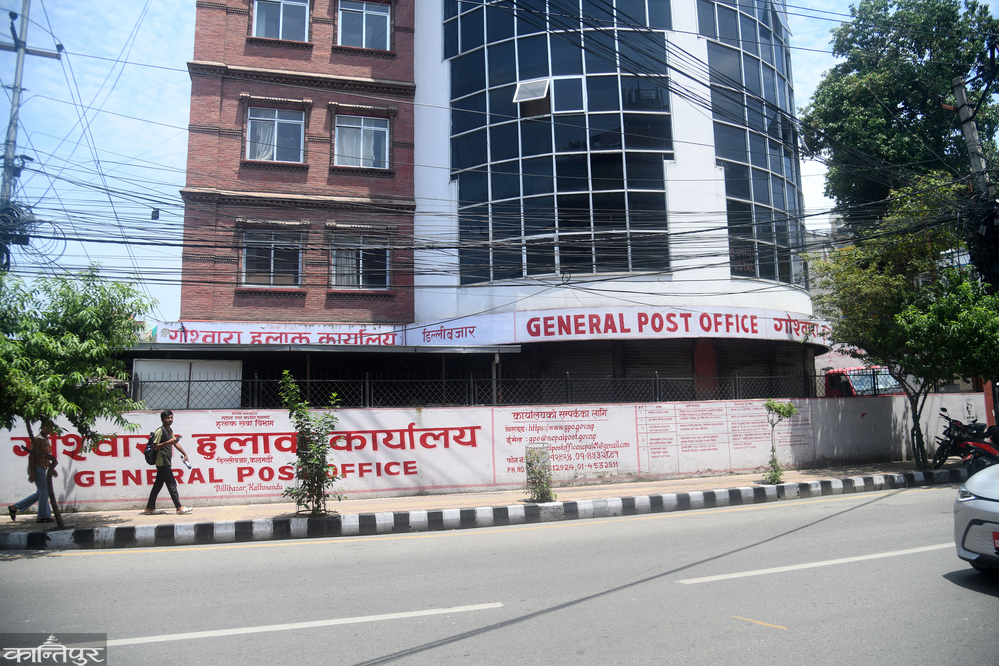
The Goshwara Post Office and Postal Training Center are operating at the central level under the department, while 6 postal directorates have been established in Morang, Dhanusha, Kaski, Dang, Surkhet and Kailali to streamline services across the country. In addition, 70 district post offices and 676 local level post offices are operating. The 3,074 additional post offices that were set up in the past to deliver information to villages are currently in the process of being abolished in accordance with government policy.
The department collects revenue worth crores of rupees every year through the post office. According to the department's director and spokesperson Sapana Kumari Bhattarai, the revenue collection of the postal service has doubled in the last five years. The department collected a total of 249.546 crore in the fiscal year 2077/78, which increased to 685.732 thousand 890 in the last fiscal year 2081/82. Spokesperson Bhattarai said that its revenue has increased after the government decided to make it mandatory to register government documents through the post office.
The data shows the revenue details of the last five years.
Fiscal Year: Tax
2077/78: 24,95,46,000
2078/79: 27,79,64,400
2079/80: 34,81,05,340
2080/81: 62,95,06,324
2081/82: 68,57,32,890
Nepal Post has its own 'Post Internal Tracking System', through which service recipients can easily track where their goods have reached from home. If at least 15-20 vehicles can be managed for transportation and the service is improved to compete with private couriers, then there is a possibility that Nepal Post can also pay additional revenue to the government.
Being a member of the International Postal Union, Nepal Post has a strong global reach. By removing legal complications and simplifying the international parcel and customs process, the post office can become the cheapest and most reliable medium for millions of Nepalis living abroad. The future of the post office now lies in its service diversification and professionalism. The main need of the day seems to be to move forward with modern technology while preserving its old reputation.
The government has announced in point number 75 of its policy and program to strengthen the regulatory system in coordination with all three levels of government for transparent and accountable management of the advertising and media sector and to diversify, modernize and digitally transform the postal service. Although digital transformation is mentioned in the policy and program, a concrete blueprint for large investments in this regard is still not clear in the budget.