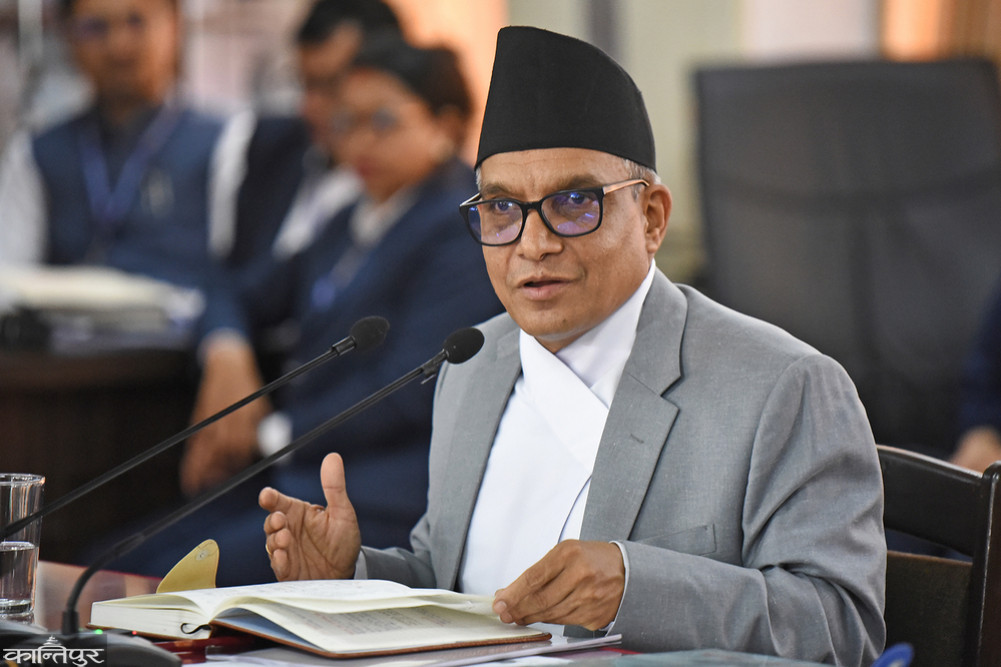
Since his appointment to the Supreme Court in 2076, on which bench has Sharma sat? How many judgments has he written? 'Kantipur' has analyzed all (1,263) judgments published in 'Nepal Kanun Patrika' during this period.
We use Google Cloud Translation Services. Google requires we provide the following disclaimer relating to use of this service:
This service may contain translations powered by Google. Google disclaims all warranties related to the translations, expressed or implied, including any warranties of accuracy, reliability, and any implied warranties of merchantability, fitness for a particular purpose, and noninfringement.
Nepal Kanun Patrika is an official publication that publishes only the judgments that are deemed to be precedent-setting by the Supreme Court. From the month Manoj Kumar Sharma was appointed to the Supreme Court (Baishakh 2076) to the latest available issue of NCAP (Bhadra 2082), 1,263 judgments have been published.
When examining his details, it is seen that Sharma has sat on 143 benches and out of them, he has written judgments in only about a third. In the rest, he was only a signatory to judgments written by others. Out of the 11 judges who have been continuously in NCAP for 6 and a half years, Sharma is in ninth place in terms of the number of judgments.
Not all benches are equally powerful. The judgments of a full bench of three judges and above that, a grand full bench are more powerful than the judgments of a joint bench of two judges. Sharma's pen seems to have been less effective in the larger benches when compared based on the benches he has been involved in. He has written about 37 percent of the judgments he has sat on in the joint bench. However, only 20 percent in the full bench and 17 percent in the grand full bench. Of the 10 other Supreme Court judges who have continuously published judgments in the NCAP during the same period, he is higher than him in all three levels.
How many judgments did Sharma write? It seems that it is mostly determined by who he sat with in the bench. He did not get the opportunity to write when he sat with Vishwambhar Prasad Shrestha and Kumar Regmi. He got only a little with Sapna Pradhan Malla. His writing load is relatively balanced with Harikrishna Karki, Prakashman Singh Raut and Anand Mohan Bhattarai.
In 6 and a half years, Sharma has written judgments only five times while sitting in a bench of three or more judges. Four in the full bench and one in the grand full bench. None of these five have been cited by the later benches so far.
Writing a judgment is one thing, quoting that judgment as an example by the later benches is another. When comparing the citation rate of the other 10 judges who have been in the NC for 6 and a half years along with Sharma, Anand Mohan Bhattarai is at the top (14.3 percent), while Prakash Man Singh Raut is at the bottom (3.8). Sharma (4.2 percent) is among the bottom two or three.
This analysis is based on all (1,263) judgments of the Supreme Court published in ‘Nepal Kanun Patrika’ from 2076 Baisakh to 2082 Bhadra.
All the judgments of 74 issues of NCAP published from the month of Chief Justice Manoj Kumar Sharma's appointment as a judge in the Supreme Court (Baishakh 2076) to the latest available issue (Bhadha 2082) have been reviewed.
'Nepal Kanun Patrika' is the official publication that publishes only judgments deemed to be precedential by the Supreme Court. All those judgments are available here .
A hierarchical database was initially created by 'scraping' all the judgments of the study period. From each judgment, the author, signatory, dissenting opinion, concurring opinion, type of bench, and number and rate of citations were extracted and categorized. This data was analyzed using 'Python' in Google Colab.
Here, ‘author’ is the judge who wrote the judgment of the bench, ‘signer’ is the judge who concurred in the judgment written by others. ‘Cited’ is the reference made by a later judgment to a previous judgment as an example, and is counted in two ways.
First, the total number of times a judge’s judgment was cited and second, the number of different judgments cited at least once (citation rate).
During the period of the judgment analysis, Sharma sat on 143 benches, of which he was the author in 48, only the signer in 94. And, in one, he wrote a separate concurring opinion.
The author, signer, bench and citation details of all 143 judgments involving Sharma have been checked and verified ‘manually’ on the NCAP website. A sample of 90 judgments randomly selected from among the judgments of other judges have also been tested and verified in the same way. This analysis is limited to the judgments published in the NCPA, i.e. it does not cover all the judgments of the Supreme Court. Judgments not included in the NCPA or not cited there are not included. How many judgments did the judge write? That count only indicates who wrote those judgments, and how much did whose contribution to the discussion? It does not indicate that.
Read Kantipur's detailed reporting on Sharma's track record in Kanun Patrika: