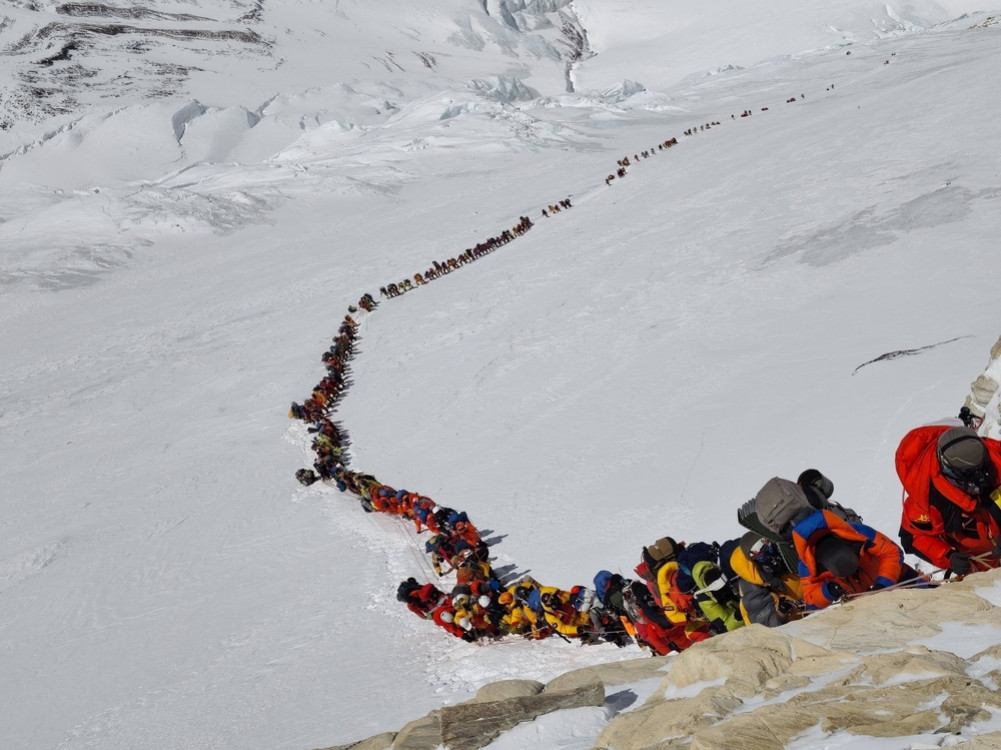
This time, more than 270 climbers from Nepal reached the summit in a single day, leading to celebrations in Kathmandu. However, images from the mountain have once again raised questions about Nepal's decision to allow hundreds of climbers to summit in a single day.
We use Google Cloud Translation Services. Google requires we provide the following disclaimer relating to use of this service:
This service may contain translations powered by Google. Google disclaims all warranties related to the translations, expressed or implied, including any warranties of accuracy, reliability, and any implied warranties of merchantability, fitness for a particular purpose, and noninfringement.
How many people can Mount Everest support? This is the question being asked by the overwhelming crowds seen again during this year's spring ascent of the world's highest peak.
A drone video and images that went viral in the media this week show a crowd of climbers on the narrow path from Camp 3 to Camp 4. Climbing companies estimate that more than 300 people were on the route at any one time.
Climbing companies say that 270 more climbers from Nepal have summited the peak on May 20 alone, raising renewed concerns about the safety and regulation of the 8,848.86-meter mountain.
"We are in the process of confirming the numbers, but the numbers appear to be similar to previous years," said Nisha Thapa Raut, director of the Department of Tourism, the government agency that monitors mountaineering activities.
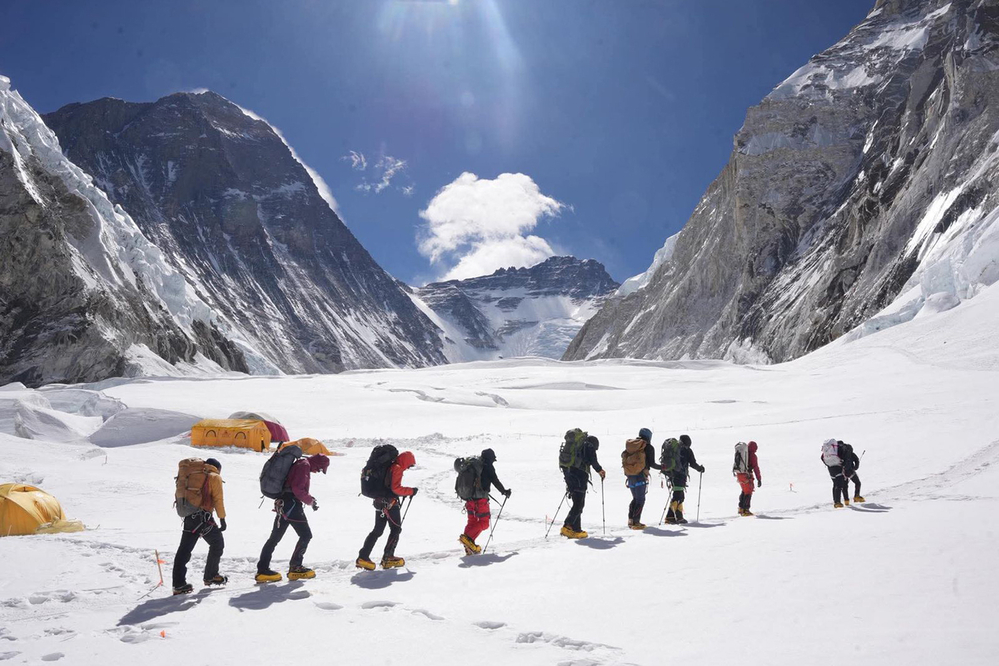
These scenes are reminiscent of the 2019 ‘Everest traffic jam’. At that time, mountaineer Nirmal Purja took pictures of a long line of climbers near the Hillary Step on May 22-23. At least three people died due to the crowd. On May 23 of that year, a record 354 people from both Nepal and Tibet climbed Mount Everest. The weather was only good for a short time that year, so a large number of tourists were rushing to reach the summit at once.
This time, more than 270 climbers from the Nepal side scaled the summit in a single day, leading to celebrations in Kathmandu. However, pictures from the mountain have once again raised questions about Nepal’s decision to allow hundreds of climbers to summit in a single day.
Experienced climber Kami Rita Sherpa, who arrived in Kathmandu last Friday after climbing Mount Everest for a record 32nd time, said that the crowds on the mountain have increased this time. ‘This time it was very crowded.’ There were more people than last year,’ he said immediately after landing at the airport, ‘It seems that it needs to be controlled a little.’
Considering the increasing crowding, pollution and security risks, the Supreme Court has already ordered the government to regulate the number of climbers on Mount Everest and other mountains in April 2024.
In recent years, there has been a lot of criticism about the ‘traffic jams’ seen on Mount Everest, increasing pollution and the human toll caused by the race to reach the summit at the same time when the weather is clear for a short time.
According to Raut, Director of the Tourism Department, two Indian climbers have died while returning from a successful climb of Mount Everest this week. One died at Camp 2 and the other near the Hillary Step.
Both climbers summited last Thursday and died while descending. Officials said the cause of death is not yet known, although mountaineering experts have speculated that they died from extreme fatigue and weakness.
With these incidents, the number of deaths on Everest in this year's climbing season, which began in April, has reached five.
May 23, 2019, is recorded in the Guinness World Records as the day when the largest number of climbers climbed Everest in a single day. On that day, 354 people from both Nepal and Tibet climbed Everest. According to the Department of Tourism, 223 people climbed Everest from the Nepal side on May 22 and 212 on May 23.
A joint bench of Supreme Court Justices Sapana Pradhan Malla and Sushmalata Mathema had ordered the concerned bodies to determine the number of climbers based on the carrying capacity and safety conditions of Mount Everest.
The decision came at a time when stakeholders were expressing concern that Mount Everest was becoming the ‘world’s tallest garbage dump’. Raut, Director of the Tourism Department, said, ‘We are fully aware of the Supreme Court order.’ However, at present we do not have any law to control climbing permits. There is no limit on it.’
According to officials, climbing Mount Everest depends heavily on the favorable weather conditions during the short spring season.
‘Out of 365 days, only about 15 days or less can be climbed on Everest, depending on the weather conditions,’ Raut said, ‘It all depends on the weather.’
The National Assembly passed the ‘Unified Tourism Bill’ on February 9, which provides for strict mountaineering regulations, safety and insurance provisions, and a permanent environmental fund to keep high mountains like Everest clean. The bill is now expected to move forward in the House of Representatives.
According to officials from the Ministry of Tourism, mountaineering provisions have been included in the tourism law for the first time to strengthen monitoring, as previous regulations were implemented in a temporary and lax manner.
‘We are hopeful that this law will be implemented to regulate climbing and control the environment,’ Raut said, ‘After all, safety is the most important thing.’
According to a key provision of the proposed law, before getting permission to climb Everest, a climber must have successfully climbed at least one mountain in Nepal that is higher than 7,000 meters.’ Officials say, ‘The aim of this criterion is to discourage inexperienced climbers from venturing towards Everest.’ Because, lack of experience is considered the main reason for increasing crowding, accidents and pressure on rescue operations.’
The proposed bill includes provisions such as climbing seasons, permit conditions, climbing standards, application fees and mandatory health certificates for all climbers.
This year’s Everest climbing season began under very difficult conditions. A large and unstable serac (ice floe) in the Khumbu Icefall blocked the climbing route below Camp 1. The climb was delayed for nearly three weeks before it was reopened. According to the Everest Pollution Control Committee, the serac was about 55 meters long, 37 meters wide and 28 meters high, and its numerous crevasses made it extremely dangerous and unstable.
After a 19-day delay, the route through the icefall opened on April 28. Climbers and guides who had been stranded at base camp then began to ascend.
Gyanendra Shrestha, a government representative at Everest Base Camp, said that while officials could not immediately limit permits, they could reconsider the climbing season schedule. ‘The condition of Everest is not the same as before due to climate change,’ said Shrestha, ‘By the third week of May, the river starts flowing at Camp-2. Sometimes it starts flowing at the base camp itself. Which was unusual in the past,’ he said.
He said that since the work of stringing ropes and installing ladders will be completed by mid-April, there is a possibility that the climbing activities can be shifted to the end of April. ‘Why wait until mid-May?’ he asked, ‘This work can be done in April.’