According to medical science, whether or not the hymen is torn does not necessarily mean that rape has occurred. The World Health Organization has called it an invasion of a woman's privacy and self-respect.
We use Google Cloud Translation Services. Google requires we provide the following disclaimer relating to use of this service:
This service may contain translations powered by Google. Google disclaims all warranties related to the translations, expressed or implied, including any warranties of accuracy, reliability, and any implied warranties of merchantability, fitness for a particular purpose, and noninfringement.
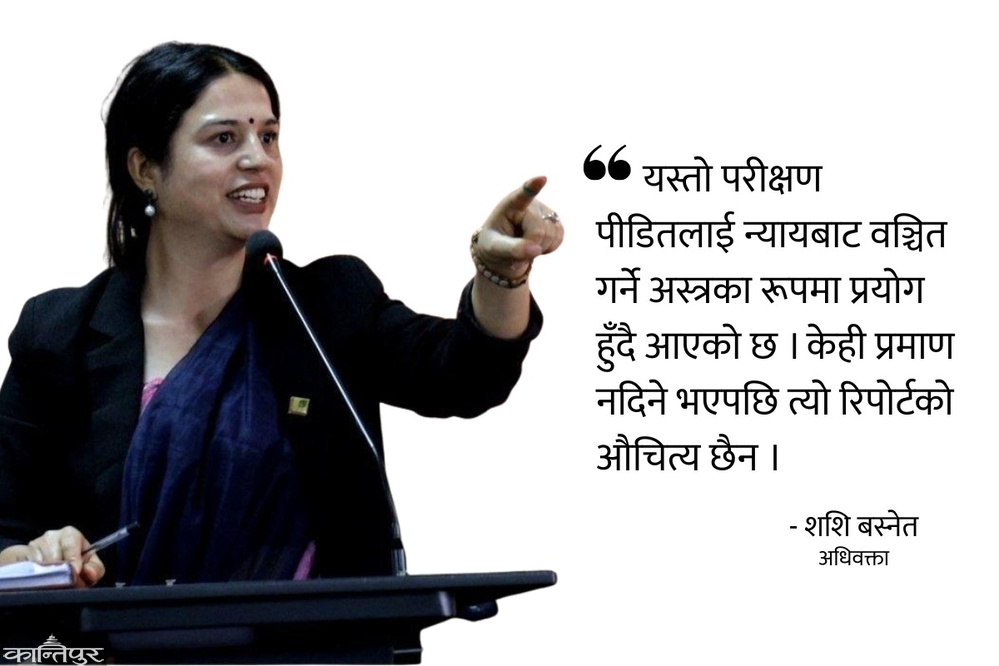
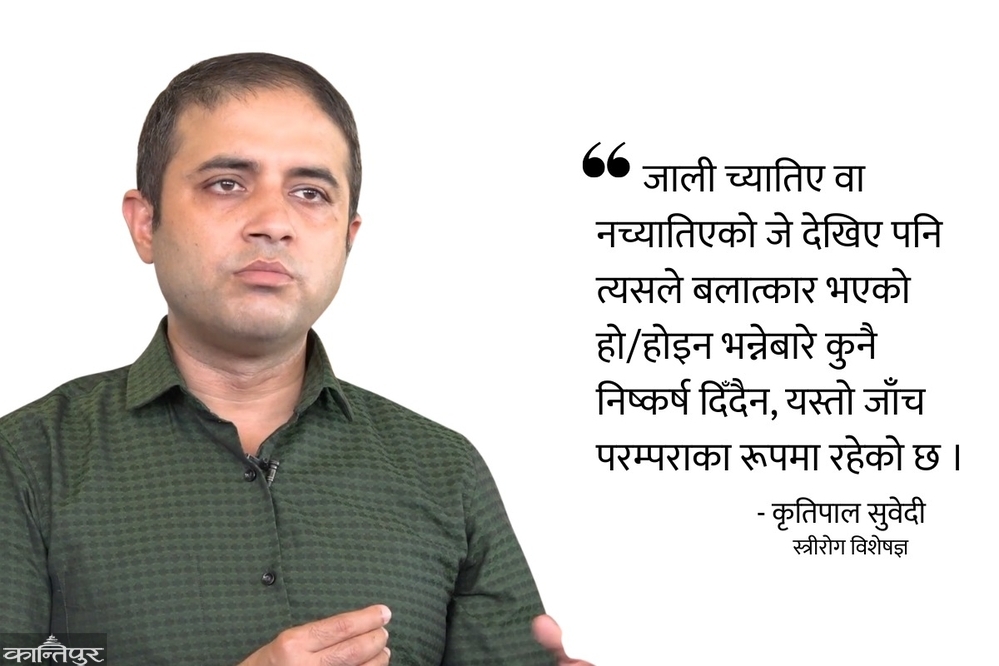
— She tried to file a complaint alleging repeated sexual violence against her. First, she went to Gaushala police. Then to Kalimati, then to Teku as suggested by Kalimati. Then she went back to Gaushala and Kalimati. After the complaint was not registered, she went to Ranipokhari police. After there was no hearing, she even went to the Ministry of Home Affairs. But the police did not immediately file a complaint. According to her statement given in the Kathmandu District Court, a police inspector at Gaushala post told her, ‘It is like a person with money and power, there is no benefit in filing a case, but if you give money, you will get it.’ After failing to do anything, she tried to commit suicide by tying a rope in her room and was rescued by chance, she survived. After she warned him that she would set herself on fire outside the police post, a complaint was filed. According to her statement in the court, the landlord would forcibly insert his penis into her mouth. According to the law, such an act is rape. After all these bumps and bruises, the woman was taken to the Paropkar Maternity and Gynecology Hospital in Thapathali for a physical examination. The medical examination report submitted to the court states that there are no new cuts or bruises on her body and that there is a scar on her left arm that is about three years old. And, the report states that her hymen was already torn (old tear). She had been married a few years ago and had divorced her husband. She had accused him of forcing her to have oral sex. That is why the doctor examined her hymen. Hymen examination is a routine examination performed on rape victims in Nepal. According to medical science, such an examination cannot prove anything in a rape case. Whether the hymen is torn or not, it cannot say whether rape has occurred or not. It cannot even tell whether sexual intercourse took place or not. According to doctors, it is even harder to tell whether oral sex took place or not. The hymen test is a routine test performed on rape victims in Nepal. Such a test cannot prove anything in rape cases. The Supreme Court has been saying in one decision after another for the past 25 years that whether or not the hymen is torn has nothing to do with whether or not rape occurred. The World Health Organization has called it an invasion of women's privacy and self-respect. The Supreme Court of India has banned such a test. But this test continues in Nepal. Here, the police send the victim to the hospital. In addition to other tests, the doctor also examines the hymen. Lower courts take it as evidence. The question arises – what evidence are doctors, police, lawyers and judges looking for in the vagina of a married woman who has been subjected to forced oral sex? The law that makes the vagina examination of rape victims a mandatory part of the ‘health check-up’ in Nepal is the ‘Crime Investigation Regulations 2075’. According to which, in addition to other things, doctors must also disclose details of whether the vagina was torn or not in the health check-up report. This provision has been copied exactly from the ‘Government Cases Regulations 2055’. According to legal experts, such a rule ignores the recent extensive legal changes made to the definition of rape. When the said regulations were being drafted in 2055, the National Code considered only ‘penetration’ as rape. Such a narrow definition has been changed by the ‘Act on Maintaining Gender Equality’ of Asoj 2072 – anal or oral penetration is also rape. In other words, according to the law of the past 10 years, ‘penetration’ of the woman’s genitals is not necessary for rape. The ‘Regulations on the Investigation of Crimes’, which came into effect on 2 November 2075, has made the hymen examination mandatory in rape cases. Advocate Shashi Basnet says that such a provision was made in the regulations with the assumption that ‘if there was rape, the hymen should have been torn.’ ‘It rejects the changed legal concept of rape.’ It represents the old view that rape is considered only if there is penetration in the woman’s vagina,’ she said. ‘It also carries the traditional belief that rape committed against a woman who is sexually active is not considered a crime.’ According to doctors, this test examines the condition of a thin membrane at the entrance to the vagina, mainly to see if it is torn or not. Kritipal Subedi, a gynecologist currently working at Bheri Hospital, Nepalgunj, says that regardless of whether the hymen is torn or not, it does not provide any conclusion about whether rape has occurred. ‘Such a test has been a tradition.’ However, it does not provide any evidence in the case,’ he said. According to Subedi, the hymen can be torn while cycling, horse riding, playing sports or exercising, giving birth, during some surgeries or gynecological tests, and even during the natural development of the body. It can also be torn due to consensual sexual intercourse or rape. But medical science cannot distinguish between these two reasons. Such a test also does not know when the hymen was torn. And, according to Subedi, the most important thing is that even if the hymen is torn due to sexual intercourse, the test can determine whether the contact was consensual or forced. Can't be broken . According to doctors, if a woman who is actively sexually active becomes a victim of rape, there is no fresh injury in the hymen . Therefore, in this case, the divorced woman, who has filed a lawsuit alleging that she was subjected to forced oral sex, cannot find anything new by examining her hymen . The World Health Organization formally rejected hymen testing of women who have been subjected to sexual violence in 2018 as 'lacking scientific and medical basis' and 'a violation of human rights'. The Office of the United Nations High Commissioner for Human Rights, UN Women and the World Health Organization issued a joint call asking countries that continue such tests to immediately stop . ‘Despite its lack of scientific basis or medical utility, doctors are conducting such tests in the name of finding out whether a rape has occurred,’ the appeal said. ‘This test traumatizes the victim a second time, just like the first time she was a victim of a crime.’ The Supreme Court of India banned such tests in 2022 through its judgment in the case of Shailendra Kumar Rai v. State of Jharkhand. The judgment stated that the hymen test is based on the assumption that ‘a woman who is actively engaged in sexual activity cannot be raped.’ ‘That assumption is completely wrong.’ The Supreme Court of India stated that such tests violate the self-respect of a woman and that whether a woman has already had a sexual relationship is not relevant to the dispute over whether she is a rape victim or not. It has also warned that doctors who perform hymen tests on women who have been victims of sexual crimes will be prosecuted for breach of professional conduct.’ The test has since been banned in India. In Nepal too, the Supreme Court has been ruling that such tests are not justified for at least 25 years . However, doctors, among other things, are still examining the hymen of every woman . In Nepal too, the Supreme Court has been ruling that such tests are not justified for at least 25 years . However, due to the provisions of the regulations, the police are sending rape victims for medical check-ups and doctors, among other things, are still examining the hymen of every woman . When you flip through the Nepal Law Journal, where precedents are published, you can see how the Supreme Court's judicial approach to rape cases has changed over time . By 2030, the Supreme Court had ruled that if the victim had no injuries on her body and had not made a noise when she was raped, then such allegations would not be credible . The Supreme Court, in its 2029 ruling, held that the woman must have ‘somehow diverted her husband’s sexual desire and rendered his senses useless, even for a moment,’ had blamed the victim for the rape. In the half-century since then, the Supreme Court seems to have come a long way from such a ruling that considered resistance and bodily injury to be mandatory. In 2057, the Supreme Court said that the fact that the victim’s hymen had already been torn does not mean that rape did not occur. This ruling was a major change in the Supreme Court’s view until then. Then, in 2064, the court gave another ruling, which stated that in most cases, there are no eyewitnesses in rape cases; the victim is the primary witness. Her statement is the central evidence. Four years after that ruling, in 2068, the court said that even if the medical report shows no signs of rape after 10 days of the incident, the crime can still be found based on other evidence. And, in 2070, the court developed a precedent that essentially ended this problem. It states that it is not necessary for the victim's hymen to be torn for rape to occur. In other words, the rulings from 2057 to 2070 said, 'The crime of rape may have been committed even if the hymen has not been torn, and the crime may have been committed even if it has already been torn.' In 2072, the definition of rape was changed by amending the then Civil Code. With that, the 'penetration' of any other object into a woman's body was also considered rape. The following year, the Supreme Court ruled that women can also rape women using artificial penises.
In 2076, the Supreme Court, in a summary of its two-decade-long rulings, said that the argument that the hymen should be torn, or that there should be signs of struggle, or that there should be ejaculation of semen to establish rape is not mandatory under Nepali law.
However, in a case of forced oral sex involving a government employee, in Jestha 2082, the Kathmandu District Court listed the report that the hymen had already been torn as a basis for not establishing rape, in addition to other reasons.
Why?
According to doctors, the main reason for this is institutional inertia.
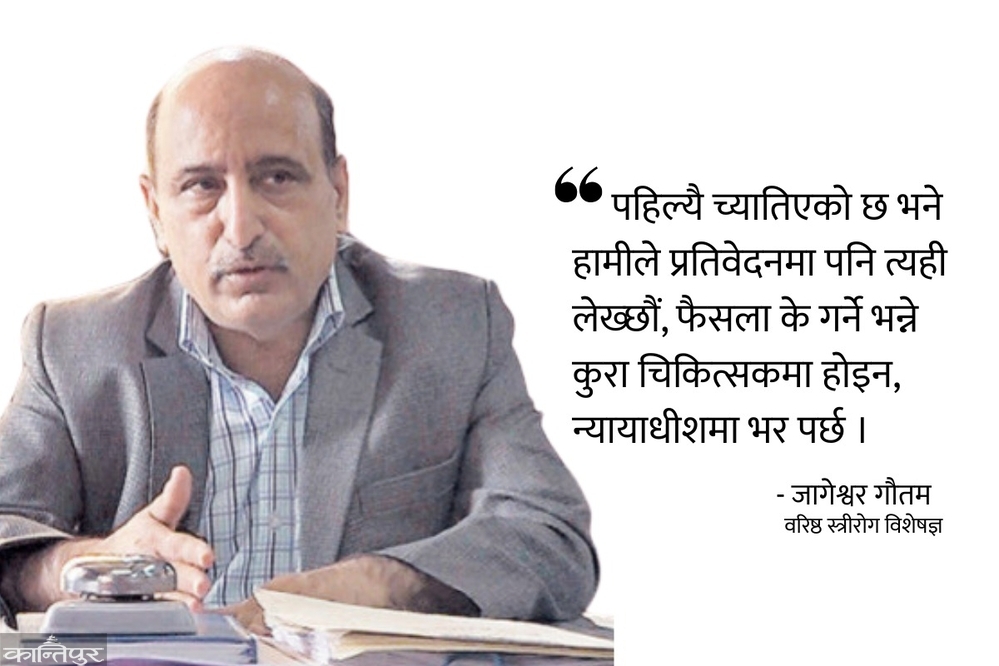
Hymen examination in rape investigations has been a practice for decades. The police send the victim to the hospital with a medico-legal form. The hospital fills out the form and sends it back. It is included in the file as a health examination report. It is accepted as evidence by the government prosecutor and the judge. Such evidence, where the hymen has already been torn, is interpreted as meaning that the woman is in an active sexual life. ‘If it has already been torn, we write the same in the report, we also file the same affidavit in court,’ says senior gynecologist Jageshwor Gautam, ‘A doctor can never say whether rape occurred or not based on that. Therefore, it is not up to the doctor, but the judge to decide.’
Advocate Basnet Doctor says that no matter whether the hymen is torn or not after examining it, it is not possible to say in court whether rape occurred or not. ‘That creates doubt in the case. And, in criminal law, there is a principle that the defendant gets the benefit of the doubt. Then, based on that doubt, the defendant is acquitted. That is why such tests have been used as a weapon to deprive the victim of justice. It should be stopped,’ she says.
No one has tried to stop such tests so far. The Ministry of Health and the Medical Council have not issued any guidelines. The Supreme Court has not yet issued a mandate to ban the test, despite one verdict after another saying that this test is meaningless.

Advocate Basnet says that although the test for the test is not necessary, other tests should be done. 'In cases where excessive force is used, the wounds should be examined and treated,' she said. 'The test is also important to understand the mental state of the victim.'
Doctor Gautam says that any health test should help the victim get justice.
In the case, the Kathmandu District Court had acquitted the accused last year, concluding that rape could not be proven, based on a medical examination report stating that the girl's vagina had already been torn. The Attorney General's Office, when Savita Bhandari was the Attorney General during the election government, has decided not to appeal against this decision. However, the test for the test for the test casts doubt on the victim's statement and other evidence. For example, the incident involving the same government employee.
The victim told Kantipur that she had now reached the Gulf country for work after being unable to stay in Nepal due to threats received over the phone and trolling on social media. (Kantipur has not mentioned the name of the accused as the court has already acquitted her and the Attorney General's Office has decided not to appeal against it.)
The doctor had given a report on the issue of oral sex in this case - the girl's vagina had already been torn.
Advocate Basnet, who is knowledgeable about the subject matter of this case, says that such a report would humiliate the victim and devalue her entire claim.
Initially, the district court had sent the employee to remand for trial. When she filed a petition in the High Court against this, she cited the doctor's report stating that the hymen had already been torn, in addition to other grounds, and said, 'I am a married woman and my hymen has already been torn. In that case, the medical examination report is not evidence of the crime....which proves my innocence and proves the complaint false.'
After the woman's physical examination, the doctor had given a report stating that the hymen had already been torn (hymen old tear) and she had testified to the same thing in court. Then, the accused employee's wife, who went to court as a witness, said in her statement, "The fact that the hymen is old torn in the health examination report of the complainant does not prove that the defendant raped her."
In front of the judge, the employee's lawyer Nagesh Krishna Pokharel asked the victim, "Your hymen appears to be old and torn. When and why was it torn?"
Then the court ruled, "The defendant is 56 years old and appears to be taking regular treatment and medication, while the complainant is 24 years old." Despite being a healthy and divorced woman, the defendant resisted the attempt to rape her and did not show any signs of injury even when she was forced to perform oral sex.’
The court went further and said, ‘The victim’s medical examination report mentions an old hymen tear and there are no other injuries on her body.’
This decision by District Judge Khimananda Bhusal is like a shadow copy of the Supreme Court’s decision in 2029 BS, saying, ‘There are no injuries on the body and if the woman did not make any noise when she was raped, such an allegation is not credible.’
Human rights activists say that such a practice makes women a second victim. The World Health Organization’s 2018 call also called such testing another form of sexual violence. The call commented that such testing could amount to rape or torture according to international legal standards. ‘The hymen test used to assess whether a woman is a rape victim does not tell whether or not she was raped, nor does it predict how traumatic or severe the impact of rape will be on the woman,’ the appeal states. ‘The results of this unscientific test influence judicial proceedings, resulting in victims losing their cases in court and perpetrators being acquitted.’
On 29 Jestha 2082, the Kathmandu District Court concluded the case of the domestic worker. Rape was not confirmed. The accused was acquitted. The phrase ‘hymen old tear’ mentioned in the medical examination report was the reason for the woman losing the case and being humiliated.
She left the country. The government did not appeal the case.
According to police statistics, an average of five women/girls are raped every day in the country. Any of them is reaching the police station at any moment with a complaint of rape. And, every day, the virginity of a woman who has been sexually assaulted is being examined. The courts are recognizing such examinations as evidence. Such evidence, which does not prove anything. Advocate Basnet says, ‘Since it does not prove anything, there is no justification for that report.’ However, the question does not end there.