Supreme Court judges are concerned that the clash of priorities could lead to an unhealthy race to become the Chief Justice and affect the administration of justice.
We use Google Cloud Translation Services. Google requires we provide the following disclaimer relating to use of this service:
This service may contain translations powered by Google. Google disclaims all warranties related to the translations, expressed or implied, including any warranties of accuracy, reliability, and any implied warranties of merchantability, fitness for a particular purpose, and noninfringement.
Breaking the tradition of making the senior-most judge of the Supreme Court the Chief Justice, the Constitutional Council has recommended the fourth-ranking Manoj Kumar Sharma. Questions are being raised from the concerned quarters as to whether the council has chosen a capable judge or is trying to make him more favorable to the executive.
The day after the council recommended the Chief Justice, Acting Chief Justice Sapna Pradhan Malla held a 'full court' (full meeting) on Friday. The Former Judges' Society has issued a statement on the matter. The Nepal Bar Association held a meeting of the advisory committee. The Supreme Court has rejected the registration of a writ petition against the recommendation.
All judges except Justice Til Prasad Shrestha participated in the 'full court' of the Supreme Court. Shrestha is abroad for medical treatment. Sharma, who was recommended as Chief Justice, also participated in the meeting. Sharma has now withdrawn himself from the hearing of the case, urging not to put him in the ballot process.
Sharma, who was recommended for the post of Chief Justice, was also present in the meeting. Sharma has now withdrawn himself from the hearing of the case, urging not to put him in the ballot process. A judge told Kantipur that the judges were divided on the issue of the recommendation for the Chief Justice. Three judges had expressed the opinion that it should wait for a few days since the recommendation was just made and had not yet reached the parliamentary hearing process.
Other judges had expressed the opinion that the executive has adopted a 'pick and choose' style and that it should not be accepted. They argued that even if the constitution does not stop it, it will lead to an unhealthy race to become the Chief Justice and will affect the administration of justice. Stating that the structure of the Constitutional Council is political, the judges were of the opinion that it needs to be corrected.
The Former Judges' Association, on the other hand, has issued a statement commenting that all bodies should stay within their respective limits. The society has also said that the Supreme Court should determine the boundaries of the relevant officials or bodies without delay to protect the constitutional supremacy.
Former Supreme Court Justice Krishna Jung Rayamajhi said that they have discussed the current situation and recent events and have made the views of former judges public. Former Justice Shambhu Bahadur Khadka said that the executive, judiciary and other constitutional organs should stay within the boundaries and accept each other's jurisdiction. 'No one can go beyond the constitution or the law. No matter how good a work done by any official is, if that work is not done by following a legal process, it cannot gain legitimacy,' he said.
The Nepal Bar Association has commented that the Constitutional Council has recommended the Chief Justice with the intention of putting the judiciary in the shadow of the executive. The Nepal Bar Association has commented that the Constitutional Council has recommended the Chief Justice with the intention of putting the judiciary in the shadow of the executive. After the advisory committee meeting, the Nepal Bar Association has issued a statement, in which it is mentioned that the government has been working to affect the entire judiciary for a long time through the Constitutional Council, without even considering the universally accepted principle of separation of powers prevailing worldwide.
‘The Nepal Bar Association is steadfast in protecting the independent judiciary, urging that such actions that are against the Constitution and constitutionalism be stopped immediately and the country not be pushed towards a confrontation,’ the statement said. ‘The Bar urges the judges of all courts, including the Supreme Court, to continue their work of administering justice with high morale without any hesitation.’
Advocate Geeta Thapa, Advocate Premraj Silwal and Senior Advocate Dinesh Tripathi had separately approached the Supreme Court on Friday with writs against Sharma’s recommendation for the Chief Justice. However, the Supreme Court administration has dismissed the writ. Senior advocate Tripathi said that the petition will now be filed in the bench on Monday.
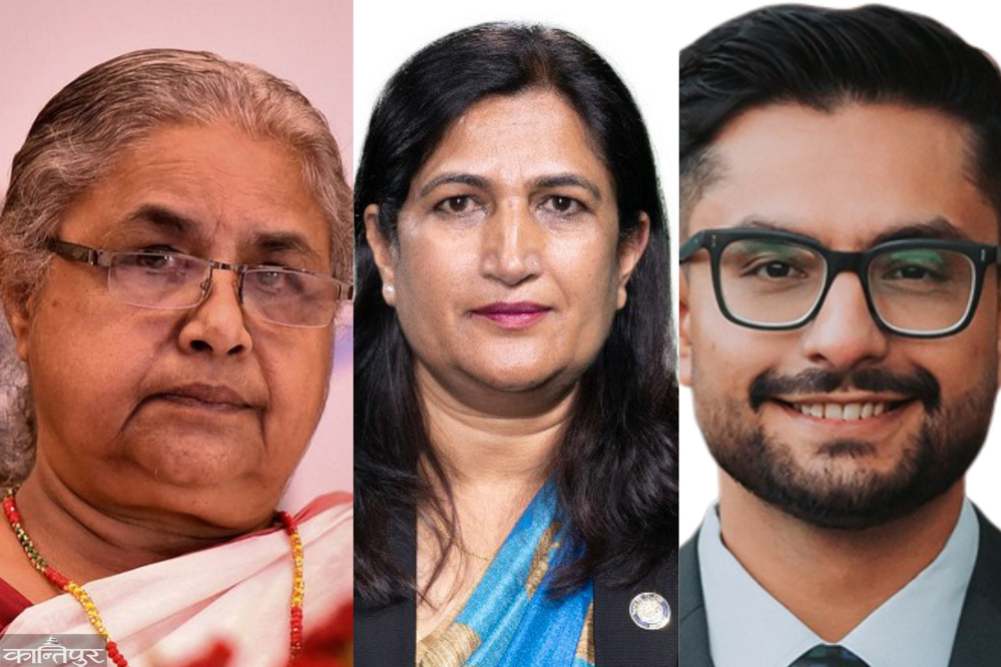
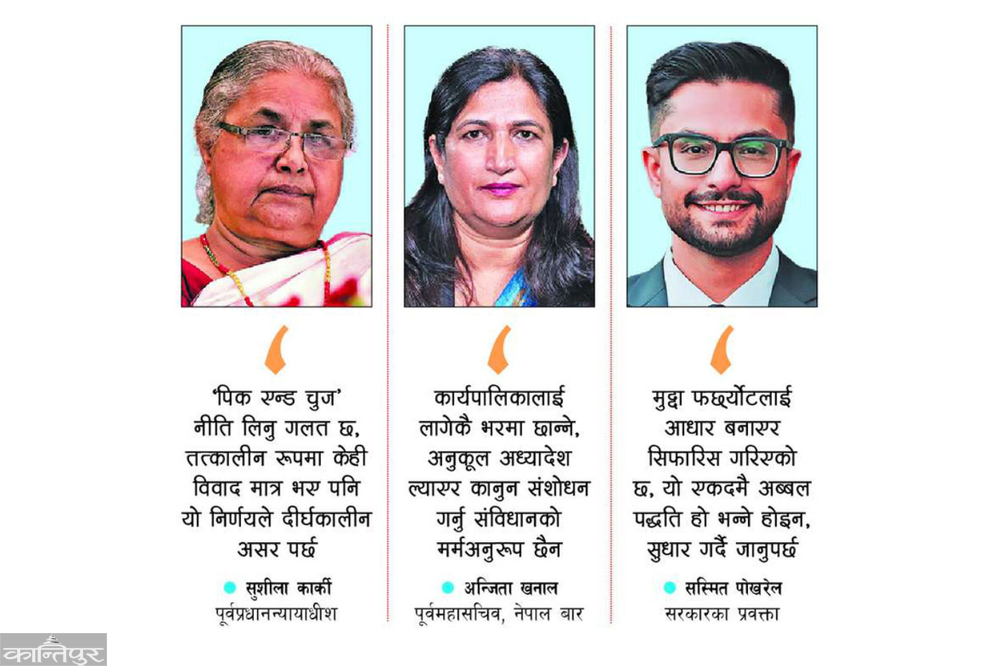
Former Chief Justice Sushila Karki expressed her surprise at the Constitutional Council's decision. She commented that it was wrong to adopt a 'pick and choose' policy in recommending the Chief Justice. 'Even if there is only some controversy at the time, this decision will have a long-term impact,' she said.
Former judge and former dean of Kathmandu School of Law, Hrishikesh Wagle, also says that the council's current decision may have a long-term impact. 'A person who becomes a judge initially thinks or decides where he will go. "If a good person in law does not become the Chief Justice, they can sit and say, 'If a competent and capable person does not come, the administration of justice will be affected.'
Wagle says that if people who are favorable to the government are made judges and Chief Justices, the tendency to decide accordingly may also begin. 'In such a situation, it is not conceivable that the court will correct the executive if it makes a mistake,' he said, 'It means that all the judges recommended to the Supreme Court are good. Therefore, the practice is to make them according to the order of precedence. Since the order of precedence is known at the time of appointment, he is not accountable to anyone and focuses only on the administration of justice.'
Wagle said that the Chief Justice should be a person who can not only decide cases but also take judicial leadership, and since the practice and preparation for this begins from the day of appointment, it should be determined from the beginning.
Wagle said that the Chief Justice should not only be someone who can resolve cases but also take judicial leadership, and since the practice and preparation for it starts from the day of appointment, it should be determined from the beginning. Former Secretary General of Nepal Bar Association, Advocate Anjita Khanal, commented that the decision regarding the recommendation for the Chief Justice was made in a way that would render the current structure of the Constitutional Council and Judicial Council useless. ‘The recommendation of the Chief Justice is not based on the long-standing seniority and the executive is choosing the Chief Justice based on what it sees fit, and for that, amending the law by bringing an ordinance to suit itself is not in line with the spirit of the Constitution,’ she said.
Former member of the Judicial Council and senior judge Upendra Keshari Neupane commented that the Constitutional Council is focused on selecting individuals rather than selecting the Chief Justice. ‘The people from the list sent by the Judicial Council have been recommended. Perhaps they were not the people they thought they would be. But it cannot be called unconstitutional,' he said, 'It was probably thought that this decision would go through a normal course, but the Prime Minister should take responsibility for the pros and cons.'
Government spokesperson and Minister for Education, Science and Technology Sasmit Pokharel claimed that the Constitutional Council recommended Sharma as the Chief Justice based on efficiency. 'Probably for the first time, the disposal of cases has been taken as an indicator on the recommendation of the Chief Justice,' he said, 'This is not to say that this is a very good system. It should be improved gradually and made a better process. But the best process has been adopted so far.'
Article 129 (3) of the Constitution states that 'a person who has served as a judge of the Supreme Court for at least three years shall be eligible for appointment as the Chief Justice.' In accordance with this provision of the Constitution, the Judicial Council had sent a list of six people to the Constitutional Council on 26 Falgun. The constitution does not say anything about seniority, but in the past, there was a practice of recommending based on priority.
Currently, Sapana Pradhan Malla is in the first priority, followed by Kumar Regmi and Hari Prasad Phuyal. Prime Minister Shah, who presided over the council meeting on Thursday, had recommended Sharma, saying that he would not follow tradition. National Assembly Speaker Narayan Dahal and parliamentary party leader of the main opposition Nepali Congress, Bhishma Raj Angdembe, expressed their disagreement in writing with the decision made by the council based on majority. Prime Minister Shah, Speaker DP Aryal, Law Minister Sobita Gautam and Deputy Speaker Ruby Kumari Thakur have signed in favor of the proposal.