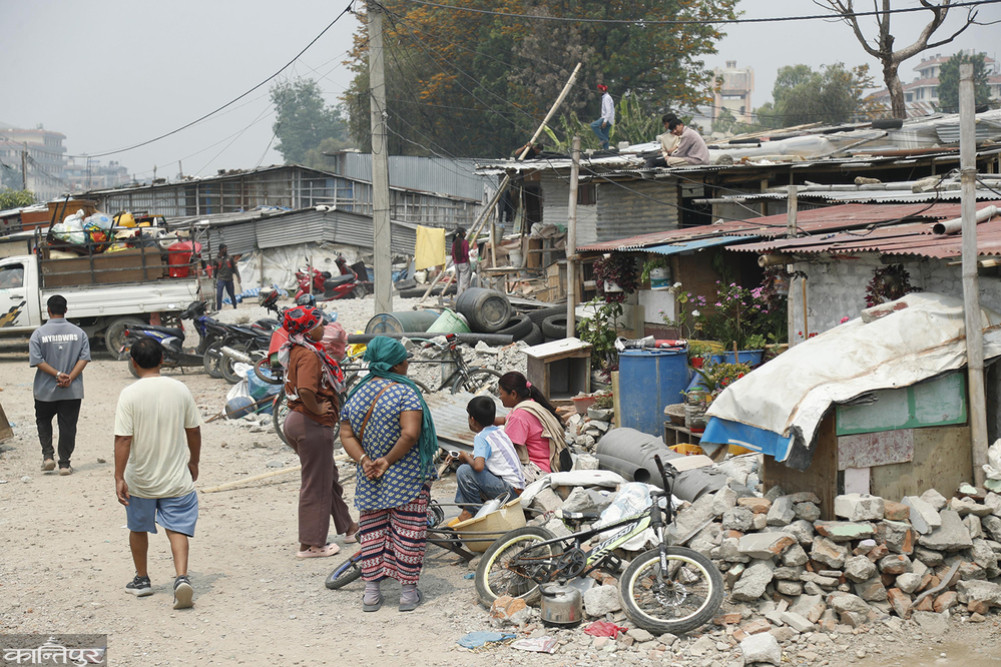
Ganesh Singh Ghalan, 49, looks at the house he built with sorrow and says, ”From tomorrow, the dozer will rain on the roof. It will collapse easily. Our sorrow will also be mixed with the soil.”
We use Google Cloud Translation Services. Google requires we provide the following disclaimer relating to use of this service:
This service may contain translations powered by Google. Google disclaims all warranties related to the translations, expressed or implied, including any warranties of accuracy, reliability, and any implied warranties of merchantability, fitness for a particular purpose, and noninfringement.
‘Where will we put our belongings, where will we go, no one here is ours,’ 58-year-old Urmila Rai was frantically looking towards the roof of her house on Friday afternoon, as she was frantically lifting her belongings. She doesn’t know where she will spend the night. There are no people who will invite her to stay here, or show her a place to stay. Her eyes are watering as she looks around the empty room. ‘Now the bulldozer is coming. I don’t even have the strength to stop it,’ Urmila says, crying. Like Urmila, other neighbors were also busy moving household belongings. Some were loading them into cars. ‘Now we will go to Bhaktapur, rent land and open a firm,’ one of them was saying in a passionate voice. But, Urmila, who was sharing the same roof, only sighed. She looked tired. ‘My daughter and I lived here. We have been here for many years. We always suffered even during the rainy season. We were living as we were. But the government has uprooted our homes and will never return,’ Urmila complains.
People are suspicious after the government ordered the squatters on the banks of the Bagmati River in Thapathali to vacate the settlement by Saturday. Prime Minister Balendra Shah has discussed with the heads of the security agencies and directed them to remove the squatters on the banks of the river in the valley.
The government has been repeatedly using microphones to urge them to evacuate the settlement. In Mangsir 2079, Balendra Shah was the mayor of Kathmandu Metropolitan City. At that time, there was resistance from the locals while removing the squatters in Thapathali. The situation had become tense. The metropolis had retreated after the police were injured. After Balendra became the Prime Minister, the locals became panicked after hearing this order again. Some were leaving the settlement. ‘We fought a lot, now we don’t even have the courage to fight,’ a local expressed his pain without giving his name, ‘We are tired.’
The same thing is also troubling the minds of the couple of 49-year-old Jang Bahadur Magar, ‘Where will we go now?’
The rumors and miking of the government bringing a dozer have not allowed them to sleep. ‘The miking was done to keep the children and the elderly in a safe place. The old man and the mother are there. Where will they go,’ he says. They wandered around looking for a room. However, since they cannot find a place for less than 10,000 a month, they are suffering even more. ‘The grief has also caused a lot of suffering. How can I survive,' he laments.
Jung Bahadur's family moved to Kathmandu 30 years ago after being burned by poverty. 'I came to Kathmandu at the age of 14 and worked as a carpet weaver . Later, I became a car driver,' he says, 'Now I am working as a wage laborer .'
Jung Bahadur's house was submerged in the flood last year . His leg, which was trapped in the flood, developed an infection . 'Bir Hospital said that his leg should be amputated . Later, with the help of Shanti Sewa and Ganeshman Hospital, he barely survived,' he says, showing his still-unhealed wound . Last year, when the flood came, it was heartbreaking to have to stay outside . Now, with the government imposing a permanent sit-in, they have not been able to sleep. He is more upset that the metropolis is not giving him an option than that he is being evicted. ‘It’s okay with us, if you pick it up, there’s nothing wrong with it, but you have to keep it in a safe place,’ he says, ‘The government may have its own vision, but that vision should not only help the poor to get up and move.’ 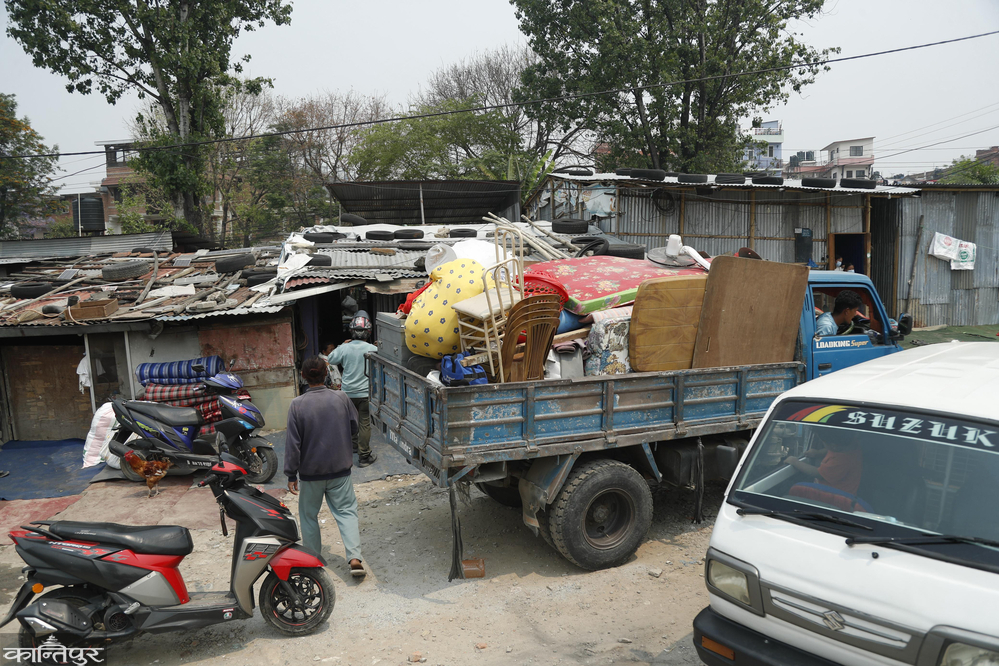
Jung Bahadur gets annoyed when the police come knocking on the door at night or when he hears the miking of the dozers coming in the daytime. ‘If a film is made on the story of the squatters, it will be a good film,’ he says with a smile.
49-year-old Ganesh Singh Ghalan looks at the house he built with sorrow and says, ‘From tomorrow, the dozers will rain on the roof. It will collapse easily. Our sorrow will also be mixed with the soil.’ The rooms inside the hut are emptying. He knows that the government will not listen even if he stands in front of the dozer and pleads. Even after Baburam Bhattarai became Prime Minister in 2068 BS, the house was still in the process of being demolished. ‘Even then, it was demolished without prior notice. There was no notice. There was no furniture left, one by one. We lived hungry for 2 days,’ he recalls. With the money he had saved by working as a wage laborer, he rebuilt the tin hut. It cost about 50,000. ‘Now it will be demolished again,’ he says in a grandmotherly voice.
Ganesh, who lost his parents at a young age, spent his childhood with his sister. He moved to Kathmandu at the age of 16. Then he started working as a laborer. He got married in Kathmandu. His 3 children also grew up here. Now, his family is upset that they have to leave this place in this condition without any choice. ‘The government is the guardian. If possible, don’t destroy it.’ Even if it had to be demolished, we had to give an alternative,' she says, 'We voted for this government to do something. But, when it does something that makes us even more disappointed, it hurts.'
When we met in the afternoon, 40-year-old Renu Rai looked exhausted. She was in a hurry to find a room. 'But where can I find her?' She said, wiping her wet eyes. Renu is the mother of three sons and a daughter. She has been living in Thapathali with her children for 19 years. She gets confused when she remembers the hut she built, 'It was built at the cost of so much money. If the dozer runs, the hut will be a mess. Where else can I keep these things?' 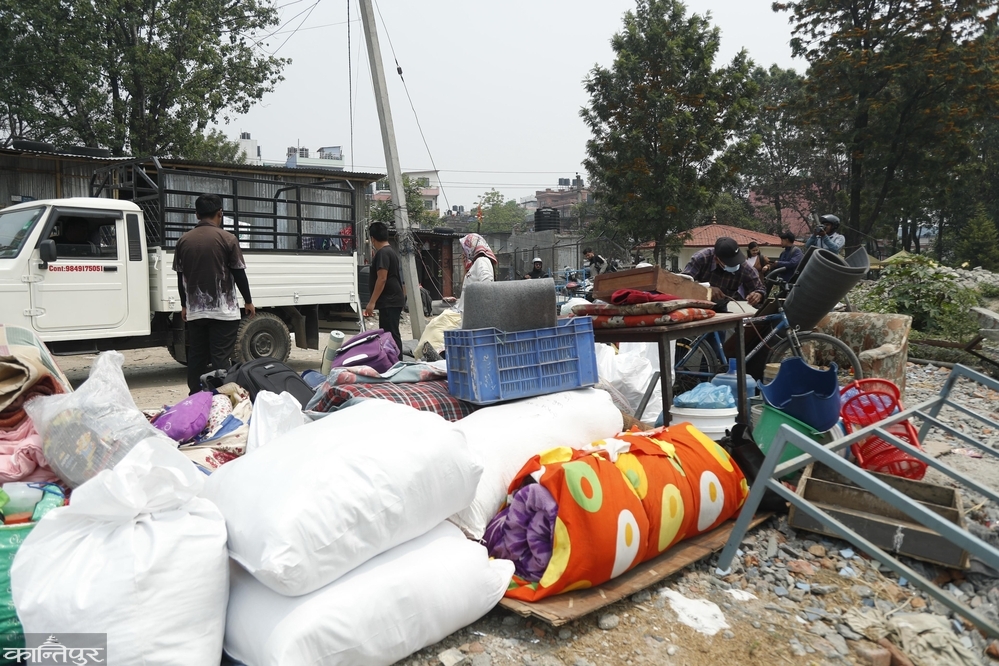
She was trying to keep the belongings in the house safe by wrapping them in a cloth. ‘We have to wear clothes. If we lose this too, what will be left for us,’ she said.
After the discussion of removing the slum, Anuj Magar did not even go to work on Friday. ‘Suddenly, we were asked to vacate the house by miking from yesterday. There was no prior information, we are at work all day long,’ she also shared the same pain as other neighbors, ‘We do not earn much by working for wages. If we have to live on rent, how will we pay? ’
Anuj is shocked to see the government becoming ruthless towards them. Her question to the government that does not want to understand her situation is, ‘If we can afford to pay the rent, why would we come to live on the banks of the river?’
Now a bulldozer is coming to the slum. He does not know how to look after his own house that is collapsing. That is why he does not even have the strength to go to work. Anuj works as a house painter. Anuj, who paints other people's houses, has not been able to sleep at night because of the pain of seeing his own house destroyed. His basic demand from the government, which has seen no alternative to demolition, is, 'At least make arrangements for living before demolishing.'
Krishnamaya Rai had great hopes after the new government came to power. 'This government will do something good. I thought I would be able to breathe a sigh of relief,' she says, remembering the trust that disappeared into the miking voice, 'But instead, it is uprooting our roots.'
Krishnamaya, who lost her son only three years ago, was short of money. She insists, 'If there was money, her son would also have survived.' The pain of that continues to haunt her. Especially now, when it seems that the government is not only going to use a bulldozer on houses, but also on poverty, she is starting to feel angry. She says with anger and love, 'Where can there be a government that does injustice to the poor?'