Nepal has shocked India for the eighth time while the 7 notes sent earlier remained unanswered. It has also sent diplomatic notes to China 3 times regarding the issue of border and Nepalese land use, but China has also responded only once.
We use Google Cloud Translation Services. Google requires we provide the following disclaimer relating to use of this service:
This service may contain translations powered by Google. Google disclaims all warranties related to the translations, expressed or implied, including any warranties of accuracy, reliability, and any implied warranties of merchantability, fitness for a particular purpose, and noninfringement.
Nepal has sent diplomatic notes to India 8 times in 10 years regarding the encroachment of its land in the west including Limpiyadhura, Lipulek and Kalapani and other border interference. Nepal has shocked India for the eighth time while the 7 notes sent earlier remained unanswered. It has also sent diplomatic notes to China 3 times regarding the issue of border and Nepali land use. China has also responded only once.
Note sent to India
Note sent to China
During his visit to India, Chinese Foreign Minister Wang Yi agreed with India to resume trade through Lipulek border crossing, Nepal has sent a note to both countries expressing dissatisfaction. After the two neighboring countries agreed on the land use of Nepal, there is a strong protest in Nepal from the parliament to the citizen level.
In the diplomatic note sent to India, it has been made clear that a solution to the border dispute will be found through discussion through the established mechanism between Nepal and India and this will lead to a solution. It is a Home Secretary-level mechanism dealing directly with India on border disputes. Similarly, the "Boundary Working Group" under the survey department is also working on border disputes. Apart from that, there is also Nepal-India joint commission. The largest formal mechanism to discuss bilateral issues is led by the foreign ministers of both countries. There are three mechanisms under the survey department to work on the border dispute between Nepal and India. There is a 'Boundary Working Group' (BWG) under the leadership of the Director General of Surveying Department of Nepal and the Surveyor General of India. Its meeting is held every year by rotation. The meeting of 'Boundary Working Group' was held in New Delhi on July 22-23 after Prime Minister KP Sharma Oli's visit to India was scheduled. After that meeting, a meeting of the Nepal-India border working group led by the head of surveying department was also held. In the meeting held from 28 to 30 July, it was agreed to resolve the border dispute between the two countries through diplomatic means. The Nepali delegation was led by the Director General of Surveyors Department, Prakash Joshi, while the Indian delegation was led by the Director General of Surveyors Department, Hitesh Kumar S. Makwana.
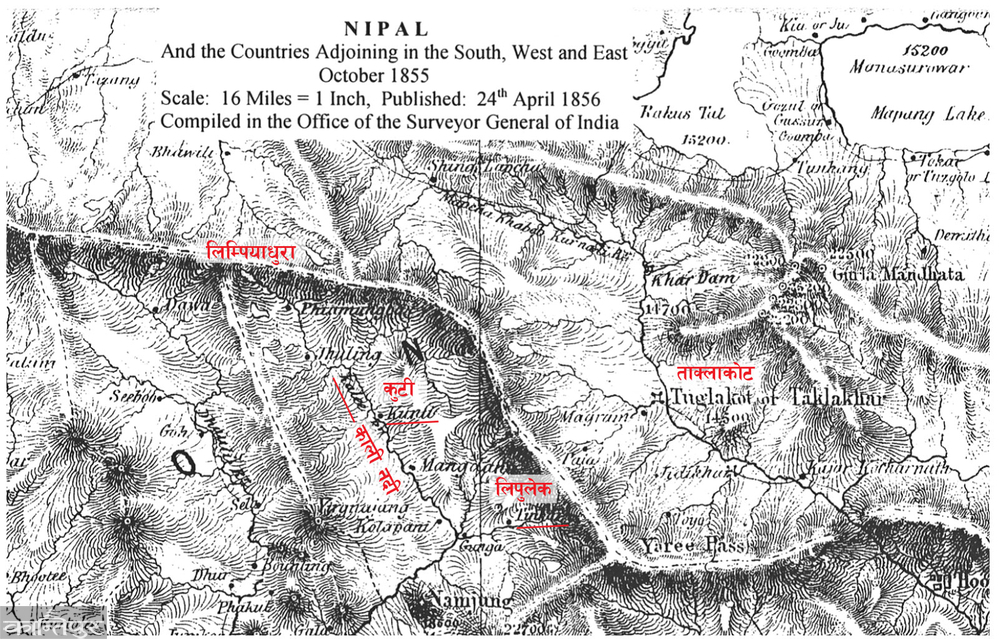
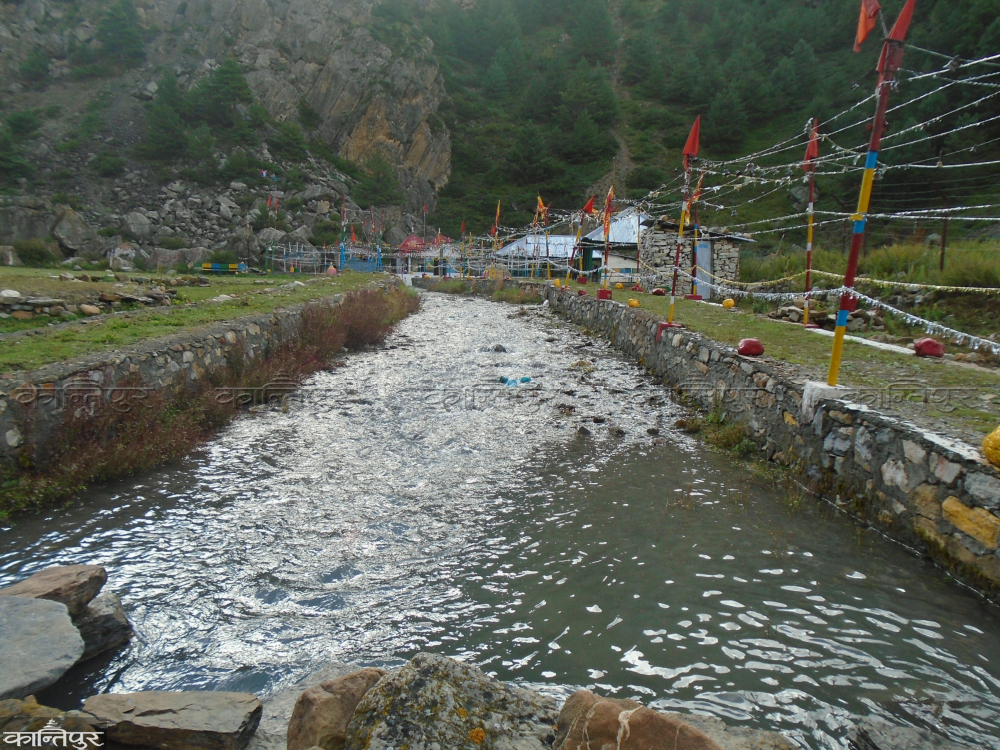
[Archive] That news from Kantipur that India has built a fake canal in Darchula...
The meeting reviewed the implementation of the outcome of the sixth meeting held in Dehradun in August 2019. The work progress of the 11th survey committee meeting held at the same place in September 2019 was also reviewed. The meeting said that it was agreed to adopt new technology in surveying and mapping to make the work of inspection and maintenance of border pillars and related mechanisms more effective in Nepal and India border area.
Both parties agreed to hold the next meeting of the committee comprising officers of the surveying department in Nepal and the next meeting of the border working group in Nepal on a date that is convenient for both countries. At a time when these meetings are being held in full swing regarding the resolution of the border dispute and Prime Minister KP Sharma Oli's visit to India is being done, India has signed an agreement with China to use Nepalese land for trade.
In the diplomatic note sent by Nepal to China, it is said that since the Lipulekh area is in Nepal, Nepal should be consulted before making any agreement and China should take care of it. This is the third time since 2072 that a diplomatic note has been sent to China on border disputes. Earlier, a diplomatic note was sent to China during the Sushil Koirala government on June 2072 and on 29 Baisakh 2077 during the KP Oli government.
, India made a road to Mansarovar through Nepali land and even inaugurated it without informing Nepal, a diplomatic note was sent to China on 29 Baisakh 2077 with the information that Nepal was dissatisfied. In the note written for the third time on Thursday, what was written to China in 2015 has been 'recalled'.
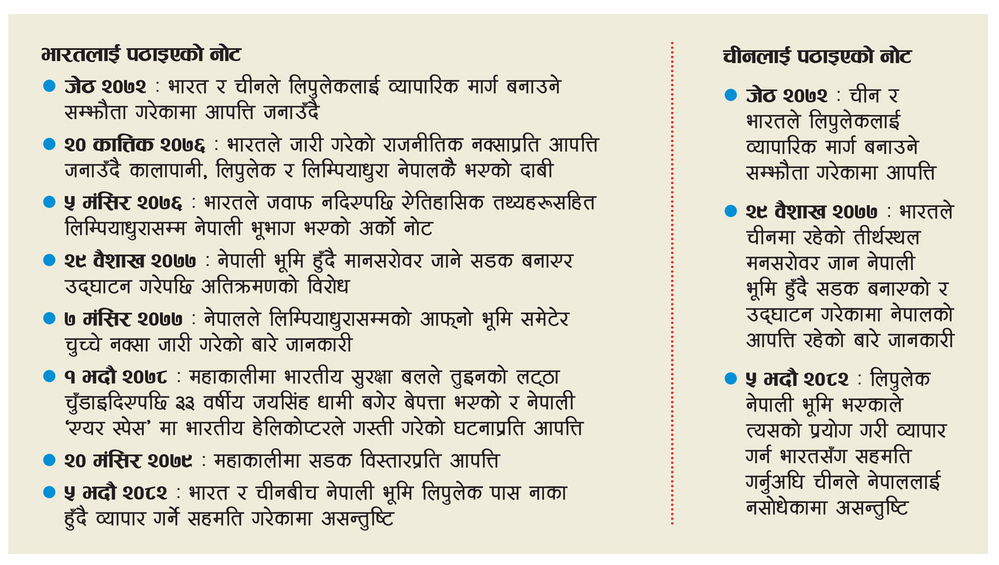
Diplomatic notes have been sent to India 8 times regarding border disputes and territorial disputes. During the visit of Indian Prime Minister Modi to China, the then Prime Minister Koirala's government sent a note to both the neighbors stating that the agreement reached on 1st May 2072 is not valid.
It was agreed in Beijing to make the Lipulekh crossing a China-India bilateral trade point. After the agreement came out, the Ministry of Foreign Affairs sent a 'protest letter' to both India and China regarding the agreement on annexation of Nepali territory. After the meeting between the President of China and the Prime Minister of India in Beijing, a 'trade agreement' was reached regarding the Lipulek territory of Nepal, a third country. After Nepal protested, China responded, but India remained silent.
India released a new political map on 16 October 2076. Since the Sugauli Treaty, there was a dispute between Nepal and India after Kalapani was released as part of its territory. This dispute lasted for a long time. Nepal expressed objection to the Indian map and sent a diplomatic note on 20 October 2076 with Kalapani, Lipulek, Limpiyadhura as Nepali territory. But there was no reply. Therefore, on 5 November 2076, Nepal again sent another note.
In this note, it was claimed that there are historical facts that these territories belong to Nepal. With this note, Nepal started the initiative for foreign secretary level talks, but India did not immediately show any interest to Nepal. India sent a reply to Nepal's diplomatic note on 8 January 2076. In the reply, it was mentioned that 'negotiations will be held on a mutually agreed date'.
India refrained from solving it immediately saying that 'this matter is also connected with Nepal's sentiments and now there is a corona epidemic'. Nepal was confident that the talks would take place. But in the meantime, the then Indian Home Minister Rajnath Singh inaugurated the 'virtual' road to Mansarovar through the territory of Nepal. On 26 Baisakh 2077, after he inaugurated the road built on the land of Nepal, the Nepal-India dispute flared up again.
The then foreign minister Pradip Gyawali sent information through the ambassador that the government was willing to talk to India at any level about the Lipulek dispute and resolve the issue through diplomatic means. The same notification was also sent through unofficial channels. However, India did not show any interest.
After increasing opposition to India's move in Nepal, the government summoned the Indian ambassador Vinaymohan Kwatra to the Ministry of Foreign Affairs and handed over the diplomatic note again. On 29 Baisakh 2077, the government handed over a diplomatic note expressing disagreement over the opening of the road to Mansarovar through Nepali land.
Nepal announced on 2nd June 2077 that it will issue a map with Nepali Bhumi Limpiyadhura in the policy and program. On May 5, the Cabinet decided to issue a new political map. On June 10, India sent a diplomatic note to Nepal for issuing a new Chuchche map including Lipulek and Limpiyadhura.
Nepal ignored it and amended the constitution on 31 July 2077 unanimously passed by the parliament. The Ministry of Land Management, Cooperatives and Poverty Alleviation wrote a letter to the Ministry of Foreign Affairs on 9th May 2077 to inform Nepali embassies abroad along with the international community about the new Chuchche map. On the basis of this letter, on 7th November 2077, the government sent a diplomatic note to other countries including India about the Chuchche map published by including Nepali land.
On 21 August 2078, 33-year-old Jaisingh Dhami went missing after Indian Security Force, SSB jawan picked up a tuin stick on the border of Darchala on 21 August 2078, and Nepal also sent a diplomatic note regarding the incident of an Indian helicopter patrolling the Nepalese air space.
When Nepal investigated the incident of Dhami's disappearance, after receiving a report that the incident was caused by the Indian side, Nepal sent a diplomatic note to India demanding real information about the incident. Foreign officials claim that a diplomatic note was also sent to the Indian side regarding the embankment on the Mahakali river.
After that, a diplomatic note was sent to India on 20 November 2079 regarding the border dispute, saying that the road was being expanded in Mahakali and even the Nepali territory was damaged. Based on the report from the Ministry of Home Affairs, the government drew attention through a diplomatic note. Nepal has again sent a diplomatic note to India and China on August 5, 2082, after Delhi signed an agreement to trade Nepalese land through Lipulekh.
'Follow-up to the diplomatic note and negotiation is the way to solve it'
It is customary to give a diplomatic note if the action of another country is not satisfactory. A diplomatic note is also given to keep it as a record when there is an uneasy situation between the two countries. But often there is no 'follow-up' of diplomatic notes. According to foreign experts, Nepal has been sending a diplomatic note on the agreement between India and China to make Lipulek a trade port, but there is no follow-up or serious diplomatic initiative.
Former ambassador and professor of political science Lokraj Baral claims that sending diplomatic notes is regular. He says that any country will send them to maintain their position and Nepal has also sent them several times to show their concern on border issues. He commented that Nepal has been doing its work since the past but the Indian side is ignoring it.
We had sent a diplomatic note before, keeping our points, it doesn't seem like India has sent a reply. Baral says, "We may have sent a note in the last dispute as well, but he made it clear by holding a press conference a few days ago that he is in his old position."
'Prime Minister Oli is going on a visit to India soon, it would be appropriate to resolve this dispute by negotiating at the same high level,' he says, 'It should be resolved through negotiations at the diplomatic level.' "This is a problem that Nepal has been facing for a long time, it is not possible to find a solution through mature diplomacy," says Thapa, "If India and China are not ready to negotiate on border issues and correct the error based on evidence, then Nepal should also go for the option accordingly."
He says that this matter should be internationalized and taken to the United Nations strongly based on national consensus. Diplomat Dinesh Bhattarai has commented that if the diplomatic note is not followed up, the issue will not be resolved. "The protest note was sent when Sushil Koirala was the Prime Minister, the subsequent governments did not follow up," says Bhattarai, who was Koirala's foreign affairs advisor at the time. "The border is also ours, we have to say let's talk, what is the situation?" Acharya says, "How can India give priority after leaving the original issue and entering another issue?" The same has happened in our case. Former Foreign Minister Prakash Chandra Lohani also says that proper initiatives have not been taken.
Former ambassador to India Nilambar Acharya comments that India has confiscated force in the latest agreement. Acharya says, "When Nepal has been claiming the area as its land since the past, it should have been negotiated and found a solution, but making an agreement with China without Nepal's knowledge did not send a good message." Nepal should talk amicably, the way to a solution is through dialogue.
Former ambassador to China, Tank Karki, says that since both countries are neighbours, diplomatic initiatives should be taken. "When Nepal has told both China and India in the past that Lipulek and other areas belong to Nepal, there is a tendency to undermine the agreement," he says. He says that since both are neighbors for Nepal, a solution should be found through dialogue and diplomatic initiatives.
Nepal-India border confusion
16 October 2076 : After India made Jammu-Kashmir and Ladakh a union territory, Limpiyadhura-Kalapani was placed within India in the new map.
3 November 2076: Sending a 'diplomatic note' to the Indian government about the new map of India, the statement of the Ministry of Foreign Affairs of Nepal reminded that according to the Sugauli Treaty, Limpiyadhura, Kalapani and Lipulek in the east of the Kali River are the lands of Nepal.
26 Baisakh 2077: India's Defense Minister Rajnath Singh inaugurated through a video conference the link road network connecting Tibet's Kailash Mansarovar through Nepali land Dharchala-Lipulek.
27 Baisakh 2077 : Nepal's statement that the unilateral activity of road construction is against the agreement between the two countries at the prime ministerial level.
27 Baisakh 2077 : The reaction by the Ministry of External Affairs of India that the road network is within the Indian border in Pithoragarh district of Uttarakhand state 7th June 2077 : The official map of Nepal with Kalapani, Limpiyadhura and Lipulek, which was passed by the Council of Ministers of Nepal, is released.


![[अर्काइभ] भारतले दार्चुलामा नक्कली कालीनदी खडा गरेको कान्तिपुरको त्यो समाचार...](http://assets-cdn.ekantipur.com/uploads/source/news/kantipur/2025/miscellaneous/map-1-2182025023537-1000x01-2382025112300-1000x0.jpg)

