The main sources of irrigation in Madhesh are rivers, ponds, dams, canals, shallow tubewells and deep borings. However, due to lack of rain for a long time, all these irrigation systems have become useless.
We use Google Cloud Translation Services. Google requires we provide the following disclaimer relating to use of this service:
This service may contain translations powered by Google. Google disclaims all warranties related to the translations, expressed or implied, including any warranties of accuracy, reliability, and any implied warranties of merchantability, fitness for a particular purpose, and noninfringement.
To provide relief to the farmers of Terai-Madhesh from the farming system dependent on sky water, the government has launched dozens of irrigation projects. There are half a dozen irrigation projects of national pride.
Although those projects were completed in time, the scene of the Terai-Madhesh region would have been different now. Now the field where the rice is being torn would have been covered with rice.
When the Sunkoshi-Marin Diversion multi-purpose project of national pride is completed, irrigation facilities will reach 122 thousand hectares of Bara, Rautahat, Sarlahi, Mahottari and Dhanusha. The water in the ground is also 'recharged'. But it is not yet certain when that time will come. This project, which was inaugurated by Prime Minister KP Sharma Oli on February 20, 2077, should be completed within this August according to the initial agreement. Its tunnel was blasted on 26 Baisakh 2081. But other work has not been able to gain momentum.
30 months after the construction of a dam on Sunkoshi bank was started with the purpose of irrigation in 5 districts of Madhesh, the progress is only 10 percent. The contract for the dam was taken by Patel-Raman JV on 17th December 2079.
Although it is a joint contract, the work is being done by Raman Construction. The contract for the construction of the dam is 55 months, 30 months have ended. "Fifty percent of the work has to be completed so far," said Badri Karki, the head of the project, "because the builders could not mobilize enough resources, the work has not been able to accelerate." After the construction of a dam about 30 meters high and 158 meters long on the Sunkoshi river, water will be released through a tunnel into the Marin River in Kamalamai Municipality-2, Kusumtar. Electricity will also be produced from there. The total cost of the project is 49 billion rupees.
The Babai irrigation project was started in the financial year 2045/46 with the aim of providing irrigation facilities to 36 thousand hectares of arable land in Bardia. According to the contract, its construction was to be completed within 2069/70. After revising the work schedule, it has been requested to extend the time by another two years for the target of completion by 2082/83. So far only 82.27 percent progress has been made while 15 billion 478 million rupees have been spent. According to Dinesh Paudel, senior divisional engineer of the
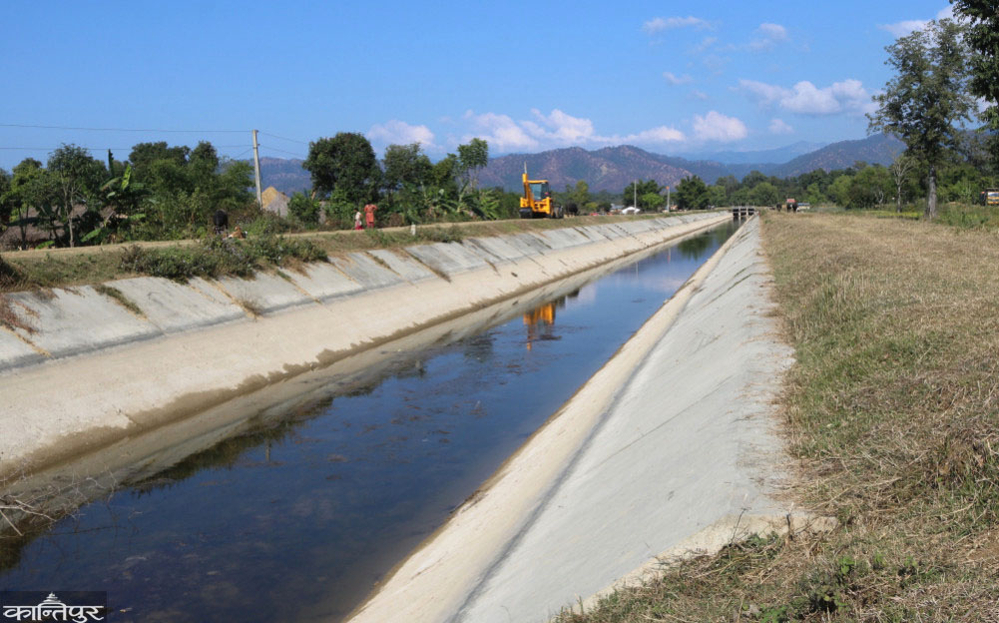
project, the work was not completed according to the initial master plan. In the past, there were also budget problems, only after the project of national pride, the work picked up speed. We have set a target to complete it within the current fiscal year," he said, "now 11 kilometers of the west main canal are being worked on. Its four branch canals are being constructed.
The initial cost estimate of the Babai irrigation project was 2.87 billion 3.9 million. Now the cost has been revised to 18 billion 963 million rupees. After the completion of the project, irrigation facilities will reach 36,000 hectares of arable land, 21,000 to the east and 15,000 to the west of Bardia. Now, irrigation facilities have been provided in 28 thousand hectares, we have provided water in some sections,' Engineer Paudel said, 'The work of the original canal in the east has been completed.'
It has been two decades since the Sikta irrigation project was started with the goal of providing irrigation facilities to 42,766 hectares of land in Banke. But the progress has not reached 45 percent. When the project started in 2062/63, it was said to be completed by 2071/72. The latest target was set to be achieved by 2084/85 with repeated time extensions. But according to the master plan, the work will be completed only within 2089/90, according to the project. "Government has given resource consent to Sikta as a priority and if they are able to work according to their capacity, there will be no problem in completing the work ahead of time," said Raju Acharya, head of the project.
Its initial cost estimate was 12.80 billion rupees. Later it was revised to Rs 52 billion 89 crore. So far 22 billion rupees have been spent. Project head Acharya said that along with the revision of the master plan, the budget was also revised. "Irrigation facilities have reached 22,500 hectares from the work done so far," he said.
The Rani Jamra Kularia irrigation project in Kailali was started in the year 2066/67. According to the initial agreement, it was supposed to be completed in 2074/75. The main purpose of its construction is to provide irrigation facility to 38 thousand 300 hectares of agricultural land of Kailali with 14 thousand 300 hectares of Rani Jamra Kularia irrigation system, 6 thousand from the extension of new branch canal Lamki and 18 thousand under the extension of irrigated area from Pathraiya to Kandra river. So far, the overall physical progress of the project is only 74 percent. In the first phase, a canal that will provide irrigation facilities to 14,300 hectares has been built, which was inaugurated by Prime Minister Oli on Tuesday.
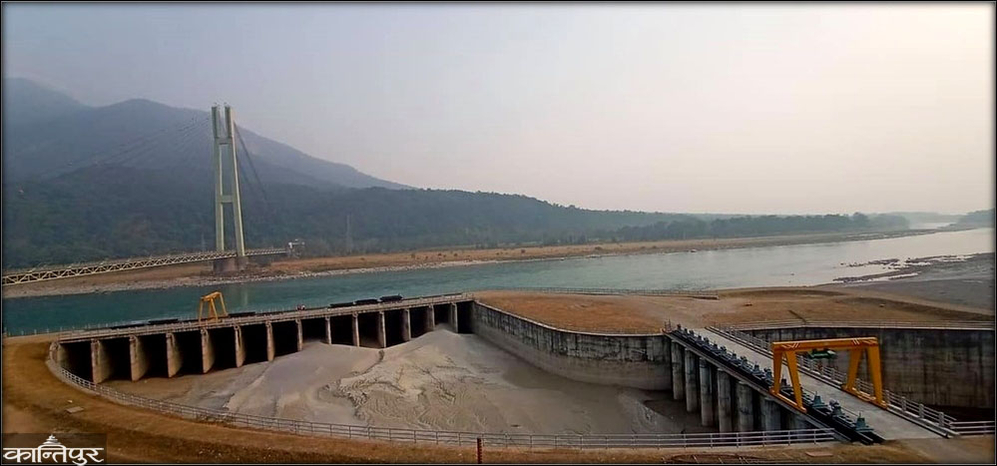
20 billion 58 crore 56 lakh rupees have been spent on this project so far. The cost estimate at the start of the project was Rs 12.37 billion. The latest cost estimate is Rs 27 billion 70 crore. Its estimated cost is 27 billion 70 crore rupees.
The progress of the Mahakali irrigation project is almost 26 percent. When the project was started in the year 2063/64, its cost estimate was 35 billion 264 million rupees. 9 billion has been spent since the project started. Its main goal is to provide irrigation facilities to 28,225 surface and 5,000 hectares of land in Kanchanpur. After the completion of the project, irrigation facilities will reach Brahmadev, Malakheti, Dodhara Chandni, Tribhuvan settlements. According to the revised schedule, it is claimed that the project will be completed by 2086/87. Yogendra Mishra, head of the
project, said that irrigation facilities can be provided in an area of 5 hectares in the current financial year. "In the beginning, the budget was coming at the rate of 10-20 million per year, only after it was announced as Gaurav's project in 2077, more budget started coming. According to the treaty, India has not given up the water that should be available in the canal," he said.
The Bheri Babai Diversion multi-purpose project started in 2068/69 is to be completed in 2079/80. So far the physical progress is only 69 percent. According to the master plan, the deadline has reached 2084/85 due to the addition of work. The initial cost estimate of the project is 16.43 billion. The revised cost estimate is 33 billion 196 million including the cost of additional works including dam and powerhouse, hydro mechanical and electro mechanical works. So far 18 billion 19 billion 97 million rupees have been spent. It is said that after the completion of the
project, irrigation facilities will be available for twelve months in about 51 thousand hectares of land in Bardia and Banke districts from the additional water available in the Babai River. "In the last fiscal year, additional budget was requested, but it was not received, the internal funds could not be transferred," said Pawan Adhikari, the information officer of the
project.
Only 49 percent of land in Madhesh has irrigation facility
Out of the total cultivable area of 542 thousand 580 hectares of Madhesh province, only 5 lakh 2 thousand 224 hectares are cultivated. Barkhe paddy is cultivated in 3 lakh 62 thousand 344 hectares and chaite paddy in 20 thousand 839 hectares. However, due to lack of rain in Madhesh, many farmers could not plant chaite paddy. Barkhe paddy planting is only 51 percent. There has been a lot of delay in planting. The plan is to speed up the irrigation facilities so that the planting can be done in the month of July," said Saroj Chaudhary, spokesperson of the Ministry of Land Management, Agriculture and Cooperatives of Madhesh Province.
According to the ministry, the production of Barkhe paddy in Madhesh province is 1 lakh 270 metric tons and the productivity is 4.81 metric tons per hectare. Chaite rice production is 12 lakh 37 thousand 41.9 metric tons and productivity is 3.41 percent metric tons per hectare.
In Madhesh province, only 49 percent of the total arable land has been irrigated. The main sources of irrigation in Madhesh are rivers, ponds, dams, canals, shallow tube wells and deep borings. However, due to lack of rain for a long time, all these irrigation systems have become useless. Spokesperson of the Ministry of Agriculture Chaudhary said, "Even if there is no rain, we are ready to plant through alternative irrigation." Narc is also discussing about what kind of crops are suitable to be planted in Madhesh in case of drought.' This project was launched 32 years ago. Information Officer of Bagmati Irrigation Project Rajan Shrestha informed that 22,600 hectares of Sarlahi and 23,000 hectares of Rautahat are being irrigated by this project. But he said that irrigation facilities cannot be easily provided everywhere as the water in Bagmati is less during the dry season.
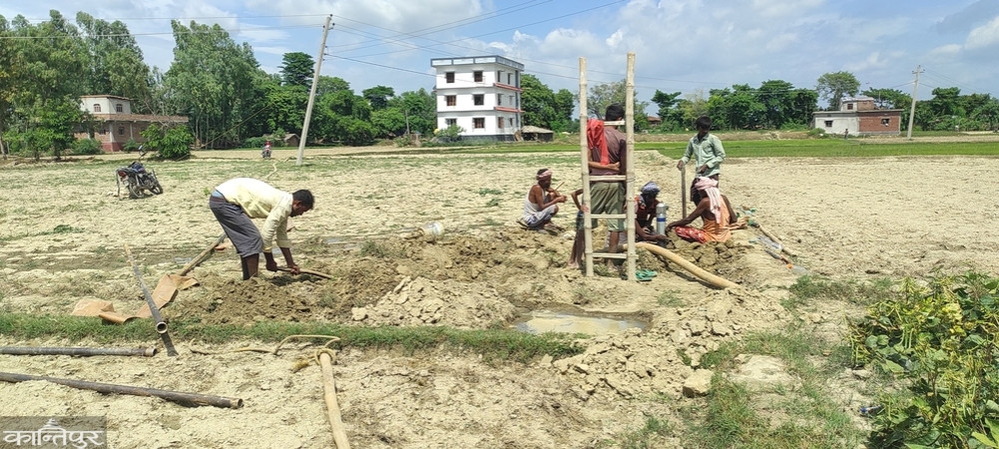
Chief Minister Satish Kumar Singh said that even though Madhesh province is a storehouse of grain, irrigation facilities could not be provided to all farms due to drought. Mentioning that the drought has dried up most of the borings, he said that the provincial government has moved forward by thinking long-term about its alternatives. He said that he has also requested some plans from the federal government. "The provincial government has started initiatives to bring the concept of storing rainwater while passing the map to build houses from the local level to build water reserve tanks at various places," said Chief Minister Singh, "Programs are also being prepared for the water storage process." have connected. He said that two bigha fields were planted on top of that and water was also given to neighbors for planting. Earlier, planting could be done in the first week of June. This time, it didn't rain at all," he said, "I spent 50,000 and installed a borehole." The seedlings are turning green in Sah's field.
Some people who are not boring are planting even by buying water. Even the planted paddy has started to dry due to drought. Surendra Prasad Kurmi, head of Krishi Gyan Kendra, informed that till now more than 60 percent of the fields have been planted in Rautahat from the Boring and Bagmati irrigation projects. Now some planting is being done with the help of boring. But water from the sky is needed. Otherwise, the harvest will be very low," he said.
According to Krishi Gyan Kendra, out of the 18 municipalities of the district, farmers of Fatuwavijaypur, Ishanath, Paroha, Boudhimai, Rajpur, Moulapur municipalities have been farming under sky water. In other municipalities, planting has been done with Bagmati irrigation, Lalbakaiya water. Most of the farmers' fields in Moulapur, Ishanath Municipality are barren. "I have left 10 paddy fields just like that," Rampravesh Yadav of Banjraha in Ishanath said, "There is no way to water the fields." Now we will plant when it rains, otherwise I will leave it like this.
Krishi Gyan Kendra has called for information to install borings for underground irrigation in 10 municipalities of the district. Farmers who are waiting for rain are worried when the seeds start drying up. According to Krishi Gyan Kendra, there are 38,500 hectares of arable land in Rautahat. Chief Kurmi informed that 4.2 metric tons of rice will be produced per hectare if planted on time.
Farmers worried
Kavilasi Municipality-2 Piparia of Sarlahi grows paddy in 4 bighas every year. They keep about 150 quintals of paddy produced in the farm and keep it for their families throughout the year. The income of the rice sale is the livelihood of his family. But this year his field is barren. Even when the second week of July is about to pass, the fields in Madhesh remain barren due to lack of sufficient rainfall. Sesha told that the field was dry during the sowing of hemp and due to lack of water even the paddy beds were dry. At other times I used to sell paddy. Now, the day to buy rice seems to be coming," he said.
Puran Mahato of Sarlahi, Haripur Municipality-3 Farhadwa has been cultivating paddy in two bighas. He also sells about 70 quintals of paddy. "This year, I don't even have enough rice to eat," he said. According to Krishi Gyan Kendra Malangwa, 3.5 metric tons of rice was produced in 46 thousand hectares in Sarlahi in the financial year 2079/80. Similarly, 3.25 metric tons of rice was produced in 44 thousand hectares in 2080/81 and 3.8 metric tons in 44 thousand hectares in 2081/82. "But this year, it is seen that there will be a decrease in rice production due to lack of rain," said Kamaldev Prasad Mahato, head of Knowledge Center Malangwa.
The rice produced in Sarlahi reaches Kathmandu, Pokhara, Birgunj. The rice produced in Madhesh is Kariya Komod, Basmati, Ram Vilas, Sona and other rice. The drought has also affected crops such as vegetables and sugarcane. The sugar cane could not flourish without rain from the sky. Pramod Thapalia, Chairman of Lalbandi Vegetable Management Committee informed about the decrease in vegetable production. In Sarlahi, rice is being cultivated on 40 thousand hectares, wheat on 30 thousand hectares, corn on 16 thousand hectares, vegetables on 13 thousand hectares and sugarcane on 21 thousand hectares.
23 deep borings stopped in Mahottari
Until a few years before the deep boring of Bhageswar pond in Jaleshwar, paddy was cultivated in the vicinity. Boring is still there but only a remnant. Boring is covered with dirt. Pump parts are stolen. The technical living room has become a haunt of gamblers and drug addicts. Mohammad Safid Rain of Jaleshwar Sari could not plant paddy this year on 10 kattas of land after boring was stopped. More than 50 bighas of surrounding fields are barren.
According to Amlesh Yadav, Engineer of Underground Water Resources and Irrigation Development Division Office, Mahottari, there are 23 deep borings which could not be operated due to general maintenance, transformer connection, pipeline extension etc. These deep borings were installed by Irrigation Development Division. "Deep borings have not been run in some places due to non-payment of electricity tariffs, consumers not getting electricity meters," Yadav said, "It is estimated that 45 million will be spent on the maintenance of borings that are not running." From that, 20 to 40 hectares of land can be irrigated.'
According to the division office, 980 hectares of land is being irrigated from 31 boreholes in operation. Groundwater and Irrigation Development Division, Kamala Irrigation Management Office Portaha, Agricultural Mechanization Promotion Center Naktazhizh Dhanusha, state government, local government and non-governmental organizations have been installing deep boring in Mahottari.
- Along with, Ajit Tiwari (Janakpur), Santosh Singh (Mahottari), Shiv Puri (Rautahat) and Omprakash Thakur (Sarlahi)



