The range of resources did not expand, ambitious programs did not come, the policy of the budget that swallows the bones
We use Google Cloud Translation Services. Google requires we provide the following disclaimer relating to use of this service:
This service may contain translations powered by Google. Google disclaims all warranties related to the translations, expressed or implied, including any warranties of accuracy, reliability, and any implied warranties of merchantability, fitness for a particular purpose, and noninfringement.
At a time when a special plan (Big Push) is needed to make economic activities sustainable and expand investment, the government has brought a traditional style budget. The continuity of the past has also been seen in terms of production growth, job creation, development of digital economy, leap in infrastructure development.
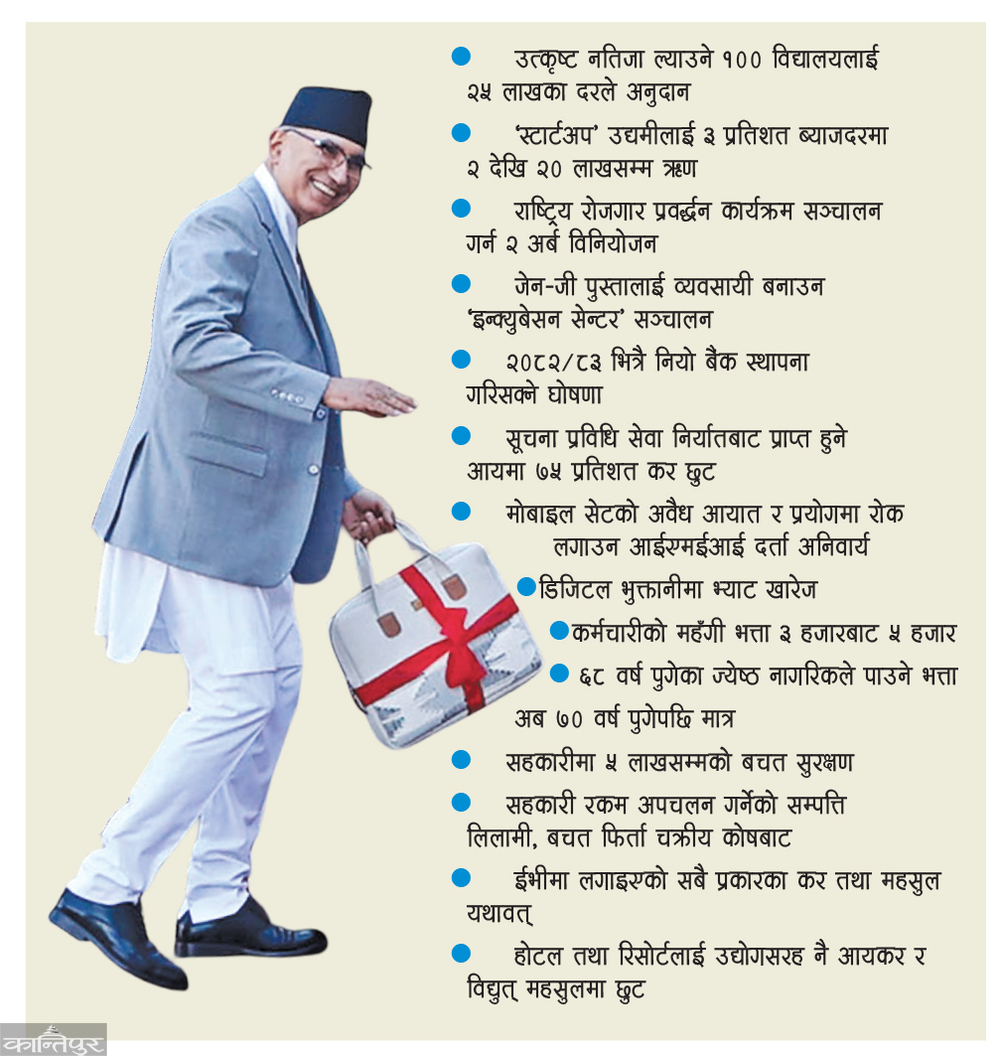
Although Deputy Prime Minister and Finance Minister Bishnu Paudel has set ambitious goals in some areas, he has not come up with an effective plan for them. Due to resource constraints, many new programs are not included in the budget for the next financial year. To reduce the state's liability in social security, the minimum age for receiving old-age allowance has been made 70 years. Finance Minister Paudel has increased the dearness allowance by 3,000 to 5,000 rupees without increasing the salary of the employees.
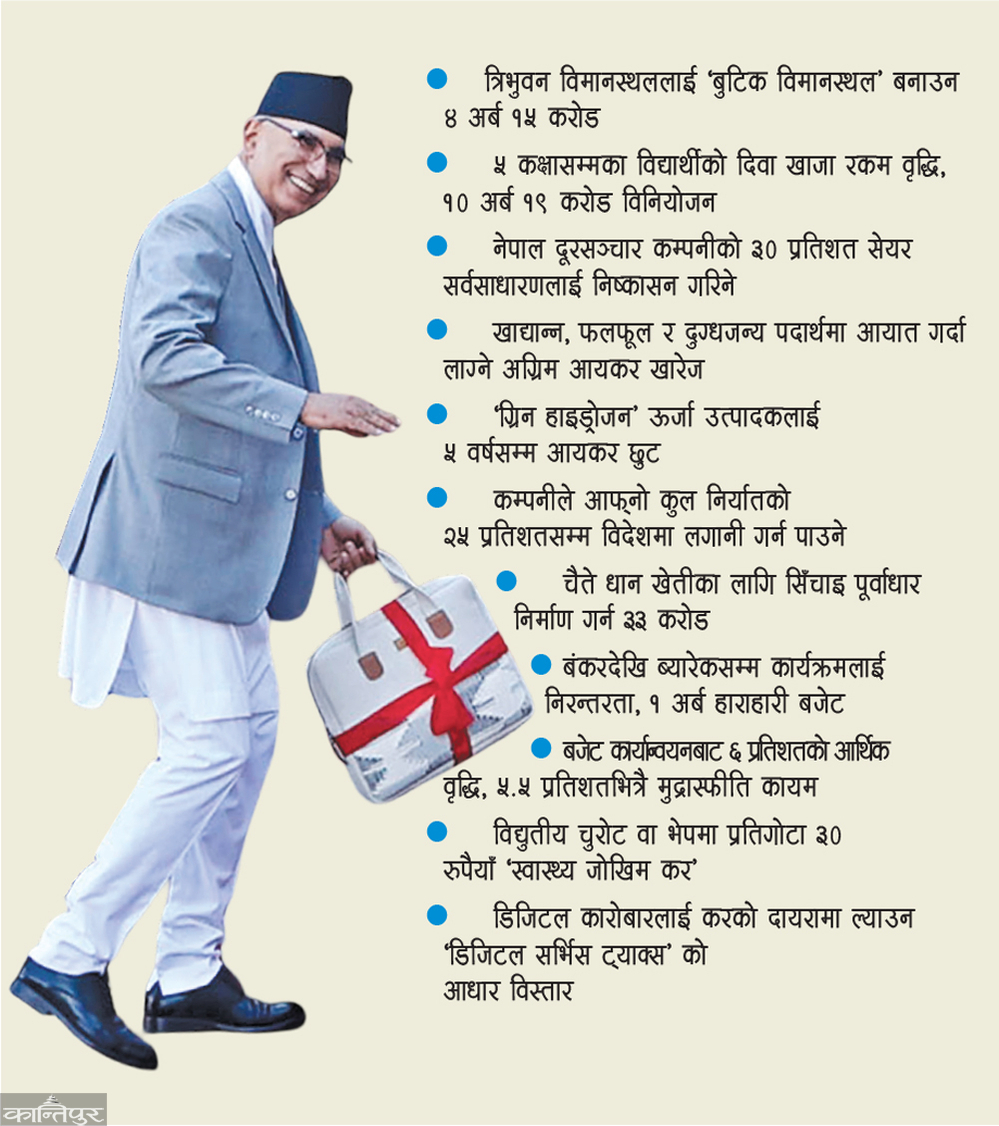
The budget has been increased for projects of national pride which are in the final stages of construction towards the infrastructure sector. Addressing some of the concerns of the private sector, Nepalis have also been given an opportunity to invest abroad by giving exemptions from land restrictions to tax facilities. Through the budget, the government has for the first time given legal recognition to 'sweat shares' and loan business in companies.
Ambitious programs such as becoming self-sufficient in rice in two years, distributing food supplies to land owners in one year, and preventing arable land from being barren have been included in the budget. 33 million rupees have been allocated to build irrigation infrastructure for Chaite paddy cultivation in order to become self-sufficient in rice production. Advance income tax on imports of food grains, pulses, fruits and dairy products has been abolished.
Although the size of the budget has been increased, Finance Minister Poudel seems to have adopted moderation. The National Planning Commission had given a 'ceiling' of 19 trillion 65 crores for the next financial year's budget. Finance Minister Paudel has presented the budget of 19 trillion 64 billion 11 billion for the financial year 082/83 in the Federal Parliament on Thursday. This is only 1 trillion 3.81 billion more than the allocated budget of the current financial year. The government had brought a budget of 18 trillion 60 billion 300 million for the current financial year, but due to the inability to collect and spend revenue, it has been reduced by 1.5 trillion.
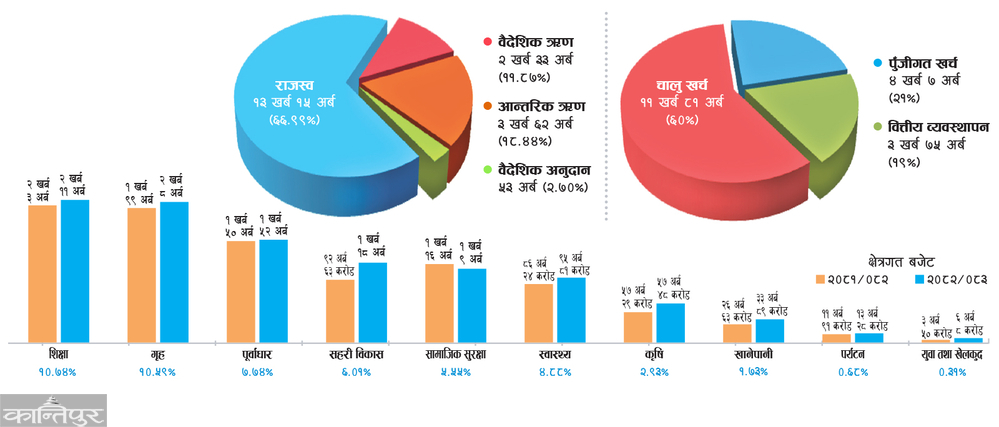
The government has allocated 11 trillion 80 billion 98 million (60.1 percent) for current affairs, 4 trillion 7 billion 89 million (20.8 percent) for capital and 3 trillion 75 billion 24 million (19.1 percent) for financial system. This estimate is 5.6 percent higher than the current fiscal year's allocation and 18.2 percent higher than the revised estimate.
Compared to this financial year, the current expenditure for the next financial year has been reduced, while the capital expenditure and financial system expenditure have been increased. 4 trillion 17 billion 83 crores have been allocated for the financial transfer to the provincial and local levels for the next financial year. This is less than the current year. For this year, the government allocated 4 trillion 8 billion 87 million rupees for financial transfer to the state and local levels.
The government has planned to spend 13 trillion 15 billion from revenue and 53 billion 45 billion from foreign grants in the coming financial year. Even adding these sources, 5 trillion 95 billion 66 billion rupees will be insufficient, to fulfill which 2 trillion 33 billion 66 billion rupees will be collected from foreign loans and 3 trillion 62 billion rupees from internal loans, said Finance Minister Paudel.
The government's revenue collection target is only about 48 billion rupees more than the current year. At the beginning of this year, the government made a revised estimate to collect 12 trillion 67 billion 39 billion rupees after the target of collecting 14 trillion 71 billion 62 billion rupees was not achieved.
Finance Minister Poudel said that to make the revenue system investment-friendly and production-oriented and to manage resources for the ever-increasing public expenditure, the government needs to adapt the tax system to international standards and practices and attract external capital and technology. But there is no specific program in the budget to improve tax compliance and control revenue leakage.
"In order to increase the productivity of the revenue system, I will widen the scope of taxes by encouraging economic activities in the coming fiscal year and increase voluntary tax participation by making timely reforms and simplifications in the tax laws," Finance Minister Paudel said in the budget statement, "I will develop a taxpayer-friendly, transparent and automatic revenue system, increase the efficiency of revenue administration and control revenue leakage, and mobilize non-tax revenue in a way that makes sustainable use of natural resources and cost-effective." The government plans to review the laws on Value Added Tax, Income Tax and Excise to address changes and new business patterns. "I have made an arrangement to give income tax and electricity tariff exemptions to information technology-based industries and hotels and resorts as a special industry," Finance Minister Paudel said. Importing mill machinery required for wood 'seasoning' industry has imposed only 1 percent customs duty and other taxes and duties have been abolished. The government has provided income tax exemption for green hydrogen producers for 5 years and 1 percent customs duty on the import of batteries and other devices needed to store electricity from solar and wind energy.
The government has made arrangements to charge 1 percent customs duty on the import of equipment required for manufacturing and assembling electric vehicle charging machines and no other tax duties. Income tax exemption for 5 years has been arranged for such industries. The government has also made provision for free company registration and tax exemption for women entrepreneurs, no fees for electronic transactions. The government has announced seed capital to set up low rate loans to microfinance borrowers, savings protection (insurance) of up to five lakhs in cooperatives, and a revolving fund to return savers' money. As mentioned in the
budget statement, the investment in physical infrastructure has not been reflected in the expansion of economic activities, so the expected contribution to production growth has not been reached. The negative impact of climate change is increasing in agriculture, drinking water, irrigation and other sectors. The pace of digital economy development is slow due to lack of digital infrastructure. There is no harmony between the country's labor market and the skills of the produced manpower. The required manpower in the industrial and construction sector is being supplied from abroad.
Due to the failure to create enough employment opportunities in the country, while the skilled and semi-skilled manpower is migrating abroad, no new programs have been introduced to create new jobs. But the government has said that it will give high priority to creating youth-oriented jobs by promoting innovation and entrepreneurship. "In order to solve the unemployment problem in a sustainable way, the skills and efficiency of the youth will be developed according to the demand of the labor market," Finance Minister Paudel said, "I have allocated 1.99 billion for the implementation of the National Employment Promotion Program." It is mentioned in the budget statement that different electricity charges will be charged based on time and people's hydropower program will be encouraged. The government is going to give loans from 2 to 20 lakh rupees at 3 percent interest rate to the youth to become entrepreneurs. The government has introduced a new program that will grant a subsidy of Rs. In most of the programs towards infrastructure, health, education, there is continuity from the past.
Former Finance Minister Barshman Pun commented that the budget brought by the government, which is said to be strong, is weak. The size of the budget has increased. The budget for the current fiscal year is 20 percent more than the revised estimate. There was no mention of what they wanted to do," he said. "In last year's budget, we mentioned five areas of economic transformation, but now nothing has been said. The budget is scattered in the startup and ICT sector, which was focused last year.'
Former finance minister Pun said that rather than instilling hope in the citizens and making the economy run, the regular budget came. He says that it is better if the tax rate on electric vehicles is kept as is. Let's see the response of the private sector tomorrow. They say it is good on the day the budget is brought, then they say it is bad on the second/third day," he said. It has to be seen whether it is selfish or with good intentions.'
Another former finance minister, Prakasharan Mahat, said that although the budget is generally heading in the right direction, there is still room for concrete improvement. In more than 4000 projects, it was done as if Kanika was scattered, it has been removed. We said that it will remain at a minimum limit of three crores, that is a good sign to stay disciplined,' he said, 'but the budget is silent on the question of quickly streamlining the government structure and removing unnecessary structures.'
Finance Minister Paudel claimed that the budget is favorable from all perspectives of raising the morale of the private sector, increasing confidence, supporting and facilitating the private sector, and increasing investment. The feature of this budget is that resources are not estimated beyond the scope of the situation. This is a budget based on reality," he said. "This is not a inflated budget, it is a real budget. Whatever the resource estimate is, it can be implemented. Whether we are talking about revenue, foreign aid, internal debt, we have worked within the limits of budget discipline. Now the economy is running.'

