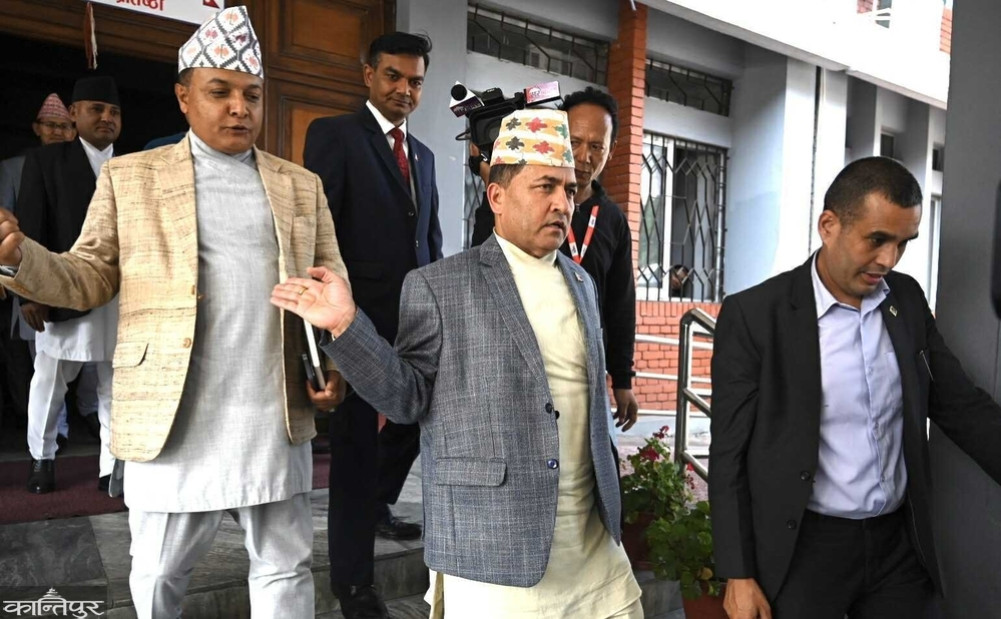
General Secretary of the Federal Parliament Padma Prasad Pandey said - 'This is not lobbying, it is not according to the constitution, keeping the cooling period is not a constitutional issue'.
We use Google Cloud Translation Services. Google requires we provide the following disclaimer relating to use of this service:
This service may contain translations powered by Google. Google disclaims all warranties related to the translations, expressed or implied, including any warranties of accuracy, reliability, and any implied warranties of merchantability, fitness for a particular purpose, and noninfringement.
The Chief Secretary and Secretaries of Nepal Sarskar have claimed that it is unconstitutional to have a provision in the Federal Civil Service Bill that prohibits appointment to constitutional, diplomatic, political, etc. positions for 2 years after retirement.
The state system and good governance committee under the House of Representatives has unanimously set the cooling period as 2 years in the 'Bill to regulate the formation, operation and conditions of service of the federal civil service'. Objecting to this arrangement, the Prime Minister KP Sharma Oli pressured the Constitution Committee through Congress President Sher Bahadur Deuba and the team led by Chief Secretary Ek Narayan Aryal met Speaker Devraj Ghimire and National Assembly Speaker Narayan Prasad Dahal on Thursday and pressured them.
Chief Secretary, General Secretary of Federal Parliament Padma Prasad Pandey, a team of secretaries who met the President of the National Assembly after the speaker argued that the cooling period system was unconstitutional.
In the Parliament, General Secretary Pandey informed that the Speaker and National Assembly Speaker were told that the provision of cooling period in the Civil Bill would be against the Constitution. "The civil service bill cannot govern employees who have retired from civil service. Therefore, if the cooling period is to be kept, then it is fine, there is no opposition from the employees, but rather than where it should be kept, either it should be kept in the constitution or in the law of appointment in the constitutional body,' said Pandey, 'the appointment should be made in the law related to the position to be appointed . We said that we should be aware of that.'
Pandey's argument was that the cooling period should be kept in an appropriate law and that it is unconstitutional and is going to be kept in the Federal Civil Bill. "This is not lobbying, it's not according to the constitution," he said, "keeping a cooling period is not a constitutional issue."
Pandey informed that the chief secretary and the secretaries have put it before the speaker and the president of the national assembly that they are going to keep the cooling period so that the civil servants will be humiliated.
The Chairman of the State Administration and Good Governance Committee Ramhari Khatiwada made it clear that the court has the right to see whether the provisions made in the bill are constitutional or unconstitutional. 'There is another body in charge of looking at the constitutionality and unconstitutionality of the bill, they look at it . We have decided unanimously. Due to the conflict of interest, he has gone to the place of reversing the decision he made as the chief secretary and secretary,' said Khatiwada, 'If the political leadership and the staff leadership do something by resigning because they are going to be appointed to such and such a place tomorrow, or leaving their job and going to that place, establishing an unnecessary nexus with the political leadership and avoiding the conflict of interest, where will the constitution with federalism that we have envisioned go?'
Khatiwada said that the committee is not worried about the fact that the chief secretary and secretaries are expressing their interest in different places that they want to leave their jobs. Stating that the decision made by the committee is the committee's, he clarified that it will go to the parliament but the committee is adamant about its decision.