The year 2082 will also be challenging due to the anger of the citizens on the streets against the old party and the street protests organized in the name of returning the monarchy by covering up the opportunity of government instability and the growing dissatisfaction within the Congress against the government.
We use Google Cloud Translation Services. Google requires we provide the following disclaimer relating to use of this service:
This service may contain translations powered by Google. Google disclaims all warranties related to the translations, expressed or implied, including any warranties of accuracy, reliability, and any implied warranties of merchantability, fitness for a particular purpose, and noninfringement.
At the beginning of 2081, the new government formed in the coalition of Congress and UML continued to shake Nepali politics throughout the year. In the parliamentary history, the formation of a government between two major parties was a rare political event in itself.
Government practice could not give confidence to the hope of the citizens that political stability will be maintained after the merger of the two big parties, the constitution will be amended, and the system and order will be strengthened with good governance. Instead, with the start of the new year, signs of political fluidity have begun to emerge.
Growing dissatisfaction within the Congress against the government belonging to their own party, the anger of the citizens on the streets against the old party and the street struggle created in the name of returning the monarchy by covering up the opportunity of government instability, there are no signs that the arrival of 2082 will be happy from a political point of view.
Human rights leader and analyst Krishna Pahadi says that if the disgraced leader of the party cannot be brought to an end, the coming year will be even more dangerous from a political point of view. Pahadi says that if the constitution cannot be amended, if the solution to the economic, political and social problems is not found, politics may turn towards disaster. The democratic republic is in danger because of the parties. There is no chance that the monarchy will be restored. It is the major leaders of the major parties who have messed it up," Pahadi said, "Now we have to form a government of national consensus.
Pahari says that because of government tendencies and corruption, frustration among common citizens has increased. The new political party, which is trying to establish itself as an alternative, has also led the citizens to despair. Ravi Lamichhane, president of RSVP, has himself gone to jail for misappropriation and embezzlement of the cooperative's savings.
Lamichhane, who was released on bail, has been sent to prison as per the order made by the Butwal Bench of Tulsipur High Court on Chait 22. This incident has also broken the trust of the citizens towards the alternative power, says analyst Swabharan Shah. According to him, there are signs that the coming year will be more unfortunate from a social, economic and political point of view.
'Last year there were more negative events than positive ones. The fledgling political power could not preserve its credibility. Caught in an unexpected controversy. The atmosphere of cooperation between the old parties also unexpectedly turned upside down. "Unfortunately," says Shah, "it is the big leaders who got caught in the corruption case." By the end of the year, the royalists had resorted to violence. Looking at all this, politics does not seem to be going in the right place. Looking at the events of 081, the new year looks more unfortunate.'
With the beginning of the new year, the implementation of the constitution is also trying to pass the decade. However, in the meantime, the work of replacing the law and creating a new law for the implementation of the constitution has not yet been completed. The main achievement of the government is the adoption of a law related to transitional justice on the basis of all-party consensus to complete the rest of the peace process.
Although the law was passed in the session last year, the officers of the commission have not been selected yet. Those who work on transitional justice are still there. 9 laws were passed in the recently concluded winter session.
It has been eight years since the promulgation of the new constitution at the union, state and local levels. However, important laws such as the adjustment of police and civil servants, which empower the province, could not be enacted this year as well. Questions have started to arise in the streets and parliament about the justification of the provinces for not being able to do effective work. When there is an earthquake in the federal government, there is a trend of aftershocks in the state government as well this year.
After the formation of the coalition government of Congress and UML at the center, the process of collapse of the government and formation of a new coalition government was repeated in the state. The ministers of the government led by Prime Minister KP Sharma Oli, who have made the slogan 'I will not do corruption and I will not allow it to be done', have not considered it necessary to make public the details of their assets even for 9 months.
Although it is mentioned on the website of the Office of the Prime Minister and Council of Ministers that all the ministers including the Prime Minister have submitted their property details, they are not able to adopt the minimum ethics and transparency that should be in politics. In the past, it was a practice to make public the property details of the Prime Minister and Ministers by taking a decision from the Council of Ministers. However, Oli, who utters the mantra of zero tolerance on corruption, has not shown any interest in making the property details public. This has seen contradictions in his words and actions.
The royalists are not the only ones on the streets now. Various professionals, teachers, meter collectors, doctors, co-operative workers are all protesting against the government. Although the government prosecutes those who embezzled the savings of cooperatives, the government does not seem serious about returning the savings. While thousands of teachers from all over the country are protesting in Kathmandu, the Prime Minister has ignored it and is busy with programs outside the capital.
dr. Kesharjang Baral resigned from the post of Vice-Chancellor of the University saying that he could not hold the position due to the non-cooperation of the Prime Minister. On the other hand, Kulman Ghising was removed from the post without being allowed to complete the remaining three months of his tenure.
Not only the small parties who tried to move the politics towards a two-party system by amending the constitution and laws, but also began to work to tighten the blockade. The Samajwadi Front has been formed under the leadership of the Maoists, while another front has been formed between the Madhesh-centric parties.
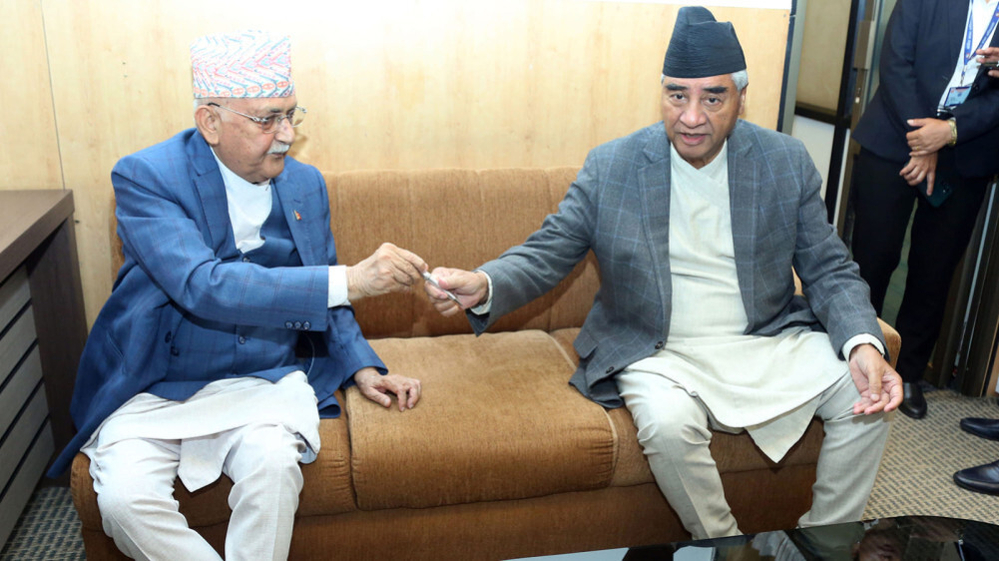
The seven-point agreement reached between the Congress and the UML on June 17 was the main task of amending the constitution, good governance and economic reform. Dissatisfaction is becoming louder within the Congress, the main component of the government, saying that the government has not been able to work in all these three areas. According to Congress leader Shekhar Koirala, the main achievement of the KP Sharma Oli-led government formed on the foundation of the seven-point agreement reached on June 17 is nothing but the passing of 9 months.
In the meantime, to show the presence of the government, the work of creating a political mechanism at the union, state and local levels was done, and the slogan was given to increase the effectiveness of the government by showing the reason for the delay in the parliamentary process. However, because all of them did not work, a rift has started within the ruling party. The government's priority was not towards people-centered work. The
priority began to focus on firing one employee and retaining another. Most of the time of the winter session of the Parliament was spent in the name of removing one employee,' says Koirala, 'For one employee, the Prime Minister and the concerned minister made it an issue. The government could not do even one thing according to the agreement.'
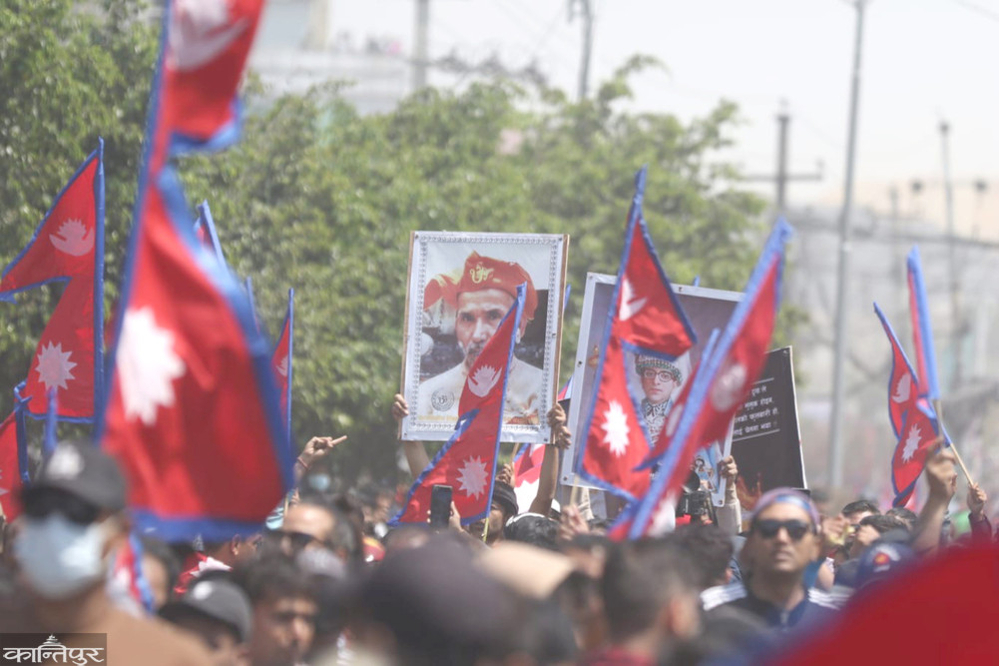
When the main leader of the major party is focused on power politics, former king Gyanendra Shah has started going out on the streets. After 17 years of establishing the Republic, Purva Raja has come out for the first time in a street demonstration. In this way, when Purvaraja came to the streets raising questions about the republic, the light of the republic bowed down this year, while the old parties were shocked.
In June 2081, the two largest parties of Nepal, Congress-UML, formed a coalition government and started a new equation. A coalition of Congress and UML was formed when Speaker Pushpa Kamal Dahal sometimes called Congress and sometimes UML, while the third party in Parliament, the Maoist Center, used the 'magic' of 32 seats. The main responsibility of the government was to amend the constitution.
"The National Consensus Government will review the strengths and weaknesses and complexities that have emerged in practice after the implementation of the Constitution and give priority to the necessary amendments to the Constitution and the creation of appropriate laws for political stability," it is mentioned in the seven points between the two parties. Prime Minister KP Sharma Oli is not satisfied with his work during the 9 months of the formation of the coalition government. However, in public, he has been claiming that the government is on the path of stability and good governance.
"With the formation of the government with the participation of a large party, the country has progressed on the path of stability, stability, development and good governance," he said at the Jagran Sabha in Jhapa Damak on Saturday. You don't have to fall under the illusion of destabilists.
Oli claimed that five laws have been introduced through ordinances and that the economy which is in deficit has started to rise. After Oli became the prime minister, the game of making and destroying the government did not come to the surface. However, it cannot be said that the growing dissatisfaction within the Congress will not be a sign of a change of government in the future. No option is impossible. If the government follows this path, if we do not give an option, the road will give it and the option given by the road will be unfortunate," says Congress leader Shekhar Koirala.
Congress, UML and Maoists have led the government alternately for the past two decades but they have failed to enact laws to strengthen federalism. "When the work of strengthening the provinces, police, personnel, and law-making related to the distribution of rights is ignored, the question of federalism has started to arise," said Pokharel, "When the slogans of strengthening the federal democratic system, raising the standard of living of the people, and creating jobs are limited to the slogans of going to the government in turn, a situation has arisen where the royalists grumble."
Former Chief Commissioner of the Election Commission Bhojraj Pokharel says that the old leaders are more responsible for the extreme disappointment in politics. The main party should have started to strengthen the system brought by itself. Leaders began to strengthen themselves, not the system. The country has become weak again and again,' says Pokharel.
main event sequence
– 7 points agreed for Congress/UML alliance on June 17
– KP Oli appointed as Prime Minister on June 30
- Parliamentary committee formed under the leadership of Surya Thapa to investigate the misappropriation and fraud of cooperative savings
– Ravi Lamichhane arrested, misappropriation of cooperative savings, organized-crime, fraud and money laundering cases registered. Cases filed against him in Kaski, Ruppandehi, Kathmandu, Chitwan, Parsa.
- Pursuant to the order of Chait 22, running the prison for trial of the case
– Prime Minister's visit to China on November 17/Signing of Agreement on BRI Framework – Implementation
– local level by-elections held on November 16
– October 10-13, floods and landslides, loss of large amount of money
- Meeting between Prime Minister KP Sharma Oli and Indian Prime Minister Narendra Modi in New York on October 7 and Thailand on March 20
Prime Minister KP Sharma Oli visited China on November 17. This year he visited China and agreed on the much talked about Belt and Road Initiative (BRI) framework. After the informal two-day talks held between high officials of Nepal and China in Beijing, the 'BRI Cooperation Framework' was finally signed during Prime Minister Oli's visit to China.
With this, it was decided that Nepal will officially proceed with the BRI signed in 2017. The BRI framework has a provision to take loans and grants as per need.
But even though his visit to India was discussed from time to time, it did not happen this year. Instead, on March 20, Oli and Indian Prime Minister Narendra Modi had a one-on-one meeting in Bangkok during the BIMSTEC conference. Earlier, Oli and Modi met in New York on October 7 when they went to the United Nations General Assembly.
Although the two leaders met twice, an environment of trust could not be created between Oli and Modi. Because of this, Oli's visit to India, which has been living as an undeclared tradition, could not take place. After Oli, who wanted to visit India for three months, was not invited, North Chhimek went on a visit to China.
The government failed to rescue the flood victims in the second week of October. The government was heavily criticized after the people who were swept away by the flood in Lalitpur's Nakkhu River could not be rescued.
In the second week of October, Kathmandu and its surrounding districts suffered huge financial losses due to floods. According to the National Disaster Risk Reduction and Management Authority, Bagmati Province suffered the most damage due to incessant rains from October 10th to 13th. Three days of heavy rain killed 250 people and left 18 missing. 178 people were injured. Landslides, floods and inundation caused billions in damage to infrastructure such as schools, health institutions, roads, hydropower and agricultural crops and livestock.
Local level by-elections held on November 16. In this by-election, the old party dominated. In the by-election for 44 seats, the first Congress won 19, the second Maoist 11, and the third UML won 8 posts. In the election, there were elections for 41 posts, including one municipal head, one deputy head, two rural village presidents, four vice presidents and 33 ward presidents. Rukum Paschim Putha Uttarganga was unopposed in Uttarganga 2 along with Okhaldhunga and Kailali District Coordination Committee chiefs.
After leaving the government, the Maoists launched the 'Maoist Tarai Madhesh Awakening Campaign with the People'. The campaign, which started from the second week of February, was suspended in the middle and the government and the warning against the regression was made the main issue. Similarly, the UML, led by the government, conducted a 'roots-centred' awakening campaign in all the wards, while the Congress continued its political campaign with regional conventions.
On March 12, the government removed Kulman Ghising, the executive director of Nepal Electricity Authority, there was a strong protest. Opposition including the main opposition party Maoist Center blocked the Federal Parliament for 6 days. Prime Minister KP Sharma Oli had to answer about this in Parliament. On Chait 15, a violent demonstration took place in Tinkune, Kathmandu, led by controversial businessman Durga Prasai. During the demonstration, one person was killed for abusing the police and one journalist was caught in the fire. Prasain, the main planner of the demonstration, was arrested on Friday, Chait 29.
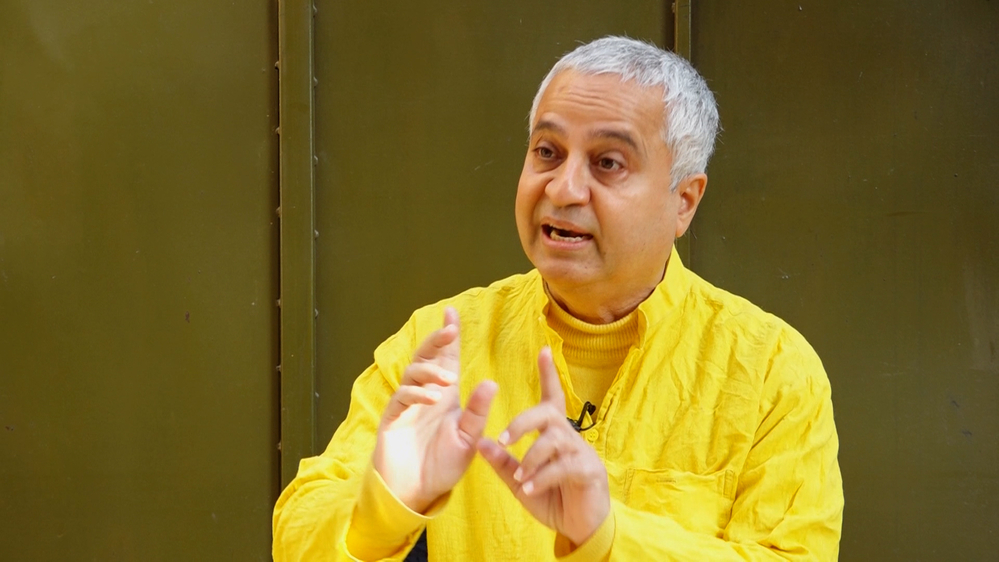 Krishna Pahari, civil leader, human rights activist
Why is there a serious question about the federal republic at this time?
has multiple dimensions behind it. Major parties focused on power play. There was no good governance in the country. Major parties have failed to satisfy the younger generation. Regressives were encouraged because of political parties. Due to the Indian founding party, Poorvaraja was excited. He came to the street. Under his direction, a violent demonstration took place in Tinkune of Kathmandu on Chait 15.
What do you see as the reason for this?
governance is the main weakness of ruling parties. We must save democracy. We are supporters of democracy. We brought the republic along with the major political parties. Even our lass does not say that the republic is bad. After Nepal went to the Belt and Road Initiative (BRI), India has encouraged Purvaraja here to shake up the parties. The rulers here did not understand this. If we are oppressed, we will protest. We are not against India and China.
The ruler of Nepal sometimes played the Chinese card and sometimes the Indian card. So the retrogressive cheers. An anarchic, violent practice ensued under the direction of the former king. Government, private companies, police, press, party offices, shops, private houses were attacked by trained people. This was the planned plan. There was a conspiracy to show that there was a rebellion in Nepal. Citizens did not take to the streets in chaotic and violent protests.
is its responsible predecessor. In the name of movement, an attempt was made to create a rebellion like that of Bangladesh. A constitutional monarchy is not what the monarchists want. The movement of 2062/063 was held with the cooperation of eight parties including seven parties Congress, UML, Maoists. Is there a third movement called regressive? These are already retrogressive. Tried to bring the third 017 year duly. It is trying to make the return of gun-carrying activist Gyanendra Shah. The present new generation saw the misrule and corruption of the government but did not see the tragedy of the monarchy in the past.
What is the solution to the current political problem?
There is still a danger if we do not bring the disgraced leaders of the party to the fore. Relations with two neighbors should be expanded. The concerns of the younger generation should be seriously addressed. The constitution should be amended. Apart from returning the monarchy, the constitution should be amended on other essential issues. Democratic republics are in danger because of parties.
The political, economic and social problems seen now should be addressed. Monarchy is unlikely to be restored. But the country is not free from other accidents. The day this constitution is torn, Ugrawam and extreme right wing will start. Now the royalists tried to rise from the chaos.
It was done by Maljal, the main leader of the major party. There should be agreement between major parties to solve the problems including constitutional amendment. A government of national consensus should be formed. Government should focus on good governance. Not old, clean people should come to the government. Constitution amendment should be done in the package. The spirit of the democratic republic of the constitution should be kept alive and the amendment should be agreed upon. If not, the danger is not over.

