As the Ministry of Home Affairs gives priority to the purchase of lethal weapons but is not interested in purchasing non-lethal materials, there is a lack of equipment related to regular security and road safety.
We use Google Cloud Translation Services. Google requires we provide the following disclaimer relating to use of this service:
This service may contain translations powered by Google. Google disclaims all warranties related to the translations, expressed or implied, including any warranties of accuracy, reliability, and any implied warranties of merchantability, fitness for a particular purpose, and noninfringement.
Police are using outdated equipment to manage street protests and crowd control. The government's focus seems to be on procurement of lethal weapons/bullets.
It's been years since the police used expired tear gas to disperse crowds that gathered in the streets to quell demonstrations that erupted. Using expired equipment is considered 'inhumane' from a human rights perspective. If the use of such expired equipment weakens the security, it will seriously affect the health.
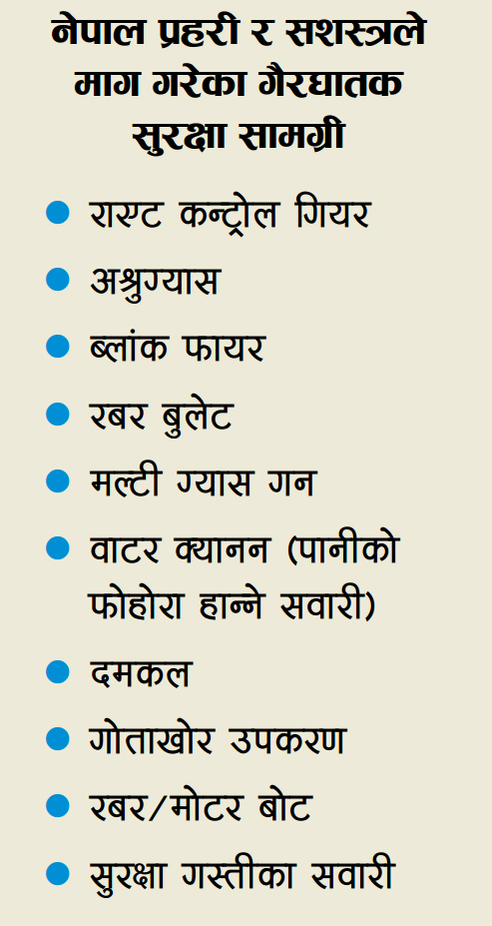
Both the Nepal Police and Armed Forces lack non-lethal security equipment. Although both police organizations have taken proposals to the Ministry of Home Affairs to purchase essential equipment such as 'riot control gear', tear gas, 'blank fire', 'rubber bullets', 'multi gas gun', 'water cannon' (water cannons), fire engines, diving equipment, 'rubber boats' for disaster management, security patrol vehicles, etc.
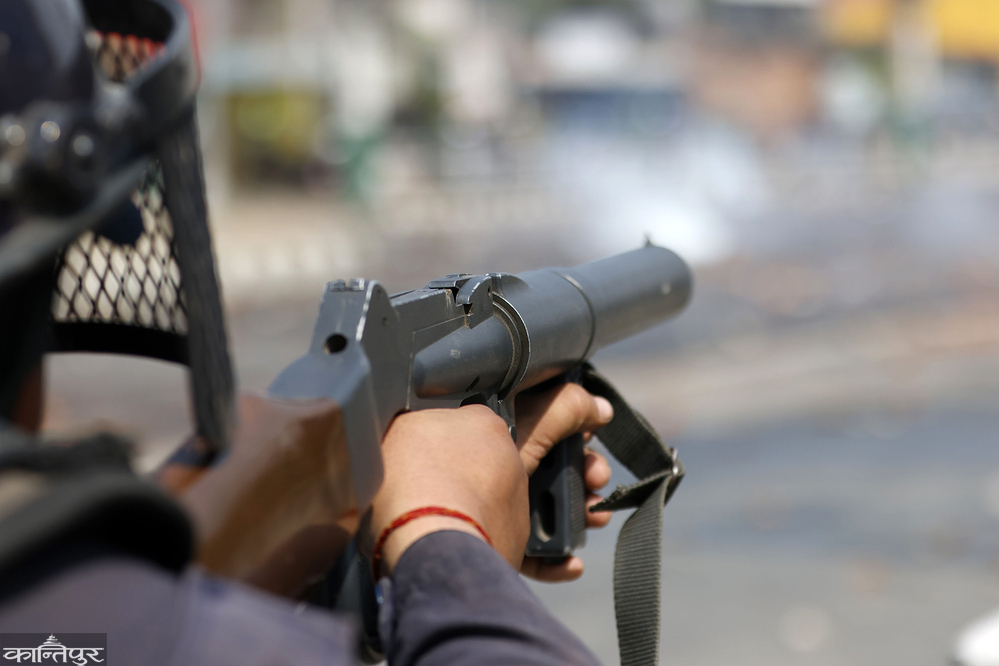
Homes prioritize the purchase of lethal weapons but are not interested in purchasing non-lethal materials, so there is a lack of equipment related to law and order and road safety. The police used expired tear gas canisters to control the demonstration held by the royalist group in Tinkune area on Chait 15. Police fired 776 rounds of expired teargas cells, 192 blank rounds, 58 rounds of bullets and 239 cartridges during the three-corner demonstration.
Last year, the police offered to purchase 8,800 riot control gear, 24,000 rounds of tear gas, 100,000 rounds of blank fire, 200,000 rounds of rubber bullets, 2,000 rounds of smoke-blowing hand grenades and 5,000 rounds of multi-gas gun cells to manage crowd control and law and order.
Armed forces also requested to ensure necessary budget for non-lethal and technical equipment including border security, crowd control, patrolling, disaster management. In order to make the border security effective, it demanded equipment according to the concept of 'digital border'.
Federal capital, state capital, metropolis and sub-metropolis, urban areas, highways and other places based on risks and challenges were proposed by both the security agencies to prepare equipment including water cannons and fire control devices. Both the security agencies also proposed to manage motor/rubber boats, underwater search and rescue and other technical equipment needed for disasters. The security agencies had requested the government to identify the fire disaster risk areas and manage the equipment including fire extinguishers. But the required equipment has not been purchased.
Former AIG of Nepal Police Puskar Karki says that the failure of the government to provide the necessary resources to the security agencies has adversely affected all types of security management from crowd control. "Even when I was SP 15 years ago, there was a proposal in the home for the purchase of equipment with non-lethal weapons and crowd control, now it's been 6 years since I retired, the problem is the same," says Karki, "The last time the three-corner demonstration and the issue connected with it also coincided with the lack of non-lethal materials, it must be addressed."
He said that the police working in law enforcement and crime control should be prepared in such a way as to deal with training, provision, job assurance, field mentality determination.
In 2079, the then government initiated the process for the purchase of lethal and non-lethal weapons worth one and a half billion rupees for both the police. Due to the pressure on the foreign exchange reserves, there was a protest when the government tried to buy weapons by transferring money while banning the import of essential goods. Home officials say that efforts are still being made to continue the process that was stopped after that. But the government has neglected the purchase of non-lethal equipment that is directly related to the health of citizens and public peace.
The government does not seem to pay attention to the purchase of necessary security equipment from the annual budget allocated to the security agencies. Under 'security system and equipment procurement expenses', 168 million rupees have been allocated for the police in the year 079/80, 29 million 87 million rupees in 080/81 and 46 million 97 million rupees in the current year 081/82. Under the same heading, 80.1 million has been allocated for armed police in the year 079/80, 4.61 million in the year 080/81 and 6.1 million in the current year 081/82. According to an official of the
house, a group that does not plan by setting a title in the budget but approves it from the Council of Ministers is active, but they are not interested in buying non-lethal and crowd control equipment.
Due to the lack of non-lethal equipment for crowd and riot control, the police have been repeatedly using more force to control the situation. Due to this, the lives of ordinary people are also lost. Sawin Maharjan of Kirtipur was killed in the three-corner protest after being shot by the police. Journalist Suresh Rajak was found dead inside the house which was set on fire by the royalists because they could not control the protest.
'Whose fault is there in the performance? The Human Rights Commission has initiated a detailed investigation into all kinds of matters including whether lethal force was used/not, whether expired tear gas was fired/not,” says Lily Thapa, a member of the National Human Rights Commission, “We will bring out the truth quickly and recommend action to those found guilty.” She informed that experts from outside the commission will be involved to make the study/research credible.
On December 13, 2080, Birendra Shah of Achham and Sujan Rawat of Dailekh lost their lives in Balkumari, Lalitpur, when the police opened fire when an anti-government protest erupted and failed to control the situation. The next week, on December 20, a local Jaishankar Sah was killed by the police while controlling the protest that broke out in Sarlahi's Barathwa.
"What we need is the equipment we need for regular security and crowd control, the same kind of security materials are needed for disaster management in Barkhayam," says another security officer, "but it seems that the government is more focused on buying lethal materials than necessary in the purchase of security materials, it has focused on the need on the one hand and the attention on the purchase on the other, it is not at all compatible." was Senior advocate Dinesh Tripathi filed a petition in the Supreme Court with the Prime Minister and Cabinet Office, Ministry of Home Affairs, Police and Armed Forces as the opposition, after two youths were killed by lethal force in the Balkumari incident and the same incident was repeated in Barhathwa. The Supreme Court also issued a show cause order, and the government also responded to the order. But attention has not been paid to the purchase of non-lethal equipment in order to address the issues mentioned in the show cause order. According to senior advocate Tripathi, the writ filed in the Supreme Court is still pending.

