While 'Gen-AI' makes it easier for children to do homework, learn new skills and get information about fashion, it is adversely affecting their intellectual development, UNICEF and ChildSafenet study finds.
We use Google Cloud Translation Services. Google requires we provide the following disclaimer relating to use of this service:
This service may contain translations powered by Google. Google disclaims all warranties related to the translations, expressed or implied, including any warranties of accuracy, reliability, and any implied warranties of merchantability, fitness for a particular purpose, and noninfringement.
The use of 'Generative AI', which can instantly 'generate' solutions to complex mathematical calculations, from answering the same questions to photos, videos, sounds, music, stories, poems, computer codes, and mathematics, is currently increasing worldwide.
Although it makes daily life easier, experts have been pointing out that it is hindering the creative ability and intellectual development of children.
Even in Nepal, a study has shown that the use of generative AI (Gen-AI) has a risk of affecting the creative and cognitive skills development of children. A report released on Friday, 'Impact of Generative AI on Nepali Children's Online Safety', pointed out that Gen-AI is a barrier to enhancing creative skills.
According to a joint study by UNICEF and ChildSafenet, 68 percent of children in Kathmandu and Lalitpur are aware of Gen-AI and 46 percent use it.
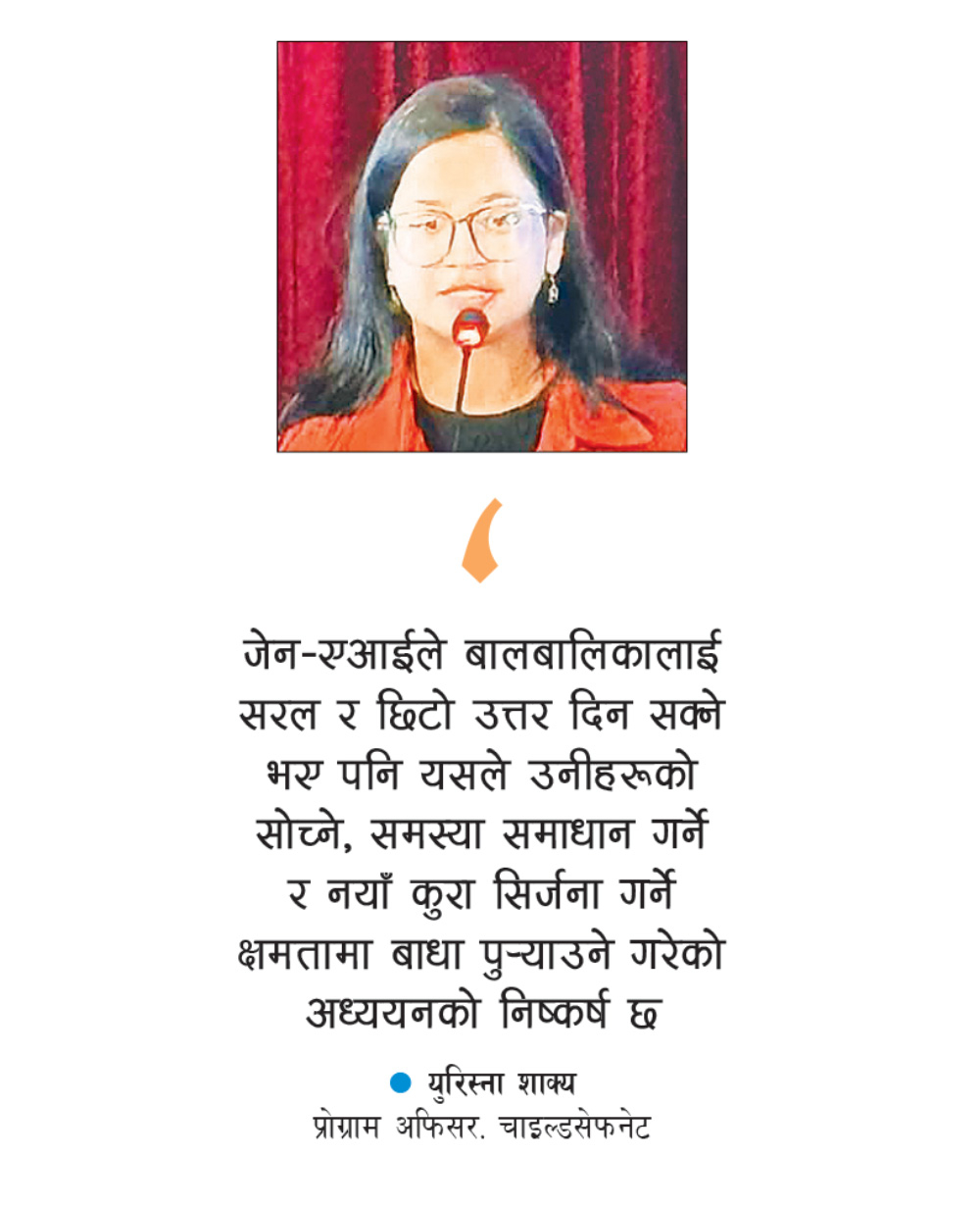
Children are using Zen-AI to do homework, learn new skills and get fashion information, according to the study. In a dialogue program titled 'Safe Digital World: Online Child Protection' held in Lalitpur on Friday, ChildSafeNet Program Officer Yurisna Shakya presented the results of a study on the impact of Gen-AI on child safety.
'Our study concluded that even though Zen-AI can give simple and quick answers to children, it hinders their ability to think, solve problems and create new things,' Shakya said, 'The study showed that more than 65 percent of children use ChatGPT as Zen- In this study, an online survey and focus group discussion (FGD) were conducted on 631 children in Kathmandu and Lalitpur. Conclusions are covered.
After being informed about this study, a panel discussion conducted by Abhinay Chauhan, active as a 'Young Changemaker', discussed issues related to Internet and children's safety. During this, Chauhan inquired about what initiatives have been taken by the government, private organizations or technology companies to keep children like him safe on the Internet.
New technologies are coming on the Internet, cyber criminals have also learned new ways to reach and harm us children. What has been done to protect us from this?' he asked.
In response, member secretary of the National Child Rights Council, Indira Devi Dhakal said that everyone should cooperate for child protection and the council is taking initiatives for various policy and legal arrangements. She pointed out that it is necessary to implement the child protection standards in the Children Act, 2075.
Yasmin Bhattarai, head of Ncell's information security unit, said that they are organizing an awareness program for safe use of the Internet. Anil Raghuvanshi, founder of ChildSafenet, believes that parents and technology companies are responsible for children's online safety.
UNICEF Nepal's Acting Head Jee Hyun Rah said in the program that collaboration between the government, private sector and civil society is essential for children's digital security. Minister for Women, Children and Senior Citizens Navalkishore Shah Sudi claims that the government is serious about protecting children online.

