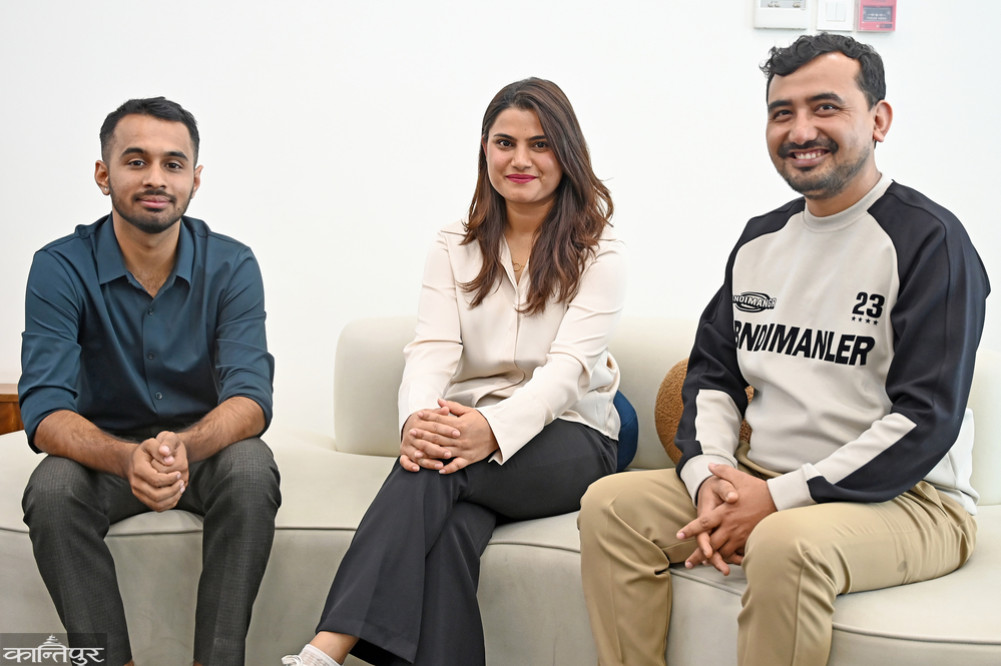
Although there are complaints that Nepal has not yet created a favorable environment for new ventures, some young people are submitting examples of success by starting a 'startup business' in the course of their studies.
We use Google Cloud Translation Services. Google requires we provide the following disclaimer relating to use of this service:
This service may contain translations powered by Google. Google disclaims all warranties related to the translations, expressed or implied, including any warranties of accuracy, reliability, and any implied warranties of merchantability, fitness for a particular purpose, and noninfringement.
What to do now? In which field to make a career?'' In meetings or tea parties, the 'Gen-G' generation often ponders over this question. They try to do something new, which is exemplary and also matches their interests. Let's listen to the logic of the message.
He kept saying, "Now we have to do something new." But what to do? There were no sheep. "We wanted to do something different and better than the work done by others," he says, "so we made a plan to start different products by extracting fiber from the banana plant." Such a hold is so wasted. How would you be able to extract fibers from the same thread and make useful items from it? To break the story, this trick came to them at that time, when they were doing the mechanical engineering fourth year project. While doing the project, they saw the 'scope' in this. "This was a work that no one else had done in Nepal," says Sandesh, "so I thought it would be different from others and useful for the community." For a year, they researched what kind of machine they needed for this. They have launched their products in the market since last 6 months. They named their venture, Kanduk Industries.

Juna Bhattarai is the founder and interior designer of Vivid Interiors. They are currently doing interior decoration and construction work. How did she start this elam? After completing an interior design course from ICE College, he had the idea of doing something but had no experience. So she worked for 2 years. During this process, she became confident that she would start her own enterprise and registered a separate company in her name. "It was 9 years ago, when there was not much interest in interiors," she says, "it was very difficult to explain about our work and about interiors at that time."
is a new venture, on the other hand people were not interested in it. "If I believed in something, one day this work would be good," she says, recalling the initial days, "I continued with that confidence and determination." At that time, they formed a group and worked to spread public awareness that "why interior design is necessary." Later, gradually people understood this area and progressed in his business.

The scary time after the first lockdown due to Corona. The question of what to do next was always bothering Nirmal Gharti. Interest in doing some trade/business was from childhood. But what to do? He didn't think anything of it. However, he was interested in farming and began to investigate whether it could be done in a new way. Eventually, this hoothooty gave birth to Himalayan Floriculture. Savin Dhakal supported him in this. He is its co-founder and managing director. Nirmal's Himalaya Floriculture takes its own land to produce flowers and transport them to the market. "On the one hand, I had experience in farming because I grew up farming since childhood," he says, "and as a business student, I also had a plan on how to combine it with earning money." But this was not something that was easily approved by the family.
There is nothing more understandable than the son who studied MBA by spending money, 'I grow flowers'. My parents used to say, 'If you were to grow flowers, why did you spend so much on studying?' On top of that, a group of mothers cultivated flowers nearby. Facing such questions from family and neighborhood, they remained engrossed in their work. 'How to give it a new look?' they started thinking. Ultimately they not only cultivate flowers but also provide them instantly as per the customer's demand and choice. "When we started this venture, the delivery was two days after the customer placed the order," he said, "now it is delivered within two hours." This business of theirs was started especially for giving flowers as gifts.
How does any enterprise business succeed? How does it earn not only money but also fame? "When starting any business, there are two things," says Nirmal, "One is sustainability and the other is commercialization." It seems that business should be seen as a business rather than a hobby. Teamwork is also necessary to carry out any enterprise business properly. This is what Juna realized when she started working on interior design. But it was very difficult to mobilize all the teams in an equally strong manner. However, due to continuous efforts and determination, this work became easy. He feels that the demand for lifestyle-based business will never decrease. Because today there is a trend, tomorrow another trend will come.

She says that when starting any business, it is necessary to have commitment, patience and skills. It is said that time demands should also be taken into account while starting any venture business. "Nowadays people are trying to use eco-friendly products," says Sandesh, "We have also seen the lack of it in Nepal." They turned this lack into an opportunity, just like there is an opportunity where there is a problem.
However, he has experience of facing many challenges when doing new venture business in Nepal. He says, 'One is that the market here is very limited. As for the other, it is difficult to get a machine like that.' Having studied mechanical engineering, they designed some machines themselves. Now they are working together with the community. Machines have been installed at the banana farmers. They have done the work of managing the market for the materials produced there. "Any business requires patience and commitment," he says, "not everything will be achieved tomorrow."