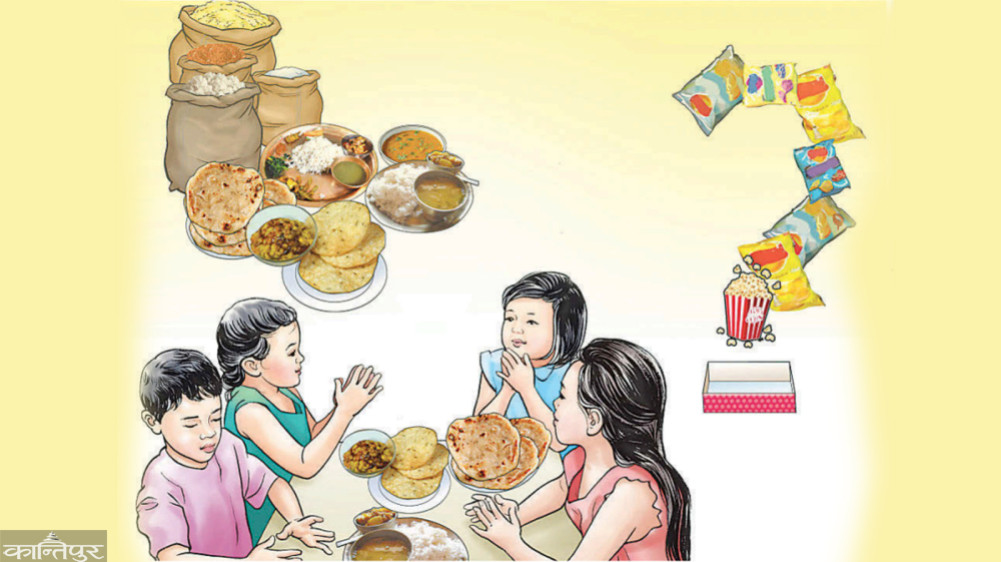
Obesity is high in the city. But Patru Khana has taken hold in the village. There is no government policy to discourage junk food. Instead, the government distributes food under various pretexts. In the event of an emergency such as an earthquake, flood, or fire, the government relief team is the first to reach the citizens' homes with food.
We use Google Cloud Translation Services. Google requires we provide the following disclaimer relating to use of this service:
This service may contain translations powered by Google. Google disclaims all warranties related to the translations, expressed or implied, including any warranties of accuracy, reliability, and any implied warranties of merchantability, fitness for a particular purpose, and noninfringement.
Until decades ago, malnutrition was defined as lack of essential nutritious food due to poverty. But now the consumption of highly nutritious food and junk food is also causing malnutrition.
Due to the development of technology and the influence of urban lifestyles that have extended to villages, the dominance of highly processed foods in people's kitchens is increasing. Due to this, the invisible epidemic of malnutrition caused by over-nutrition along with under-nutrition is increasing at a higher rate. Moreover, the government has been making various efforts to reduce malnutrition for the past three and a half decades. But formal government programs and narrow state policies have not been able to cover the multifaceted nature of malnutrition.
In recent times, lack of policy and lack of clarity are the challenges of reducing malnutrition, experts say. Nutritionist Dr. Aruna Upreti says, 'Government policy does not cover the multifaceted nature of malnutrition. Malnutrition is still misconceived as only a health issue. It is a problem intertwined with social development. It also affects the economic and mental development of people. It affects the country's GDP. It affects the production of skilled manpower. But policy making does not seem to understand this. Current policies and government programs focus only on reducing malnutrition. No one has paid attention to how to balance nutrition.'
The government has been running a multi-sectoral nutrition program since 2006. Currently, the 'Multi-Sectoral Nutrition Plan-Third' is being implemented. But it is said that the budget of the relevant ministry will be used for the implementation of the plan, which is ineffective according to nutritionist Dr. Upreti says. The government does not allocate a separate budget for nutrition. Such programs are neither the priority of the provincial government nor the local government. Due to the lack of cooperation between the ministries in the Union, nutrition-targeted programs have not been effective," she says. But they don't teach how to make litto at home and feed it. The effect of over-nutrition is even higher because of not going to eat now.'
The problem that appears due to insufficient protein, carbohydrate and micronutrient deficiency or frequent health infections is under-nutrition. And, obesity caused by dietary imbalances and inactive lifestyles is over-nutrition. Inadequate nutrition causes problems such as obesity, hunger, and low weight in children, while chronic diseases such as diabetes, heart disease, high blood pressure, cancer, and rapid death occur over time.
increases the chances of aging. Similarly, obesity is also causing these diseases.
dr. Upreti adds, 'Now the government's focus is only on malnutrition caused by micro-nutrition. The government has not thought about the effects of obesity caused by excess nutrition. In particular, it is more risky. The government makes a policy to subsidize the treatment of diabetes and cancer caused by obesity, but does not bring a lifestyle change program to prevent the spread of these diseases.
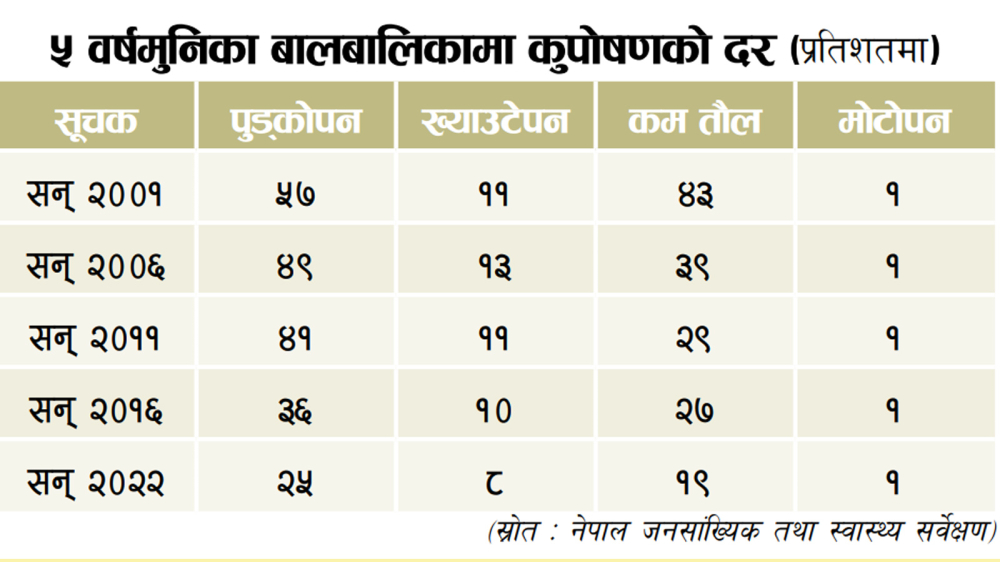
According to the Demographic and Health Survey 2022, 57 percent of children aged 6 to 23 months in Nepal do not receive even the minimum acceptable diet. Due to micro-nutrition, 25 percent of children under 5 years of age are stunted, 8 percent are malnourished, 19 percent are underweight and 43 percent are anemic. Similarly, 35 percent of women in the age group of 20-49 years are obese due to lack of nutrition. Out of which, 20 percent of women from poor households are obese, while 53 percent of women from rich households have the problem of obesity.
One percent of children under the age of 5 are obese, while 6 percent of girls between the ages of 15 and 19 are obese. Dr. Dr. Dr. Upreti says. A child of a malnourished mother is born malnourished. He has no ability to fight disease. Learning power is reduced. Again, when mothers do not feed their milk and do not eat home-cooked meals, it also causes malnutrition, said Dr. Upreti says, "The tradition of feeding children traditional food in the village has disappeared. Even if the child is less than a year old, medicine is started. But children do not get our culturally important foods that are medicinal. There is no policy of the state to use such items.
He alleged that even the midday meal program given by the government for nutrition has helped spread malnutrition. Nutritious food should be served in the midday meal. But noodles and biscuits are being distributed in villages," she says. "The government has given a budget of Rs 15 for lunch. I wonder, the children of ministers and secretaries who make such policies are eating nutritious food for 15 rupees? In fact, it does not come with nutritious food. Instead, they would have taught what to eat and what not to eat. According to
study, the problem of obesity is high in the city. But Patru Khana has taken hold in the village. There is no government policy to discourage junk food. Instead, the government distributes food under various pretexts. In the event of an emergency such as an earthquake, flood or fire, the government relief team is the first to reach the citizens' doorsteps with food. Women, pregnant women, pregnant women and children need more nutritious food during disasters. But the government itself distributes noodles and biscuits," Dr. Upreti says, "It seems like a small thing, but this small thing means a lot in the campaign against malnutrition." Therefore, first of all, it is necessary for the state to make a policy to discourage junk food.' The government, which started the initiative to reduce malnutrition since 2046, is currently implementing the 'National Nutrition Policy 2077'. But analyst Dipesh Ghimire says that those arrangements have not been effective according to the constitution and the government's policy. "Studies have shown that now junk food is being used more in villages than in cities," he says. The government's nutrition policy is basic but not clear and effective. On top of that, even if federalism is implemented, the lack of inter-agency coordination seems to be a challenge.'
According to him, some harmful social and traditional practices are also causing malnutrition. But the state's policy resistance against such harmful practices is weak. "Poverty, food insecurity, lack of access to health services, lack of water and sanitation and lack of education and awareness are not the only causes of malnutrition," he says, "Some harmful traditional practices also lead to malnutrition." For example, you should not eat milk, curd, and ghee when you are pregnant, you should not stay inside the house or in a similar risky place, you should not feed your newborn baby prematurely, you should give supplementary food to your daughter after 4/5 months of birth, etc. break According to the World Health Organization, children up to 6 months should be exclusively breastfed. But in Nepal, 44 percent of children are deprived of full breastfeeding. In the urban areas, mothers have recently been accused of giving up full breastfeeding due to the fear of body deterioration. But Kamala Parajuli, chairperson of the National Commission for Women, says that many mothers are not able to breastfeed their children completely because of the government's policy disorder. "Today's mother is independent. They are doing the duties of being a mother and their work together. Instead of finding a policy solution, it is said that women stop breastfeeding because their bodies will deteriorate, which is wrong," she says. "A working mother can do both work and child care at the same time. But the government should provide sufficient facilities by making policy arrangements for that. Government should make policy arrangements to create suitable environment. For that, programs such as provision of adequate facilities and care centers in the office should be brought.' Madhesh, Karnali, Dalit and marginalized communities are more and more in poverty. Due to this, malnutrition is also rooted in those areas and communities. President of the National Muslim Commission Samim Mian Ansari says, "Malnutrition is rampant among the poor, marginalized and Dalit, Muslim and Madhesi communities. The government has not made any program targeting them. These communities do not have access to general programs. He says that a special action plan should be created for the poor, marginalized and Dalits, Muslims and Madhesi and nutrition campaigns should be carried out.
The current nutrition policy of the government has not touched the women and children of Madhesh, says Muktakumari Yadav, a member of the House of Representatives. "There is not only poverty in Madhesh, there is also illiteracy, hunger is there. There are a large number of people who cannot make ends meet in the evening if they do not work all day. Maternal mortality is also high there. Malnutrition has not decreased due to poverty and illiteracy," MP Yadav says, "The government runs programs to reduce malnutrition through health institutions. While those communities do not have access to health institutions. To break the cycle of malnutrition, there is a need for the government to systematically study and implement policies accordingly. It is not that there is nothing now. But I don't think that such a small initiative can break the cycle of malnutrition in Madhesh.'
According to the World Health Organization, malnutrition accounts for 45 percent of the various causes of death among children under the age of 5 worldwide. Malnutrition is causing up to 11 percent loss in gross domestic product. Malnutrition is the biggest cause of death of children in Nepal. Doctors say that after malnutrition, the child gets pneumonia, tuberculosis, diarrhea and malaria and dies due to blood loss. Not only children, but also women, adults and the elderly are going to the hospital with dozens of health problems due to unhealthy eating.
In recent years, the infection rate of non-communicable diseases and the death rate due to them are on the rise. According to a study by the Health Research Council, 71 percent of deaths in Nepal are caused by non-communicable diseases. In such a situation, the government is bringing treatment and subsidy program in full swing. But there is no thought about preventing those diseases.
Nutritionist Dr. Upreti says, 'The government has made arrangements for the treatment of non-communicable diseases. This is also a good thing. But at the same time, attention has not been drawn to avoid getting those diseases. While most of these diseases are caused by unhealthy eating habits i.e. malnutrition. So much so that there is no nutrition expert in the country.'
According to the minimum service standards made by the Ministry of Health and Population in 2075, one senior dietitian officer and one dietitian assistant in each hospital as well as under special services (ICU, NICU, PICU, Nephrology) and hemodialysis) it is mentioned that one more senior dietitian officer should be arranged. But until now, according to that, there is no post of nutritionists in hospitals except sporadically.
The head of the nutrition branch of the ministry Dr. Leelavikram Thapa says, "There has been talk about the need to arrange nutritionists in hospitals." But so far no such arrangements have been made. The Health Service Act and Regulations have not provided for it. According to him, not only in hospitals, but also in village health posts, health workers have been instructed to provide awareness and counseling on nutrition issues. He admits that challenges such as lack of coordination and lack of budget have been added to the malnutrition reduction campaign after federalism. Now the multi-sectoral nutrition plan has been implemented by the association. But the Union's budget alone is not sufficient for that. The coordination and cooperation that should be done between the three governments is not done,' he says, 'if the state and local levels do not invest in nutrition, it will be difficult for us to achieve the sustainable development goal.' Poshan Yojana is implemented in all 753 local levels of 77 districts, mainly through health institutions. Which includes counseling services from nutrition of pregnant and newborn babies to nutrition against obesity and malnutrition. Dr. Thapa says, "The service has been expanded and implemented. But its quality is not guaranteed. There is lack of regular monitoring and skilled manpower. At the same time, it is not certain that all citizens are using the service. He claimed that the government is conducting consultation programs for reduction even though it does not make separate policy arrangements to control the consumption of highly processed and junk food.
Analyst Ghimire says that the government has failed to cover its multifaceted aspects to reduce malnutrition. Here, according to the geography, the economic status is different, the diet is different. In the basis of gender, religion, and caste, "he says, 'These things have determined the access, consciousness, and their health for marriage, consciousness, and their health. Therefore, it is not the case with the nutrition policy of the kingdom. When I was 2 years old, 12.5 should be semeins for 8.5 cords. Must decide by 7 to 9 every year. Women's average height of women should be 166 semities in adults and men. According to age, it cannot be height and NBSP;
is Pudding. According to experts this is long malnourished. According to the latest survey, the rate of veils under the age under the age of 5 is 25 percent. However, Karnali has 36 per cent in Karnali, and only 18 percent in Madhes and Bagmati. The city has been 12 percent of Polections in the village and 42 percent in the village and mountains. The child who has a higher education mother has only 12 percent of the child. But children have 37 percent of children who are born by the uneducated. Padoconrance in the rich family is 13 percent but 37 percent in poor class. & Nbsp;
a deteriorating another condition that causes the risk of low nutrition. Because of the trial, a severe disease, there will be deteriorating decline in children. This is an eastern malnutrition. The renahand of the arm (10.15, in a birth of Daboo, has risen between Rs. But if you remain less than 12.5 for a 5 years old, it is called a solution. According to sustainable development goals, you should limit a quantity to 4 percent. According to demist and health survey 2022, there is still a quotation in Nepal in Nepal. & Nbsp;
is the other condition of low nutrition. Being generated in Dabsach, a child's weight should be 2.5 to 3.4 kg. In the first 5 months, it should be added by 2.4 kg in the second year, more than 2.4 kg of KJ, 2-2 kg in 2 years, and 25-2 kg in 27 years. It is less than a situation that does not belong to. It is even a state of columnating with both of the saver and the other. & Nbsp;
Survey According to the survey, 19 percent of children under the age of 5 are under age. A bird's age group has been thinned by 26 percent of adversity.